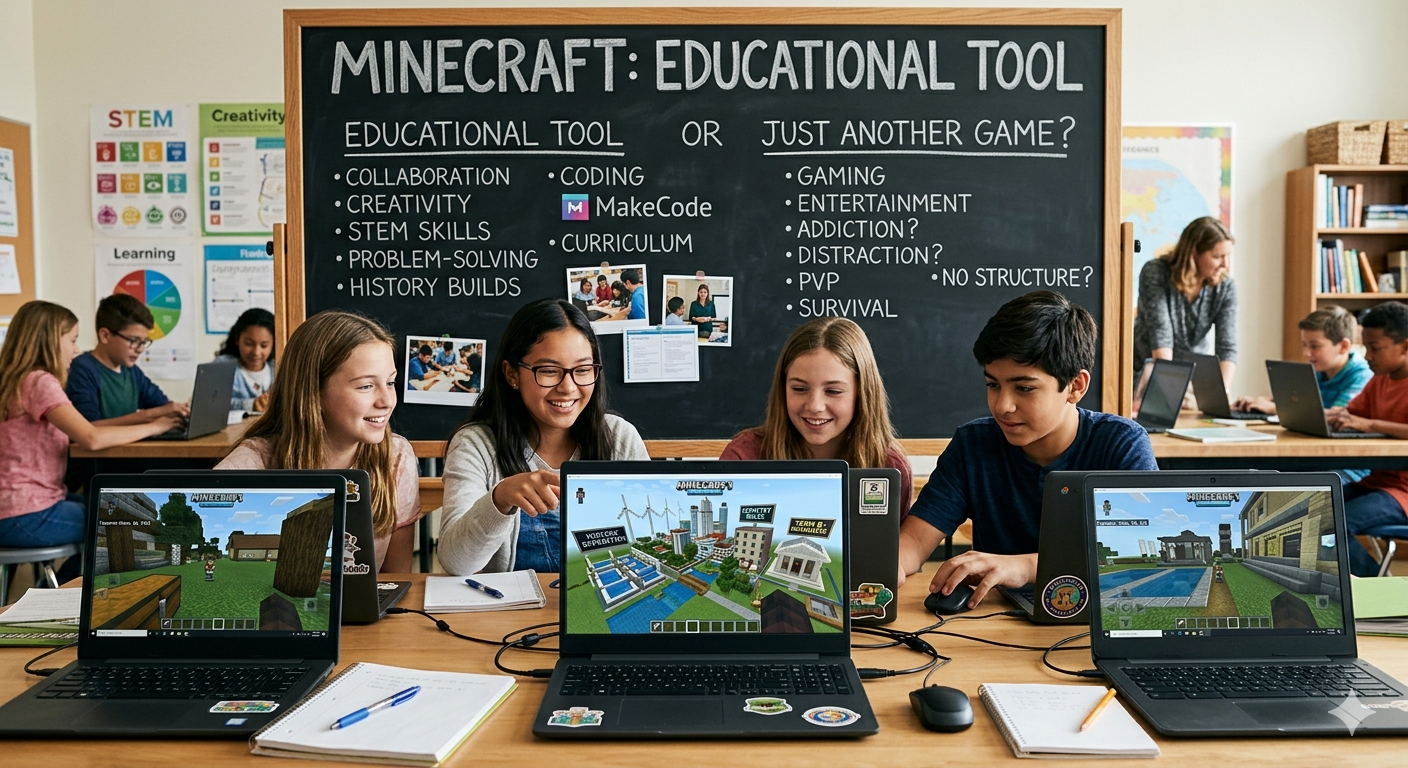
Exploring How Minecraft Can Develop Creativity, Logic, and Problem-Solving When Used the Right Way
For many parents, teachers, and researchers, Minecraft has become one of the most fascinating digital platforms of the modern generation. Unlike many fast-paced online games focused purely on competition or constant stimulation, Minecraft offers something different: a virtual world built almost entirely around creativity, exploration, experimentation, and imagination.
Children use Minecraft to:
- Build cities
- Design houses
- Create machines
- Explore landscapes
- Solve survival challenges
- Collaborate with friends
- Learn coding concepts
- Experiment with engineering ideas
This has led many educators and parents to ask an important question:
Is Minecraft truly educational, or is it simply another video game disguised as learning?
The answer is more complex than either extreme.
Minecraft can absolutely support creativity, logic, problem-solving, collaboration, and digital learning when used intentionally. At the same time, excessive or unstructured gameplay can still create screen-time challenges similar to any other digital activity.
Understanding the difference between healthy, purposeful Minecraft use and unhealthy overuse is the key to unlocking its benefits.
This article explores how Minecraft affects learning, creativity, brain development, and behavior — and why many educators in 2026 continue to see it as one of the most powerful educational gaming tools ever created.
What Makes Minecraft Different From Other Games?
Unlike many online games built around speed, combat, or constant rewards, Minecraft focuses heavily on:
- Open-ended exploration
- Creative building
- Resource management
- Planning
- Experimentation
- Long-term thinking
There is no single “correct” way to play.
Children can:
- Build castles
- Create farms
- Design machines
- Explore caves
- Survive environmental challenges
- Recreate historical landmarks
- Simulate cities
- Build logic systems
This freedom encourages children to become creators rather than passive consumers.
That distinction matters.
Many digital platforms are designed primarily to capture attention. Minecraft often encourages children to produce, design, imagine, and solve problems instead.
Creativity in Minecraft
One of Minecraft’s strongest educational benefits is its ability to support creativity.
The game gives children an enormous digital canvas where they can transform ideas into structures, systems, and environments.
Children regularly create:
- Houses
- Villages
- Roller coasters
- Pixel art
- Fantasy worlds
- Underground bases
- Working machines
- Complex architecture
Unlike rigid games with fixed objectives, Minecraft allows children to invent their own goals.
This kind of open-ended creative play is important for brain development because it encourages:
- Imagination
- Experimentation
- Decision-making
- Independent thinking
- Creative confidence
Some children spend hours carefully planning structures, solving design challenges, and adjusting their ideas through trial and error.
This process mirrors many real-world creative disciplines.
Minecraft and Problem-Solving Skills
Minecraft constantly places children in situations that require problem-solving.
Players must think critically about:
- Resource management
- Construction planning
- Survival strategies
- Navigation
- Tool usage
- Environmental hazards
- Time management
In survival mode, children learn to:
- Gather materials
- Prioritize tasks
- Protect resources
- Build shelter
- Prepare for threats
- Adapt to changing situations
This encourages strategic thinking rather than passive entertainment.
Instead of simply reacting, players often plan several steps ahead.
Learning Through Trial and Error
One of the most powerful educational aspects of Minecraft is how naturally it encourages experimentation.
Children learn by:
- Trying ideas
- Making mistakes
- Testing solutions
- Improving designs
Failure in Minecraft is rarely permanent.
If a structure collapses or a strategy fails, players simply rebuild and adjust.
This helps develop:
- Persistence
- Resilience
- Flexible thinking
- Confidence in experimentation
These are valuable life skills far beyond gaming.
How Minecraft Encourages Logical Thinking
Minecraft includes systems that quietly teach logical reasoning.
For example:
- Resource crafting requires sequencing
- Construction involves spatial planning
- Redstone systems mimic electrical logic
- Farming systems teach efficiency
- Survival gameplay rewards preparation
Children often learn to think systematically:
“If I need this material, I must first gather these resources.”
This step-by-step thinking supports:
- Executive functioning
- Sequential reasoning
- Organizational skills
Many educators describe Minecraft as a digital environment that rewards curiosity and logical experimentation.
Redstone and Basic Engineering Concepts
One of Minecraft’s most educational features is Redstone.
Redstone functions similarly to simple electrical circuitry inside the game.
Players can create:
- Automated doors
- Traps
- Elevators
- Farms
- Timers
- Sorting systems
- Logic gates
Many children unintentionally learn beginner engineering and computational thinking skills while experimenting with Redstone systems.
Some advanced players even build:
- Calculators
- Functional computers
- Automated factories
This type of systems thinking can introduce children to concepts related to:
- Engineering
- Coding
- Automation
- Electronics
- Logic design
Minecraft and STEM Education
Many schools now use Minecraft Education to support classroom learning.
Teachers use Minecraft to teach:
- Math
- Science
- History
- Geography
- Architecture
- Coding
- Environmental systems
For example:
- Students may recreate ancient civilizations
- Build mathematical models
- Simulate ecosystems
- Explore geometry concepts
- Practice teamwork through collaborative projects
This works because Minecraft transforms abstract learning into interactive experiences.
Children often learn more effectively when they actively build and participate rather than simply memorize information.
Spatial Awareness and Brain Development
Minecraft strongly engages spatial reasoning skills.
Players constantly think about:
- Dimensions
- Positioning
- Navigation
- Structure layout
- Distance
- Perspective
Research in child development has long connected spatial reasoning with:
- Mathematics performance
- Engineering ability
- Architecture skills
- Scientific thinking
Building in three-dimensional space encourages children to mentally visualize structures before creating them.
This type of thinking strengthens cognitive flexibility and planning abilities.
Collaboration and Teamwork in Minecraft
Minecraft is often played socially.
Children collaborate by:
- Sharing resources
- Dividing responsibilities
- Building together
- Solving challenges cooperatively
In multiplayer environments, players may:
- Assign tasks
- Design projects collectively
- Protect shared communities
- Communicate strategies
These experiences can support:
- Teamwork
- Communication
- Leadership
- Negotiation skills
- Conflict resolution
Unlike purely competitive games, Minecraft often encourages collaborative creativity.
Can Minecraft Improve Focus?
Interestingly, many parents report that children show unusually deep focus while building in Minecraft.
Complex projects require:
- Patience
- Attention to detail
- Long-term planning
- Sustained concentration
Some children spend days or weeks carefully working on large creations.
This type of focused engagement differs from fast-scrolling digital content designed around constant interruption.
However, balance still matters.
Even productive digital focus can become unhealthy if it replaces:
- Sleep
- Physical activity
- Family interaction
- Outdoor experiences
Is Minecraft Addictive?
Like any highly engaging digital platform, Minecraft can become difficult for some children to stop playing.
The game activates reward systems through:
- Exploration
- Achievement
- Creative progress
- Discovery
- Social interaction
Children may become emotionally attached to:
- Completing projects
- Protecting worlds
- Expanding creations
- Unlocking resources
Minecraft is generally considered less psychologically aggressive than many competitive online games, but excessive use can still lead to:
- Sleep disruption
- Reduced physical activity
- Emotional frustration when interrupted
- Screen-time imbalance
The issue is often not the game itself, but the absence of healthy boundaries.
Healthy Minecraft Use vs Unhealthy Overuse
Healthy Minecraft use often looks like:
- Creative building
- Collaborative play
- Structured play sessions
- Balanced daily routines
- Emotional stability after gaming
Unhealthy use may include:
- Obsessive play
- Avoiding responsibilities
- Sleep problems
- Emotional outbursts
- Loss of interest in offline activities
- Excessive isolation
The difference usually comes down to moderation and parental involvement.
Why Minecraft Appeals to Different Learning Styles
Minecraft supports multiple types of learners.
Visual learners benefit from:
- Building environments
- Spatial design
- Visual experimentation
Hands-on learners benefit from:
- Interactive problem-solving
- Trial-and-error learning
- Exploration
Creative learners benefit from:
- Open-ended design
- Storytelling
- Artistic construction
Logical learners benefit from:
- Systems thinking
- Resource management
- Engineering-style mechanics
This flexibility makes Minecraft unusually adaptable as a learning tool.
Minecraft and Emotional Development
Minecraft can also support emotional growth in subtle ways.
Children often experience:
- Pride in creations
- Persistence through challenges
- Confidence from mastering systems
- Satisfaction from long-term effort
Unlike games built around constant winning and losing, Minecraft allows children to progress at their own pace.
This can reduce performance pressure for some players.
The game’s slower, exploratory structure may also feel calming compared to highly competitive online games.
Concerns Parents Should Still Understand
Although Minecraft has educational value, parents should still remain attentive to potential concerns.
These include:
- Excessive screen time
- Online chat exposure on public servers
- Exposure to inappropriate user-created content
- Gaming dependency patterns
- Sleep disruption
- Reduced physical activity
Public multiplayer servers can expose children to:
- Inappropriate language
- Bullying
- Toxic behavior
- Stranger interactions
Younger children especially benefit from supervised or private multiplayer environments.
Minecraft vs Passive Screen Time
One reason many educators view Minecraft positively is because it differs significantly from passive digital consumption.
Passive screen activities often involve:
- Endless scrolling
- Watching without interaction
- Constant stimulation
- Minimal creativity
Minecraft usually requires:
- Active thinking
- Decision-making
- Construction
- Experimentation
- Goal-setting
In many ways, Minecraft resembles digital building blocks more than traditional entertainment media.
The Importance of Parental Involvement
Parents play a major role in determining whether Minecraft becomes beneficial or unhealthy.
Helpful strategies include:
- Setting screen-time boundaries
- Encouraging creative projects
- Discussing online safety
- Playing together occasionally
- Balancing gaming with offline life
- Asking children about their creations
When parents engage with children’s interests rather than dismiss them entirely, communication improves significantly.
Minecraft in Schools and Future Learning
Many educators believe Minecraft represents an important shift in how children learn digitally.
Future education increasingly values:
- Creativity
- Adaptability
- Collaboration
- Problem-solving
- Digital literacy
Minecraft naturally encourages many of these skills.
As technology becomes more integrated into education, platforms like Minecraft may continue influencing:
- Virtual classrooms
- Interactive simulations
- Creative STEM learning
- Collaborative digital projects
Is Minecraft Educational?
The answer is yes — but with an important condition.
Minecraft becomes educational when children use it actively, creatively, and in balance with healthy real-world development.
The game supports:
- Creativity
- Logic
- Strategic thinking
- Spatial reasoning
- Collaboration
- Persistence
- Problem-solving
However, it is still possible for Minecraft use to become excessive if boundaries disappear.
Like books, sports, or technology itself, the impact depends largely on:
- How it is used
- How long it is used
- The environment surrounding it
- The guidance children receive
Final Thoughts
In 2026, Minecraft remains one of the most unique digital experiences available to children.
It is far more than a simple video game for many players.
When used thoughtfully, Minecraft can function as:
- A creative platform
- A problem-solving environment
- A collaborative learning space
- A digital engineering playground
- A tool for imagination and experimentation
Its greatest strength is that it transforms children from passive consumers into active creators.
Still, even educational gaming requires balance.
Children thrive most when digital creativity exists alongside:
- Outdoor activity
- Family interaction
- Reading
- Physical movement
- Emotional connection
- Real-world experiences
Minecraft works best not as a replacement for childhood, but as one meaningful part of a balanced and healthy modern childhood experience.