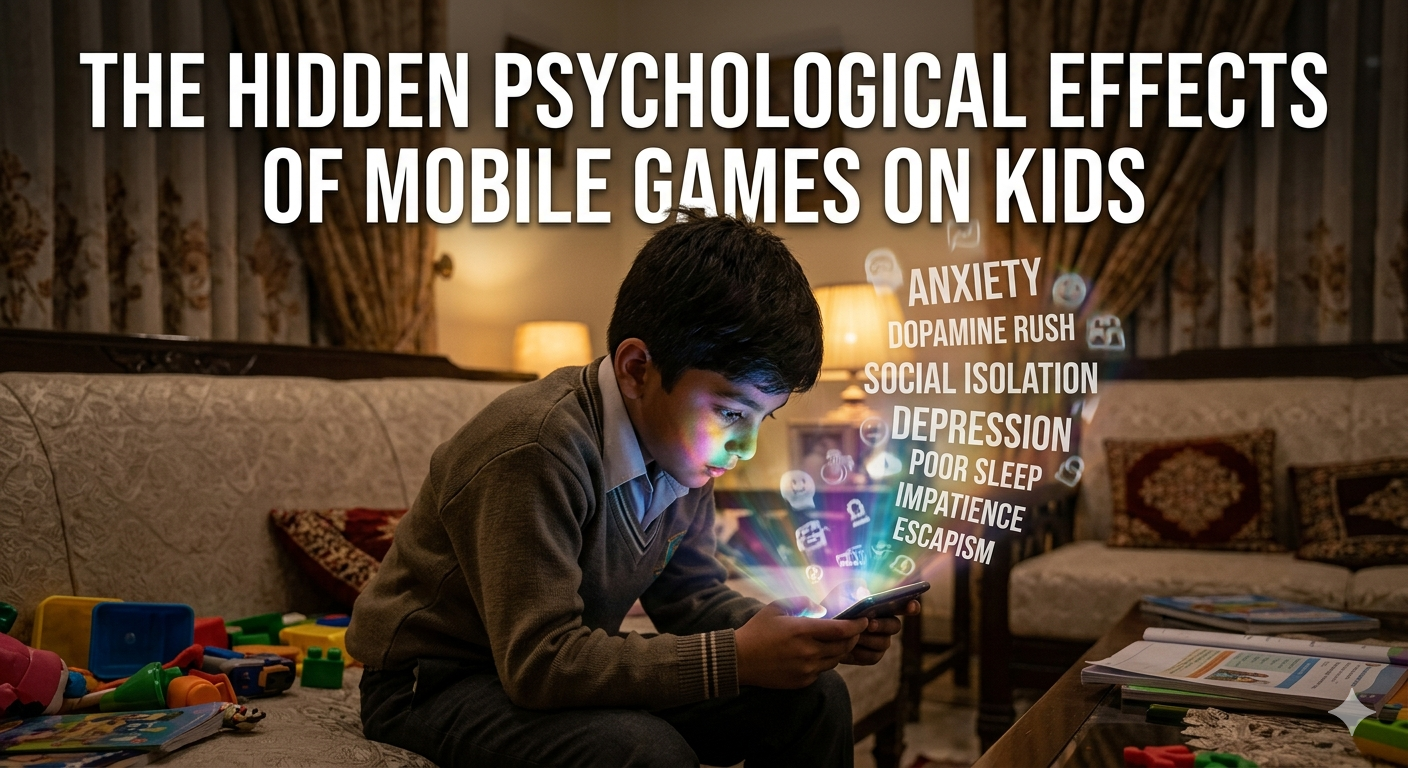
How reward systems, levels, and in-game progression impact motivation, patience, and focus
Mobile games are no longer just casual entertainment for children—they are carefully engineered psychological systems designed to capture attention, sustain engagement, and maximize playtime. What looks like harmless fun on the surface often contains deeply structured reward loops that influence how children think, feel, and behave over time.
While gaming is not inherently harmful, research in child development and behavioral psychology shows that repeated exposure to fast reward cycles, leveling systems, and progression mechanics can subtly reshape a child’s motivation, patience, and ability to focus on long-term tasks.
Understanding these effects is essential for parents, educators, and anyone concerned with healthy cognitive development in the digital age.
1. Why Mobile Games Are So Psychologically Powerful
Mobile games are designed around one core principle: keep the player engaged as long as possible.
To achieve this, developers use behavioral reinforcement techniques based on reward psychology. These systems are not accidental—they are built using insights from cognitive science and behavioral conditioning.
The most common mechanisms include:
- Constant rewards (coins, points, loot, achievements)
- Level progression systems
- Daily login bonuses
- Timed challenges
- Unlockable content
- Social comparison (leaderboards, rankings)
These systems activate the brain’s reward circuitry, particularly pathways associated with motivation and pleasure. In psychological terms, this is closely tied to dopamine-based reinforcement learning, where the brain begins to associate certain actions (playing the game) with emotional reward.
Over time, this creates strong behavioral habits.
For children whose self-control systems are still developing, these mechanics can feel especially compelling.
2. The Reward Loop: How Games Train the Brain
At the heart of most mobile games is a simple loop:
Action → Reward → Repeat
A child taps, swipes, or completes a task and immediately receives something in return—points, stars, coins, or progress.
This rapid feedback system is significantly different from real-life learning environments, where rewards are often delayed:
- Studying for exams → grades later
- Practicing sports → improvement over time
- Reading books → knowledge gained gradually
Mobile games compress reward cycles into seconds or minutes.
This difference is crucial because children’s brains naturally prefer immediate feedback. The faster and more frequent the reward, the stronger the behavioral reinforcement becomes.
Over time, this can lead to:
- Preference for instant gratification
- Reduced patience for delayed outcomes
- Lower tolerance for slow tasks
- Increased frustration with effort-based learning
The brain begins to expect rapid feedback in all activities, not just games.
3. Levels and Progression: The Illusion of Constant Achievement
Level systems are one of the most powerful psychological tools in mobile gaming.
Each level gives the child a clear sense of:
- Progress
- Achievement
- Advancement
- Mastery
This creates a continuous sense of accomplishment, even if the tasks are relatively simple.
The problem is not achievement itself—it is the frequency and speed of achievement.
In many games:
- A child levels up within minutes
- Small tasks produce visible progress bars
- Rewards appear constantly
- Failure is minimal or quickly reversible
This creates a perception that progress should always be:
- Fast
- Visible
- Easy to measure
In contrast, real-life growth is often:
- Slow
- Unpredictable
- Effort-dependent
- Sometimes invisible for long periods
This mismatch can subtly affect how children interpret real-world challenges.
For example, a child accustomed to rapid leveling may:
- Become impatient with school subjects
- Lose interest in long-term projects
- Expect quick success in learning tasks
- Feel discouraged when improvement is slow
The brain becomes trained to associate “progress” with constant visual reinforcement.
4. The Impact on Motivation: From Internal Drive to External Rewards
One of the most important psychological shifts linked to gaming systems is the transition from intrinsic motivation to extrinsic motivation.
Intrinsic motivation:
Doing something because it is interesting, meaningful, or enjoyable.
Examples:
- Reading for curiosity
- Learning a skill for personal growth
- Playing sports for enjoyment
Extrinsic motivation:
Doing something for external rewards or recognition.
Examples:
- Playing games for points, skins, or levels
- Completing tasks for badges or rewards
- Acting based on external validation
Mobile games heavily emphasize extrinsic motivation. Children are constantly rewarded for participation, not just effort or learning.
Over time, this can shape behavior patterns such as:
- “Is there a reward for this?”
- “What do I get if I finish this?”
- “Why should I do something without points or levels?”
This does not mean children lose all internal motivation, but their expectation of reward-based activity may increase.
In school settings, this can sometimes create friction:
- Studying feels unrewarding compared to gaming
- Homework feels “pointless” without immediate feedback
- Learning becomes harder to sustain without external incentives
5. Attention Fragmentation: Why Focus Becomes Harder
Mobile games are designed for constant stimulation. They rarely allow long periods of silence, waiting, or reflection.
Instead, they offer:
- Rapid visual changes
- Frequent sound effects
- Constant notifications
- Fast-paced interactions
- Immediate transitions between tasks
This environment trains the brain to expect frequent novelty.
Over time, children may experience:
- Difficulty focusing on slow-paced tasks
- Reduced attention span for reading or studying
- Increased boredom during non-stimulating activities
- A need for constant stimulation to stay engaged
This is not a sign of permanent cognitive damage, but rather a form of attention conditioning.
The brain adapts to environments it is repeatedly exposed to.
When a child spends significant time in high-stimulation environments, low-stimulation tasks can feel unusually demanding.
6. Patience and Delayed Gratification: A Key Developmental Challenge
One of the most important skills in childhood development is delayed gratification—the ability to wait for rewards.
This skill is strongly linked to:
- Academic success
- Emotional regulation
- Decision-making ability
- Long-term goal achievement
Mobile games, however, often reduce the need for patience.
Examples include:
- Instant rewards for completing tasks
- Short timers for progression
- Easy retries after failure
- Continuous achievement systems
Children become accustomed to:
- Quick results
- Minimal waiting
- Frequent reinforcement
As a result, real-life tasks that require patience may feel more frustrating:
- Long homework assignments
- Learning instruments or sports
- Saving money for something desired
- Long-term academic goals
This does not eliminate patience, but it can weaken tolerance for delayed outcomes if not balanced with real-world experiences.
7. The “Just One More Level” Effect
One of the most common behavioral patterns in mobile gaming is the inability to stop playing due to progression systems.
This happens because:
- Levels are short
- Rewards are frequent
- Progress feels continuous
- There is always a “next achievement”
This creates a psychological loop where the brain seeks closure:
- “Let me finish this level”
- “I’m almost there”
- “Just one more reward”
But games are designed so that completion never truly feels final.
This can lead to:
- Extended play sessions
- Loss of time awareness
- Difficulty stopping voluntarily
- Sleep delay
This effect is especially strong in children, whose impulse control systems are still developing.
8. Emotional Conditioning: How Games Shape Feelings
Mobile games do not only affect thinking—they also influence emotional responses.
Children may experience:
- Excitement from rewards
- Frustration from failure
- Anxiety during competitive moments
- Relief from progression milestones
Over time, emotional patterns can become linked to gaming cycles.
For example:
- Winning → happiness
- Losing → frustration
- Progress → satisfaction
- Stagnation → boredom
This structured emotional environment can feel more predictable than real life, where outcomes are often uncertain and delayed.
Some children may begin preferring the emotional predictability of games over the complexity of real-world interactions.
9. Social Comparison and Validation Pressure
Many mobile games include:
- Leaderboards
- Rankings
- Competitive scores
- Multiplayer performance metrics
These features introduce early forms of social comparison.
Children may begin to:
- Compare achievements with others
- Feel pressure to “keep up”
- Tie self-worth to rankings
- Seek validation through performance
While competition can be healthy in moderation, constant comparison systems may increase stress or reduce enjoyment for some children.
10. Long-Term Cognitive Effects: What Research Suggests
Current research does not suggest that gaming causes permanent cognitive harm. However, it does show that excessive exposure to high-reward digital environments can influence:
- Attention regulation
- Impulse control
- Motivation systems
- Emotional responses to effort
These effects are generally reversible when balanced with:
- Offline activities
- Physical play
- Reading and learning
- Social interaction
- Structured routines
The brain remains highly adaptable during childhood, meaning environment plays a major role in shaping habits.
11. When Gaming Becomes a Problem
Mobile gaming becomes concerning when it consistently disrupts:
- School performance
- Sleep patterns
- Emotional stability
- Family interaction
- Physical activity
- Interest in offline life
Warning signs may include:
- Irritability when gaming is restricted
- Loss of interest in non-digital activities
- Constant thinking about games
- Declining academic focus
- Difficulty stopping gameplay
These signs suggest that gaming is no longer just entertainment but has become a dominant behavioral system.
12. Healthy Balance: How Parents Can Respond
The goal is not to eliminate gaming but to create balance.
Effective strategies include:
1. Structured time limits
Clear and predictable gaming schedules help children develop self-control.
2. Balanced activity mix
Ensure gaming is not replacing:
- Sleep
- Exercise
- Learning
- Social interaction
3. Encourage slow activities
Reading, sports, and creative hobbies help rebuild patience and focus.
4. Co-play and awareness
Understanding the games children play helps parents guide behavior more effectively.
5. Teach awareness of reward systems
Older children can be taught how games are designed to keep attention engaged.
Final Thoughts
Mobile games are powerful psychological systems built around reward loops, progression mechanics, and continuous engagement strategies. For children, these systems can significantly influence motivation, patience, attention, and emotional responses.
The key issue is not gaming itself, but imbalance.
When children experience a healthy mix of digital and real-world activities, gaming can be enjoyable and even beneficial. But when reward-driven systems dominate daily life, they can reshape expectations about effort, time, and achievement.
Understanding these hidden psychological effects allows parents and educators to guide children toward healthier digital habits—without fear, but with awareness and structure.