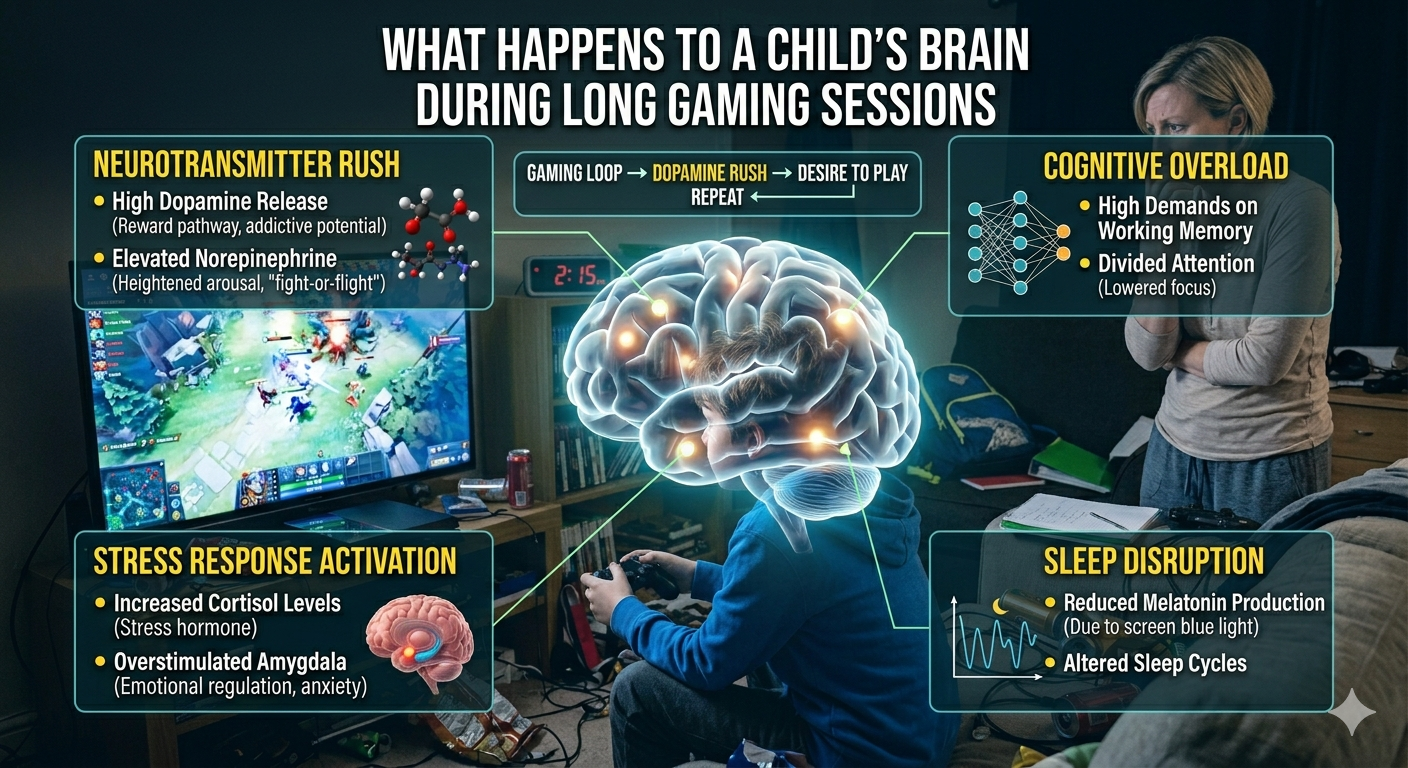
A simplified explanation of dopamine, reward cycles, and mental fatigue
Video games are now a major part of childhood. Whether children play on smartphones, tablets, consoles, or computers, gaming has become one of the most common forms of entertainment around the world.
For many children, gaming is simply a fun hobby. It can encourage creativity, problem-solving, teamwork, and relaxation. But when gaming sessions become very long or excessive, parents often notice changes in behavior, mood, attention, sleep, and emotional regulation.
A child may become:
- irritable after stopping,
- mentally exhausted,
- emotionally reactive,
- distracted from schoolwork,
- or unusually focused on returning to the game.
Many parents wonder:
What exactly happens inside a child’s brain during long gaming sessions?
The answer involves several important brain processes, including:
- dopamine,
- reward systems,
- attention cycles,
- emotional stimulation,
- and mental fatigue.
Understanding these processes can help parents make more informed decisions about screen time without relying on fear, shame, or panic.
This article explains in simple language how long gaming sessions affect a child’s brain and why balance matters.
The Brain Loves Rewards
The human brain is designed to seek rewarding experiences.
When we do something enjoyable or meaningful, the brain releases chemicals that create feelings of pleasure, motivation, and satisfaction.
One of the most important chemicals involved in this process is dopamine.
Dopamine is often misunderstood as the “pleasure chemical,” but it is more accurately connected to:
- motivation,
- anticipation,
- reward,
- and the desire to repeat behaviors.
Dopamine helps the brain learn:
“This activity feels rewarding. Do it again.”
This system is extremely important for survival and learning.
Children experience dopamine release during many healthy activities:
- playing outside,
- achieving goals,
- social connection,
- praise,
- learning new skills,
- sports,
- and creative activities.
Video games also activate this reward system very effectively.
Why Video Games Trigger Strong Dopamine Responses
Games are carefully designed to keep players engaged.
Many games provide:
- instant rewards,
- achievements,
- points,
- upgrades,
- competition,
- surprises,
- visual excitement,
- and social interaction.
Unlike real life, games often deliver rewards very quickly.
For example:
- win a level,
- unlock an item,
- earn coins,
- receive praise,
- defeat an opponent,
- or level up.
Each reward creates excitement and anticipation.
The brain responds by increasing motivation to continue playing.
This is why children often say:
- “Just one more game.”
- “I’m almost done.”
- “I need to finish this level.”
The brain becomes highly focused on continuing the reward cycle.
The Reward Cycle Explained Simply
Gaming reward systems work in loops.
A simplified version looks like this:
- The child starts playing.
- The game provides stimulation and rewards.
- Dopamine increases motivation and excitement.
- The child wants to continue playing.
- More rewards appear.
- The cycle repeats.
Modern games are especially effective because rewards often happen unpredictably.
For example:
- surprise prizes,
- random rewards,
- rare items,
- unexpected victories,
- or bonus events.
The brain becomes highly attentive because it does not know exactly when the next reward will appear.
This unpredictability increases engagement.
It is similar to why people repeatedly check social media notifications or messages.
The brain keeps anticipating:
“Maybe something exciting will happen next.”
Why Children Struggle to Stop Playing
Parents often become frustrated when children resist stopping games.
But understanding the brain’s reward system explains why transitions can feel difficult.
During long gaming sessions, the brain becomes deeply focused on stimulation and reward anticipation.
Stopping suddenly can feel emotionally uncomfortable because:
- excitement drops,
- stimulation decreases,
- and the reward cycle ends abruptly.
This is why some children become:
- angry,
- emotional,
- frustrated,
- or restless after gaming ends.
Their brains are shifting from high stimulation to normal everyday activity.
For younger children especially, this transition can feel very challenging because self-regulation skills are still developing.
This does not mean children should play endlessly.
It simply means parents should approach gaming limits with understanding instead of assuming intentional defiance.
What Happens During Long Gaming Sessions
Short gaming sessions are usually easier for the brain to recover from.
Long gaming sessions are different.
When children play for many hours without meaningful breaks, the brain experiences continuous stimulation.
This can affect:
- attention,
- emotional regulation,
- decision-making,
- energy levels,
- and mental fatigue.
The brain stays highly alert for extended periods.
Action games especially may increase:
- excitement,
- adrenaline,
- fast reactions,
- and sensory stimulation.
Over time, this constant activation can become mentally exhausting.
Even though gaming feels enjoyable, the brain is still working hard.
Mental Fatigue and “Brain Overload”
Many parents assume gaming is mentally relaxing.
While games can reduce stress temporarily, long sessions can also create mental fatigue.
Mental fatigue happens when the brain remains intensely active for too long without proper rest.
Children may experience:
- irritability,
- difficulty concentrating,
- mood swings,
- slower thinking,
- or emotional exhaustion.
After long gaming sessions, some children struggle with tasks requiring patience or sustained focus, such as:
- homework,
- reading,
- chores,
- or classroom learning.
The brain becomes accustomed to high-speed stimulation.
Normal activities may suddenly feel:
- boring,
- slow,
- or mentally uncomfortable.
This is one reason some children resist schoolwork after gaming.
Attention Span and Constant Stimulation
Fast-paced games train the brain to expect rapid changes and immediate feedback.
Many games involve:
- constant movement,
- flashing visuals,
- instant responses,
- and continuous interaction.
Over time, some children may become less comfortable with slower-paced activities.
School and studying often require:
- delayed rewards,
- quiet concentration,
- patience,
- and deep thinking.
Compared to gaming, these activities may feel less stimulating.
This does not mean games permanently damage attention spans.
However, excessive gaming without balance can make focused academic work feel harder for some children.
Children who constantly switch between:
- games,
- videos,
- notifications,
- and apps
may also develop habits of fragmented attention.
Their brains become used to constant novelty and interruption.
Emotional Effects of Long Gaming Sessions
Gaming can strongly affect emotions.
Positive emotions may include:
- excitement,
- achievement,
- confidence,
- and social connection.
But long sessions can also increase:
- frustration,
- emotional intensity,
- irritability,
- or overstimulation.
Competitive games especially may create strong emotional highs and lows.
Children may become extremely excited after winning or very upset after losing.
Long exposure to emotional stimulation can leave children mentally drained.
This is why some parents notice:
- emotional outbursts,
- aggression,
- or moodiness after gaming.
The issue is often not the child’s personality. It is the brain struggling to regulate emotions after prolonged stimulation.
The Role of Dopamine in Motivation
One important thing parents should understand is that dopamine influences motivation, not just pleasure.
After long gaming sessions, ordinary activities may temporarily feel less rewarding compared to the excitement of games.
For example:
- homework feels dull,
- chores feel frustrating,
- reading feels slow,
- or quiet activities feel unstimulating.
This does not mean the brain is “broken.”
It simply means the brain has adapted temporarily to high stimulation.
Children may seek more gaming because their brains remember the strong reward experience.
This is why moderation and balance are important.
Sleep and Brain Recovery
The brain needs sleep to recover properly.
During sleep, the brain:
- processes information,
- restores energy,
- regulates emotions,
- and strengthens memory.
Long gaming sessions, especially late at night, can interfere with this recovery process.
Children who game late into the evening may struggle with:
- falling asleep,
- poor sleep quality,
- shorter sleep duration,
- and daytime fatigue.
Blue light from screens can also affect melatonin, the hormone that helps regulate sleep.
A tired brain struggles with:
- learning,
- emotional control,
- concentration,
- and decision-making.
Over time, poor sleep combined with excessive gaming can create significant mental exhaustion.
Why Some Children Become “Obsessed” With Games
Not every child becomes overly attached to gaming.
Some children can play moderately without major problems.
Others become intensely focused on games.
Several factors may contribute:
- personality,
- emotional stress,
- social difficulties,
- boredom,
- loneliness,
- anxiety,
- or lack of enjoyable offline activities.
Games provide:
- structure,
- goals,
- rewards,
- social interaction,
- and escape from stress.
For children struggling emotionally, gaming can become a coping mechanism.
This is why simply removing games without addressing emotional needs may create more conflict.
Parents should look beyond the screen itself and ask:
“What is my child getting emotionally from gaming?”
Are Games Harmful to the Brain?
This is one of the biggest fears many parents have.
The reality is more balanced than extreme headlines often suggest.
Moderate gaming does not automatically damage a child’s brain.
Some games may even improve:
- coordination,
- strategic thinking,
- problem-solving,
- creativity,
- and reaction speed.
The problem is usually excessive, unbalanced use.
When gaming replaces:
- sleep,
- physical activity,
- learning,
- social interaction,
- or emotional balance,
negative effects become more likely.
The brain develops best through variety.
Children need:
- movement,
- face-to-face interaction,
- outdoor play,
- creativity,
- rest,
- learning,
- and emotional connection.
Healthy development depends on balance, not total screen elimination.
Why Breaks Matter
The brain handles stimulation better when children take regular breaks.
Breaks help:
- reduce mental fatigue,
- restore focus,
- regulate emotions,
- and protect eye and brain health.
Encouraging breaks every hour can help prevent overstimulation.
Good break activities include:
- stretching,
- walking,
- drinking water,
- outdoor movement,
- or non-screen activities.
The goal is helping the brain reset.
Signs a Child May Be Mentally Overstimulated
Parents should watch for signs such as:
- irritability after gaming,
- emotional outbursts,
- trouble focusing,
- sleep problems,
- mental exhaustion,
- resistance to stopping,
- declining school performance,
- or loss of interest in offline activities.
These signs do not necessarily mean addiction.
But they may indicate the child’s brain is struggling with too much stimulation and insufficient balance.
How Parents Can Support Healthy Brain Balance
Parents do not need to panic about gaming.
Instead, they can focus on creating healthy habits.
Helpful strategies include:
- setting reasonable time limits,
- encouraging offline activities,
- protecting sleep routines,
- creating screen-free times,
- and staying emotionally calm during transitions.
Children respond better to structure than constant conflict.
Parents should also avoid:
- shame,
- insults,
- or extreme punishments.
Fear-based approaches often increase resistance.
The goal is teaching self-regulation, not creating power struggles.
Helping Children Transition Out of Gaming
Stopping a game suddenly can feel difficult because the brain is highly stimulated.
Transitions become easier when parents:
- give advance warnings,
- use predictable schedules,
- stay calm,
- and validate feelings.
For example:
“I know you’re having fun. You have 10 more minutes.”
This approach reduces emotional shock.
Children are more cooperative when limits feel predictable and respectful.
Building a Healthy Relationship With Technology
Technology is now part of everyday life.
The goal is not raising children who never use screens.
The goal is helping children develop a balanced relationship with technology.
Healthy digital habits include:
- moderation,
- self-awareness,
- emotional regulation,
- and balance with offline life.
Children need guidance, especially because their brains are still developing.
Parents play an important role in teaching:
- boundaries,
- routines,
- and healthy coping skills.
Final Thoughts
Long gaming sessions affect a child’s brain through dopamine, reward cycles, emotional stimulation, and mental fatigue.
Games activate powerful brain systems connected to:
- motivation,
- excitement,
- anticipation,
- and reward.
When gaming becomes excessive, children may experience:
- overstimulation,
- concentration problems,
- emotional exhaustion,
- sleep disruption,
- and difficulty transitioning back to everyday tasks.
This does not mean games are inherently dangerous or harmful.
The key issue is balance.
Children’s brains develop best when gaming exists alongside:
- healthy sleep,
- physical movement,
- learning,
- creativity,
- family connection,
- and emotional support.
Parents who understand how the brain responds to gaming are better equipped to create healthy boundaries without fear, shame, or constant conflict.
The goal is not to eliminate joy from children’s lives. It is to help them enjoy technology in ways that support long-term emotional, mental, and cognitive well-being.