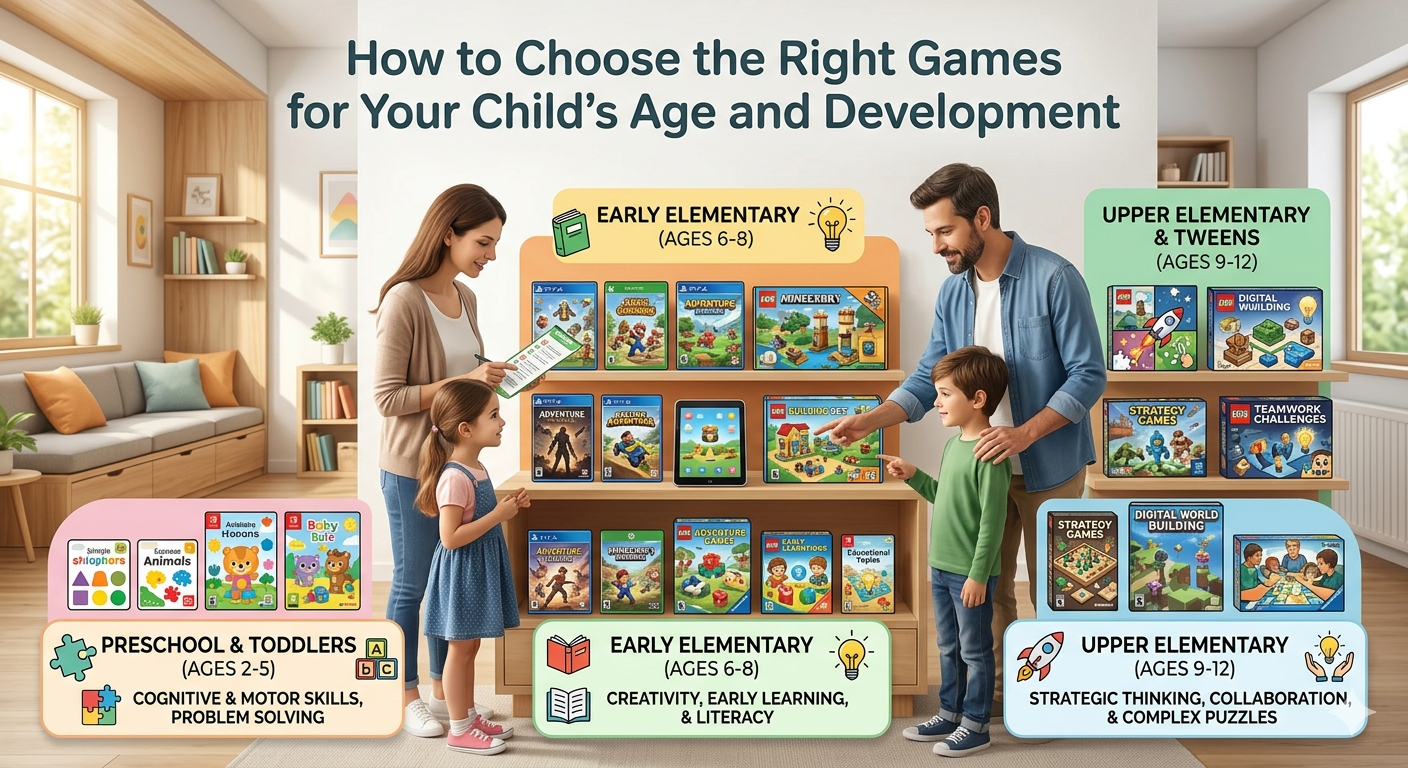
For many parents, choosing video games for children feels overwhelming. One game is praised for creativity, another becomes wildly popular on social media, and a third carries a “kid-friendly” label despite containing frustrating mechanics, addictive reward systems, or inappropriate social features.
The challenge is that game selection today is far more complicated than simply checking an age rating.
A game can technically be suitable for a child’s age while still being emotionally overwhelming, overly stimulating, socially risky, or developmentally unhelpful. On the other hand, some games dismissed as “just entertainment” may actually encourage creativity, problem-solving, teamwork, and learning.
This is why parents need a smarter framework for evaluating games — one based not only on ratings and popularity, but also on a child’s emotional maturity, learning style, attention span, social readiness, and developmental needs.
The goal is not to eliminate gaming completely. Games are now part of modern childhood. Instead, the goal is to choose games intentionally so they support healthy development rather than interfere with it.
Here’s how parents can evaluate games more thoughtfully and confidently.
Why Age Ratings Alone Are Not Enough
Most parents begin with official ratings systems like:
- ESRB (Everyone, Teen, Mature)
- PEGI
- App Store age recommendations
These systems are useful starting points, but they have limitations.
Ratings mainly focus on:
- Violence
- Language
- Sexual content
- Gambling elements
- Fear intensity
They do not fully evaluate:
- Addictiveness
- Emotional overstimulation
- Social pressure
- Competitive toxicity
- Attention fragmentation
- In-app purchase manipulation
- Sleep disruption potential
For example, a game rated “Everyone” may still contain:
- Endless reward loops
- Aggressive advertising
- Chat systems with strangers
- Frustrating progression systems
- High-pressure competitive environments
Similarly, some games rated for older children may actually be emotionally manageable for mature younger players when supervised appropriately.
This is why age ratings should be treated as a guideline — not the final decision-maker.
The Most Important Question: What Does This Game Train?
Every game trains something.
The real question is whether the skills being reinforced are healthy and developmentally appropriate.
Some games strengthen:
- Creativity
- Planning
- Problem-solving
- Cooperation
- Patience
- Strategic thinking
Others heavily reinforce:
- Impulsivity
- Constant stimulation
- Reward dependence
- Aggressive behavior patterns
- Short attention cycles
Parents should begin evaluating games by asking:
“What mental and emotional habits does this game encourage?”
That single question often reveals more than reviews or popularity charts.
Step 1: Match Games to Developmental Stage
Children at different ages process games very differently.
A game that is exciting and beneficial for a 12-year-old may overwhelm a 6-year-old emotionally and cognitively.
Understanding developmental readiness matters more than raw intelligence.
Ages 3–5: Exploration and Simplicity
Young children are still developing:
- Emotional regulation
- Language skills
- Basic attention control
- Cause-and-effect understanding
At this age, the best games are:
- Slow-paced
- Visually clear
- Simple to navigate
- Non-violent
- Free from aggressive reward systems
Good options often include:
- Shape puzzles
- Matching games
- Creative sandbox play
- Basic educational games
- Gentle exploration games
Avoid games with:
- Fast flashing rewards
- Competitive rankings
- Online chat
- Complex menus
- Constant advertisements
Young children struggle to separate persuasive design from genuine play.
Ages 6–8: Building Logic and Patience
At this stage, children begin developing:
- Rule-following abilities
- Sequential thinking
- Frustration tolerance
- Early strategic reasoning
Games can now become slightly more challenging.
Helpful game features include:
- Puzzle-solving
- Resource management
- Cooperative play
- Creativity tools
- Basic strategy
Children this age still benefit from limited stimulation intensity. Games that constantly bombard them with rewards and rapid pacing can reduce attention endurance over time.
Parents should especially monitor emotional reactions:
- Does the child become extremely upset when losing?
- Do they obsess over rewards?
- Are they becoming irritable after play?
The emotional response to the game matters as much as the content itself.
Ages 9–12: Independence and Social Learning
This is often when gaming becomes socially important.
Children may begin:
- Playing multiplayer games
- Watching gaming influencers
- Comparing progress with friends
- Developing online identities
At this age, parents should evaluate:
- Social features
- Competitive intensity
- Communication systems
- Monetization pressure
Many games targeted at preteens are designed around:
- Daily rewards
- Limited-time events
- Social pressure to stay active
These mechanics can encourage compulsive play patterns.
Games that support healthy development during this stage often involve:
- Teamwork
- Creative problem-solving
- Strategic planning
- Skill mastery over luck-based rewards
Parental discussions become extremely important here.
Instead of only enforcing limits, parents should talk with children about:
- Online behavior
- Advertising tactics
- Emotional self-control
- Healthy screen habits
Ages 13+: Identity, Competition, and Self-Regulation
Teenagers often use games for:
- Social belonging
- Competition
- Stress relief
- Identity exploration
At this stage, the focus shifts from simple protection to guided independence.
Parents should evaluate:
- Emotional maturity
- Sleep habits
- Time management
- Online safety awareness
- Ability to self-regulate
Teens can often handle more complex themes, but not all teens are equally ready for highly competitive or emotionally intense games.
A mature 13-year-old and an impulsive 13-year-old may respond to the same game very differently.
Step 2: Evaluate the Reward System
One of the most overlooked aspects of gaming is reward design.
Modern games are carefully engineered to keep players engaged.
Some reward systems encourage:
- Persistence
- Skill development
- Exploration
Others encourage:
- Endless grinding
- Impulsive spending
- Constant dopamine chasing
Parents should ask:
Does the game reward skill or compulsive repetition?
Healthy reward systems typically:
- Encourage improvement
- Have natural stopping points
- Reward creativity or mastery
- Avoid excessive manipulation
Unhealthy systems often include:
- Daily login pressure
- Loot boxes
- Endless progression bars
- Constant notifications
- Fear-of-missing-out events
Games built around psychological pressure can become emotionally draining for children.
Step 3: Look Beyond Violence
Violence receives the most attention in game discussions, but other factors may affect children even more strongly.
A non-violent game can still be unhealthy if it:
- Creates emotional dependency
- Encourages obsessive play
- Disrupts sleep
- Promotes toxic social interaction
Meanwhile, some mild fantasy-action games may be perfectly manageable for emotionally stable older children.
Parents should assess:
- Emotional intensity
- Stress level
- Social environment
- Addictive mechanics
- Behavioral effects after play
The question is not only:
“Is this violent?”
But also:
“How does this game affect my child emotionally and behaviorally?”
Step 4: Observe Your Child After Playing
Children’s behavior after gaming reveals enormous information.
Pay attention to:
- Mood changes
- Irritability
- Aggression
- Attention problems
- Sleep quality
- Social withdrawal
- Emotional resilience
Healthy gaming experiences often leave children:
- Relaxed
- Satisfied
- Creative
- Socially engaged
Problematic gaming experiences may leave children:
- Angry
- Hyperstimulated
- Exhausted
- Emotionally dysregulated
The same game can affect different children differently.
This is why observation matters more than online reviews.
Step 5: Understand the Difference Between Active and Passive Gaming
Not all screen time affects the brain equally.
Some games require active thinking:
- Strategy games
- Building games
- Puzzle-solving
- Creative design
- Planning
Others rely mostly on passive reward chasing:
- Endless tapping
- Automatic progression
- Repetitive grinding
- Minimal decision-making
Generally, games that demand:
- Creativity
- Problem-solving
- Patience
- Strategic thinking
provide more developmental value than games built around constant stimulation and rapid rewards.
Step 6: Evaluate Social Features Carefully
Many parents focus on gameplay while overlooking online interaction.
But multiplayer communication can strongly influence children’s emotional development.
Questions to ask include:
- Can strangers contact the child?
- Is voice chat enabled?
- Are there moderation tools?
- Is bullying common?
- Does the game encourage cooperation or hostility?
Online social environments shape behavior patterns.
Some multiplayer games encourage:
- Teamwork
- Leadership
- Communication skills
Others normalize:
- Harassment
- Toxic competition
- Emotional outbursts
- Peer pressure
Children need guidance to navigate these spaces safely.
Step 7: Avoid Popularity-Based Decisions
One of the biggest parenting traps is choosing games simply because “everyone else is playing them.”
Popularity does not equal developmental value.
Some massively popular games succeed because they are intentionally designed to maximize engagement and spending.
Parents should resist social pressure and ask:
- Does this match my child’s maturity?
- Does it support healthy habits?
- Does it fit our family values?
- Does my child handle this game well emotionally?
Children benefit more from appropriate games than trendy ones.
Step 8: Balance Gaming With Other Experiences
Even healthy games should not dominate childhood.
Children still need:
- Outdoor play
- Face-to-face friendships
- Reading
- Physical activity
- Imaginative offline play
- Family interaction
Games become problematic when they replace too many other developmental experiences.
A balanced child usually handles gaming far better than a child whose entire emotional world revolves around screens.
Signs a Game May Be Developmentally Helpful
A game may support healthy development if it encourages:
- Creativity
- Cooperation
- Strategic thinking
- Patience
- Exploration
- Skill-building
- Problem-solving
- Emotional resilience
Helpful games often have:
- Clear goals
- Moderate pacing
- Low manipulation
- Positive social interaction
- Opportunities for learning
Warning Signs Parents Should Watch For
A game may be unhealthy if it causes:
- Extreme emotional reactions
- Sleep disruption
- Obsessive thinking
- Constant reward-seeking
- Social withdrawal
- Academic decline
- Increased irritability
- Inability to stop playing
Parents should especially pay attention when children:
- Become angry when interrupted
- Lose interest in offline activities
- Think constantly about the game
- Sneak extra screen time
- Struggle with self-control
These patterns matter more than the game’s rating alone.
The Importance of Co-Playing
One of the best ways to understand a game is to play it with your child.
Co-playing helps parents:
- Understand gameplay mechanics
- Observe emotional reactions
- Build trust
- Discuss online safety
- Teach healthy habits
Children are often more open to guidance when parents show genuine interest instead of immediate criticism.
Even 15–20 minutes of occasional co-play can provide valuable insight.
Teaching Children Healthy Gaming Habits
Choosing the right game is only part of the equation.
Children also need help developing:
- Self-regulation
- Time awareness
- Emotional balance
- Healthy stopping habits
Parents can encourage this by:
- Setting consistent limits
- Creating screen-free routines
- Avoiding gaming before bedtime
- Encouraging breaks
- Modeling balanced technology use
The long-term goal is not permanent control.
It is helping children eventually manage gaming responsibly themselves.
Final Thoughts
Choosing games for children today requires more than checking an age rating or following trends.
Parents need to evaluate games based on:
- Emotional impact
- Cognitive demands
- Reward systems
- Social environment
- Developmental appropriateness
- Behavioral effects
The best games are not necessarily the most educational or the most popular.
They are the games that align with a child’s stage of development while encouraging healthy thinking, emotional balance, creativity, and self-control.
Games are powerful tools. They can teach persistence, strategy, teamwork, and problem-solving. But they can also reinforce impulsivity, overstimulation, and unhealthy dependency if chosen carelessly.
Thoughtful game selection is not about fear or restriction.
It is about helping children engage with technology in ways that support their growth rather than control their attention.
When parents focus less on hype and more on developmental fit, gaming becomes easier to manage — and far more beneficial for children in the long run.