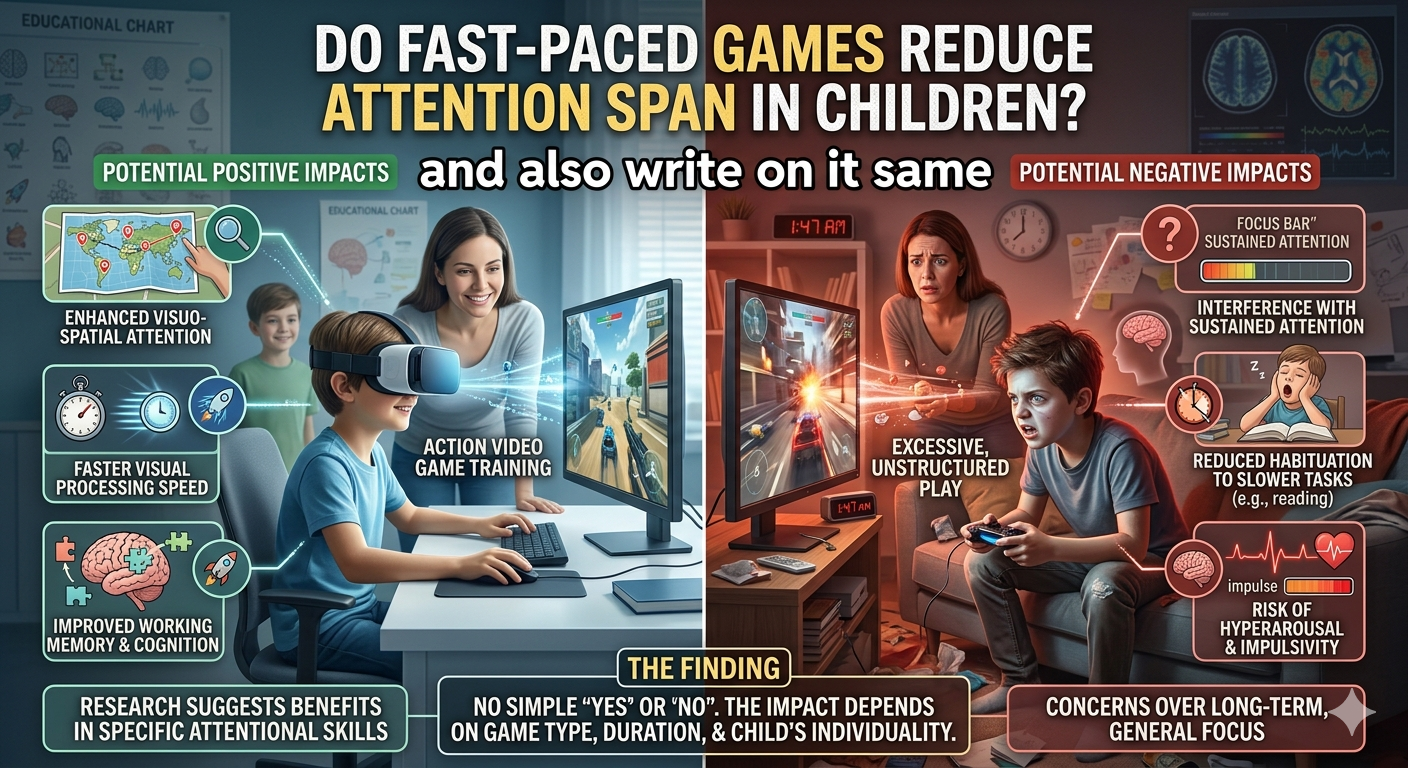
Exploring How Constant Stimulation Impacts Focus, Patience, and Learning Ability
Fast-paced digital games are everywhere. From mobile “tap-to-play” games to competitive multiplayer titles, children today are exposed to environments filled with rapid rewards, constant motion, bright visuals, and nonstop feedback.
For many parents, a common concern arises:
Are these games shrinking children’s attention spans?
It’s an understandable worry. Children who switch quickly between apps, struggle with homework focus, or become impatient during slower tasks are often assumed to be “damaged” by fast digital stimulation.
But the reality is more nuanced.
Fast-paced games do not automatically “destroy attention span,” but they can shape how attention is used, trained, and rewarded. In some cases, they may strengthen certain quick-response skills while weakening patience for slower, sustained focus tasks.
To understand this properly, we need to explore what attention span really is, how the brain responds to rapid stimulation, and where the real risks and misunderstandings lie.
1. What We Mean by “Attention Span”
Attention span is not a fixed number or permanent trait. It is better understood as a set of mental systems that allow a person to:
- Stay focused on a task
- Ignore distractions
- Sustain effort over time
- Switch attention when necessary
- Regulate mental energy
Children do not simply “have” or “lose” attention span. Instead, attention develops through experience, environment, sleep, emotional regulation, and practice.
This is important because it means attention is trainable, not permanently fixed.
2. What Counts as Fast-Paced Gaming?
Fast-paced games are those that involve:
- Rapid visual changes
- Short reaction times
- Frequent rewards or feedback
- High stimulation environments
- Constant decision-making
- Time pressure or competition
Examples include:
- Competitive action games
- Endless runner games
- Battle-style multiplayer games
- Hyper-casual mobile games
- Reaction-based puzzle games
These games are designed to keep players alert and engaged moment-to-moment.
They often create a sense of urgency and immediate feedback that feels exciting—but very different from slow, reflective activities like reading or solving long problems.
3. How the Brain Responds to Fast Stimulation
The human brain naturally responds to novelty and reward. Fast-paced games are especially effective at activating the brain’s reward system because they provide:
- Immediate feedback
- Frequent success moments
- Rapid sensory input
- Constant changes in challenge
This activates dopamine pathways associated with motivation and reward learning.
The key issue is not dopamine itself—dopamine is essential for learning and focus—but how frequently it is triggered.
When rewards come very quickly and often, the brain begins to adapt by expecting:
- Fast results
- Constant stimulation
- Immediate feedback
This can make slower tasks feel less engaging by comparison.
4. Do Fast Games Actually Shorten Attention Span?
The short answer is:
Not permanently—but they can influence attention habits.
Research suggests that fast-paced digital environments can affect how children allocate attention, especially in the short term. Children may become:
- More distractible after gaming sessions
- Less tolerant of slow tasks
- More prone to switching between activities
- Less patient with delayed rewards
However, these effects are usually context-dependent, not permanent brain damage.
In other words:
- Attention does not “shrink”
- But expectations for stimulation can change
A child accustomed to rapid rewards may find slower environments less rewarding, even if they are fully capable of focusing when required.
5. The Difference Between Speed and Control
A critical distinction often missed in discussions about gaming is this:
Fast attention is not the same as poor attention.
Fast-paced games often train:
- Quick reaction time
- Visual tracking
- Multitasking under pressure
- Rapid decision-making
These are real cognitive skills.
However, they primarily strengthen short-burst attention, not sustained deep focus.
So children may become:
- Better at reacting quickly
- But less practiced at staying focused for long periods
This is not a loss of ability—it is a shift in training emphasis.
6. The Problem Is Not Gaming—It Is Imbalance
Fast-paced games become problematic not because they exist, but because they can dominate a child’s attention environment.
A child who regularly engages in:
- Reading
- Outdoor play
- Homework
- Creative activities
- Slow problem-solving
is likely to maintain balanced attention development even if they also play fast games.
But a child whose primary stimulation comes from fast-paced digital environments may experience:
- Reduced tolerance for boredom
- Difficulty starting slow tasks
- Preference for instant rewards
- Lower persistence in long activities
The issue is imbalance, not exposure alone.
7. Why Slow Tasks Feel Hard After Fast Games
Parents often notice a pattern:
A child plays a fast game → then struggles with homework.
This happens because of a contrast effect.
Fast-paced games:
- Provide constant stimulation
- Offer immediate success feedback
- Keep the brain in high-arousal mode
Homework or reading:
- Requires delayed reward
- Needs sustained focus
- Has minimal immediate feedback
After intense stimulation, the brain temporarily finds slower tasks less engaging.
This does not mean the child “lost attention.” It means the brain is adjusting from one stimulation environment to another.
8. Attention Span Is Also Shaped by Age
Different developmental stages respond differently to fast-paced gaming.
Early Childhood (5–8 years)
At this stage:
- Attention systems are still developing
- Self-regulation is limited
- Emotional responses are strong
Fast-paced games can easily overwhelm attention capacity if overused.
Middle Childhood (9–12 years)
Children begin:
- Improving cognitive control
- Developing longer focus ability
- Becoming more influenced by reward systems
Fast games can shape habits strongly during this stage.
Teenagers (13+)
Teens have:
- More developed attention systems
- Better self-control (though inconsistent)
- Higher exposure to multitasking environments
However, they are also more vulnerable to:
- Habitual multitasking
- Digital overstimulation
- Sleep disruption from gaming
9. The Role of Reward Speed in Attention
One of the most important scientific insights is this:
The speed of reward affects attention habits.
Fast rewards:
- Train the brain to expect immediate outcomes
- Encourage rapid task-switching
- Reduce tolerance for waiting
Slow rewards:
- Build patience
- Strengthen sustained effort
- Improve long-term focus endurance
Fast-paced games heavily emphasize rapid reward cycles.
This does not make them harmful by default, but it does explain why children may struggle with slower environments afterward.
10. Does This Affect Learning?
Learning requires:
- Sustained attention
- Memory encoding
- Patience with difficulty
- Repetition and practice
If a child becomes accustomed to constant stimulation, they may initially struggle with:
- Reading long passages
- Completing homework
- Working through multi-step problems
- Sitting through lessons
However, this is often reversible with:
- Structured learning routines
- Reduced overstimulation
- Practice in focused tasks
- Balanced screen habits
The brain adapts both ways.
11. The Myth of “Permanent Damage”
One of the most common fears is that fast-paced games permanently shorten attention spans.
Current understanding does not support this idea.
Attention is:
- Flexible
- Trainable
- Environment-dependent
Children exposed to fast games do not lose the ability to focus. Instead, they may:
- Prefer stimulation-heavy environments
- Need transition time for slower tasks
- Require structured guidance to refocus
With balanced habits, attention patterns can normalize.
12. When Fast Games Can Be Helpful
It is important not to demonize fast-paced games completely.
They can support:
- Reaction speed
- Visual attention
- Decision-making under pressure
- Hand-eye coordination
- Short-term focus bursts
These skills are valuable in many real-world situations.
The problem arises only when:
- They dominate leisure time
- Replace slower cognitive activities
- Reduce exposure to patience-building tasks
13. Signs of Attention Imbalance in Children
Parents should watch for patterns such as:
- Difficulty starting homework
- Frequent boredom with slow tasks
- Constant need for stimulation
- Restlessness during reading
- Quick frustration with learning tasks
- Preference for screens over offline activities
- Trouble finishing long activities
These signs do not automatically mean gaming is the cause—but they may indicate an imbalance in attention training.
14. Restoring Balanced Attention
If fast-paced gaming has become dominant, balance can be restored through:
A. Gradual reduction of high-stimulation time
Not abrupt bans, but structured limits.
B. Introducing slow-focus activities
- Reading
- Puzzles
- Building projects
- Drawing or crafts
C. Encouraging boredom tolerance
Allowing moments without screens helps the brain reset.
D. Establishing focus routines
Short, consistent homework or reading sessions build endurance.
E. Sleep protection
Sleep is essential for attention regulation and recovery.
15. The Real Issue: Stimulation Overload
Modern children are not exposed to only games—they are surrounded by:
- Short videos
- Notifications
- Social media feeds
- Rapid content switching
Fast-paced games are part of a broader ecosystem of high-speed digital stimulation.
The attention challenge is therefore not about one activity, but about an entire environment that rewards constant switching.
Final Thoughts
Fast-paced games do not destroy attention span, but they do influence how attention is trained and rewarded.
They can:
- Improve quick thinking and reaction skills
- But reduce tolerance for slow, sustained focus if overused
The key issue is not speed itself, but balance.
Children need both:
- Fast attention skills for modern digital environments
- Slow attention skills for learning, patience, and deep thinking
When gaming exists alongside reading, creativity, offline play, and structured learning, attention develops in a healthy and flexible way.
But when fast stimulation becomes the dominant form of engagement, children may struggle more with patience and sustained effort—not because their brains are damaged, but because their habits are shaped toward immediacy.
In the end, attention is not lost or broken.
It is trained—and it can be retrained.