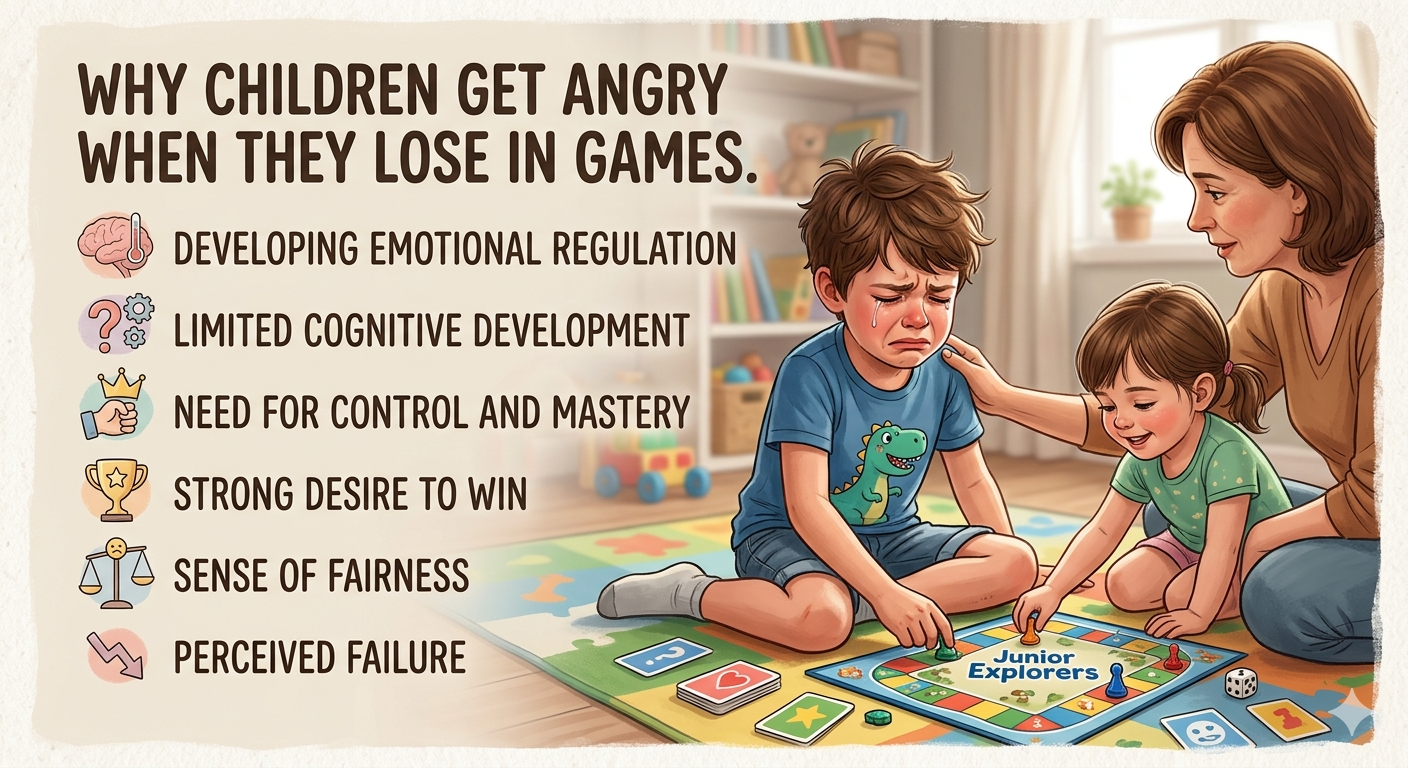
Understanding Emotional Reactions, Frustration, and How to Build Resilience
Winning feels good. Whether it’s a board game at home, a football match at school, or a video game with friends, children naturally enjoy success. But what happens when they lose? Many parents and teachers have witnessed emotional outbursts after a game ends badly for a child. Tears, yelling, blaming others, refusing to play again, or even throwing game pieces are surprisingly common reactions.
While these behaviors can be frustrating for adults, they are also deeply human. Losing can trigger powerful emotions in children because games are not just about entertainment—they are tied to identity, fairness, competence, and social belonging. Understanding why children become angry when they lose is the first step toward helping them develop emotional resilience and healthier coping skills.
This article explores the psychology behind children’s reactions to losing, the developmental reasons anger appears so strongly, and practical ways adults can guide children toward emotional growth.
Why Losing Feels So Intense for Children
Adults often view games casually. Children, however, may experience games with much greater emotional intensity. For many children, winning and losing feel personal.
A child may unconsciously interpret losing as:
- “I’m not good enough.”
- “People will laugh at me.”
- “I disappointed everyone.”
- “It’s unfair.”
- “I failed.”
Children are still developing emotional regulation skills, so they struggle to separate temporary outcomes from their self-worth. A simple loss in a game can feel much bigger inside their minds.
Emotional Brain vs. Rational Brain
Young children especially rely more heavily on emotional processing than logical thinking. The areas of the brain responsible for impulse control, emotional regulation, and perspective-taking are still developing throughout childhood and adolescence.
This means children often:
- Feel emotions very strongly
- React quickly before thinking
- Struggle to calm themselves independently
- Have difficulty understanding long-term perspective
When a child loses, frustration may flood their system faster than they can manage it. Anger becomes the visible expression of disappointment, embarrassment, or helplessness.
The Role of Competition
Competition itself is not harmful. In fact, healthy competition can teach motivation, discipline, teamwork, and perseverance. However, children interpret competition differently depending on their personality, age, and environment.
Some children naturally enjoy challenges and bounce back easily from defeat. Others are more sensitive to criticism or fear failure intensely.
Why Competitive Situations Trigger Strong Emotions
Games create conditions that naturally increase emotional pressure:
- Clear winners and losers
- Public comparison with peers or siblings
- Fast-paced decision-making
- Fear of embarrassment
- Desire for approval
- High excitement and stimulation
For children who are emotionally sensitive, these conditions can overwhelm coping abilities.
Developmental Stages and Reactions to Losing
Children’s reactions to losing often change with age.
Preschoolers (Ages 3–5)
Young children are still learning basic emotional control. At this stage:
- They often expect to win
- They struggle to understand fairness fully
- They think emotionally rather than logically
- They may believe games should go their way
Tantrums after losing are very common because self-regulation skills are still immature.
Early School Age (Ages 6–8)
Children become more aware of rules and social comparison. They begin noticing who performs better and may become highly sensitive to losing in front of peers.
At this age:
- They may blame others or accuse cheating
- They often dislike feeling incompetent
- They can become perfectionistic
- Their self-esteem may become tied to achievement
Older Children and Preteens (Ages 9–12)
Older children usually understand games more maturely, but emotional reactions can still be intense. Peer approval becomes especially important during this stage.
Children may:
- Hide disappointment externally while feeling upset internally
- Become highly competitive
- Compare themselves constantly
- Feel humiliation after losing publicly
Some children become angry not because they lost, but because they fear judgment from others.
Frustration Tolerance: A Skill That Must Be Learned
One major reason children react angrily to losing is that frustration tolerance develops gradually. Some children naturally cope better with setbacks, while others need more guidance and practice.
Frustration tolerance is the ability to:
- Handle disappointment
- Stay calm under stress
- Continue trying after failure
- Accept imperfect outcomes
Children are not born with these skills. They learn them through repeated experiences, supportive adults, and emotional coaching.
Personality Differences Matter
Not every child reacts to losing in the same way. Temperament plays a major role.
Highly Sensitive Children
Sensitive children often:
- Feel disappointment deeply
- Overthink mistakes
- Take losses personally
- Cry or withdraw easily
Their anger may actually mask sadness or shame.
Perfectionist Children
Perfectionistic children may believe:
- Mistakes are unacceptable
- Winning proves worthiness
- Losing means failure
These children often react strongly because they place enormous pressure on themselves.
Strong-Willed Children
Children with intense personalities may:
- Struggle with flexibility
- Resist losing control
- Become explosive during frustration
Their anger is often tied to feeling powerless when outcomes don’t go their way.
The Influence of Parents and Adults
Children learn emotional responses by observing adults. Family attitudes toward success and failure strongly shape how children react during games.
Children Notice Adult Reactions
If adults:
- Overemphasize winning
- Criticize mistakes harshly
- Compare siblings constantly
- Become angry when they lose themselves
children may internalize the message that losing is shameful.
On the other hand, children learn resilience when adults model:
- Calmness during setbacks
- Humor after mistakes
- Persistence
- Emotional regulation
A child who sees adults lose gracefully is more likely to develop similar behaviors.
Why Some Children Melt Down After Losing
A child’s angry reaction may look dramatic, but there is often more happening underneath the surface.
Common Hidden Emotions Behind Anger
Embarrassment
Children may feel exposed or judged by others.
Shame
Some children interpret losing as proof they are “bad” or “stupid.”
Fear of Rejection
Children may worry others will not want to play with them again.
Helplessness
Losing can create a painful sense of lack of control.
Overstimulation
Exciting games raise adrenaline levels, making emotional regulation harder.
Anger is often the “top layer” emotion covering more vulnerable feelings.
The Impact of Modern Culture
Today’s culture can unintentionally increase children’s difficulty coping with losing.
Constant Comparison
Social media, online gaming, rankings, and competitive environments expose children to frequent comparison. Many children feel pressure to excel continuously.
Achievement-Focused Parenting
Some children receive praise mainly for:
- Winning
- High performance
- Being “the best”
This can create anxiety around losing because children begin linking love and approval with achievement.
Reduced Opportunities for Unstructured Play
Free play teaches negotiation, flexibility, and emotional adaptation naturally. Structured environments focused heavily on performance may reduce opportunities to practice losing casually and safely.
How Adults Can Help Children Handle Losing Better
Helping children cope with losing does not mean preventing disappointment. In fact, disappointment is necessary for emotional growth. The goal is to teach children how to experience frustration without becoming overwhelmed by it.
1. Stay Calm During Outbursts
When a child reacts angrily, adults often become frustrated too. But responding with yelling or punishment may intensify shame and defensiveness.
Instead:
- Speak calmly
- Acknowledge emotions
- Set clear boundaries for behavior
For example:
“I know you feel upset about losing. It’s okay to feel angry, but it’s not okay to throw pieces.”
This teaches emotional acceptance alongside behavioral limits.
2. Normalize Losing
Children need repeated reminders that everyone loses sometimes.
Share examples of:
- Athletes losing championships
- Adults making mistakes
- Personal stories of setbacks
When losing becomes normalized, children stop seeing it as catastrophic.
3. Praise Effort, Not Just Outcomes
Children build resilience when adults focus on:
- Persistence
- Improvement
- Teamwork
- Creativity
- Good sportsmanship
Instead of:
“You’re the best!”
try:
“I’m proud of how hard you kept trying.”
This shifts attention away from winning as the sole measure of worth.
4. Teach Emotional Vocabulary
Many children act out because they cannot explain what they feel.
Help them identify emotions such as:
- Frustrated
- Disappointed
- Embarrassed
- Nervous
- Jealous
Children who can label emotions are more likely to regulate them effectively.
5. Avoid Overprotecting Children From Failure
Some adults intentionally let children win all the time to prevent tears or frustration. While understandable, this can unintentionally reduce resilience.
Children benefit from:
- Experiencing manageable disappointment
- Practicing recovery after setbacks
- Learning that difficult feelings are survivable
Resilience grows through experience, not avoidance.
6. Model Healthy Reactions Yourself
Children observe adult behavior constantly.
If you lose:
- Laugh gently
- Congratulate the winner
- Talk positively about the experience
Children absorb these emotional patterns over time.
7. Encourage Problem-Solving
After emotions settle, help children reflect:
- “What was the hardest part?”
- “What could you try differently next time?”
- “How can you calm down when frustrated?”
Reflection builds emotional awareness and coping strategies.
8. Teach Self-Calming Skills
Children often need concrete tools for emotional regulation.
Helpful techniques include:
- Deep breathing
- Counting slowly
- Taking a short break
- Positive self-talk
- Stretching or movement
These strategies help children regain control during intense moments.
The Importance of Sportsmanship
Good sportsmanship is not simply about politeness. It reflects emotional maturity, empathy, and resilience.
Children learn sportsmanship when adults consistently reinforce:
- Respect for opponents
- Grace in victory
- Dignity in defeat
- Fairness
- Appreciation for effort
These lessons extend far beyond games. They influence friendships, school experiences, future careers, and emotional health.
When Anger Around Losing May Signal Bigger Issues
Strong reactions are common, but sometimes excessive anger may indicate deeper struggles.
Parents may want additional support if a child:
- Becomes aggressive frequently
- Cannot calm down after long periods
- Avoids all competitive situations
- Shows extreme perfectionism
- Experiences severe anxiety around performance
- Has difficulty regulating emotions in many settings
In some cases, emotional regulation challenges, anxiety disorders, ADHD, or low self-esteem may contribute to intense reactions.
Professional guidance from a counselor or child psychologist can help when emotional responses become overwhelming or disruptive.
Building Resilience Takes Time
Resilience is not developed in one conversation or one game night. It grows gradually through repeated experiences of challenge, disappointment, recovery, and encouragement.
Children who learn to handle losing constructively often develop:
- Greater emotional intelligence
- Better relationships
- Stronger coping skills
- Increased perseverance
- Healthier self-esteem
The process is not about eliminating anger entirely. Even adults feel frustrated when things don’t go their way. The goal is to help children move from emotional explosions toward emotional understanding and self-control.
Turning Losing Into a Learning Opportunity
Games provide a surprisingly valuable emotional training ground. Every loss offers children an opportunity to practice:
- Patience
- Perspective
- Flexibility
- Emotional regulation
- Recovery from disappointment
With supportive adults, children can learn that losing does not define their value. It simply reflects one moment, one outcome, one experience among many.
Over time, children begin to understand an important truth:
Winning feels wonderful, but resilience matters even more.
Final Thoughts
Children get angry when they lose because losing touches deep emotional needs: competence, fairness, belonging, approval, and self-worth. Their brains are still developing the ability to manage disappointment calmly, which is why frustration often appears as anger.
Rather than viewing these reactions as bad behavior alone, adults can see them as opportunities for emotional teaching. By modeling calmness, normalizing mistakes, encouraging effort, and helping children process disappointment, parents and educators can nurture resilience that lasts far beyond childhood games.
The child who learns how to lose gracefully is also learning how to face setbacks in school, friendships, work, and life itself. And that may be one of the most valuable lessons any game can offer.