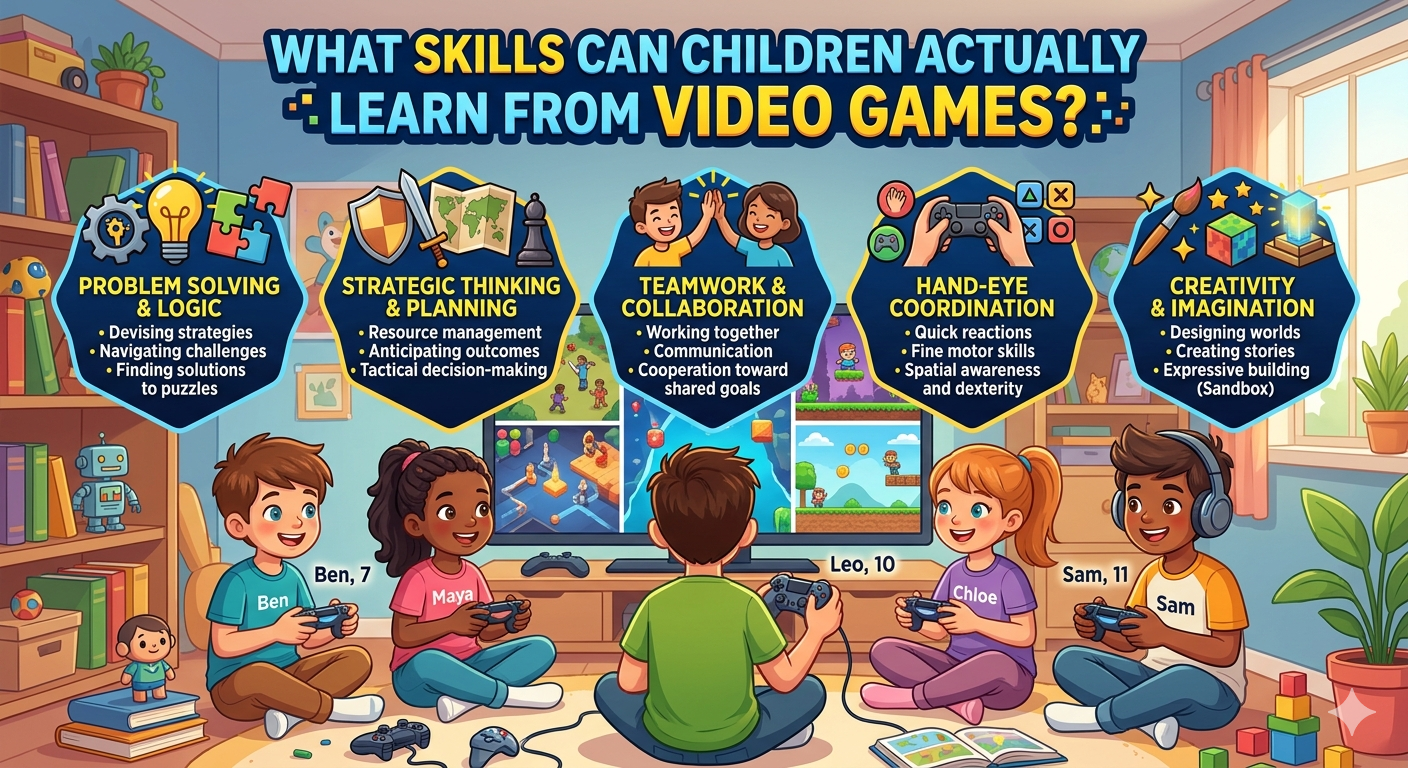
For years, video games have been trapped in a cultural tug-of-war. One side sees them as mindless entertainment that damages attention spans, ruins grades, and keeps children glued to screens. The other side celebrates gaming as the future of learning, creativity, and digital problem-solving.
The truth sits somewhere in the middle.
Video games are neither magical brain enhancers nor automatic developmental disasters. Like books, sports, or social media, their impact depends on how they are used, which games are played, and how much time children spend with them.
Research over the last decade has shown that some games can improve cognitive skills, strategic thinking, teamwork, and even emotional resilience. But many popular claims about gaming are exaggerated or misunderstood. Not every child becomes smarter from gaming, and not every game teaches meaningful life skills.
So what can children actually learn from video games?
Let’s separate the real benefits from the myths.
The Myth: “Video Games Rot the Brain”
This idea became popular in the 1990s and early 2000s when gaming was associated with violence, laziness, and social isolation. While excessive gaming can create problems, modern research paints a more nuanced picture.
Several studies have found measurable cognitive benefits linked to gaming, particularly in areas involving attention, memory, and spatial reasoning. A large study involving nearly 2,000 children found that kids who played video games performed better on tasks related to impulse control and working memory than non-gamers. (National Institutes of Health (NIH))
At the same time, researchers warn against oversimplified conclusions. Some studies show correlation rather than direct causation, and excessive gaming may still interfere with sleep, exercise, schoolwork, or emotional development. (Lifewire)
The more accurate statement is this:
Video games can strengthen certain skills under the right conditions — but they are not universally beneficial.
Skill #1: Problem-Solving and Strategic Thinking
One of the clearest benefits of many games is problem-solving.
Games constantly ask players to:
- Analyze situations
- Predict outcomes
- Test strategies
- Adapt after failure
- Manage limited resources
Strategy games, puzzle games, survival games, and sandbox games are especially strong in this area.
A child playing a game like Minecraft learns to plan, gather materials, experiment, and troubleshoot. A strategy title like StarCraft II requires rapid decision-making, prioritization, and multitasking.
Research reviews have found that many video games improve cognitive flexibility and decision-making abilities. (ScienceDirect)
Importantly, games create an environment where failure is expected rather than punished. Children repeatedly try new approaches until something works. That trial-and-error mindset mirrors real-world learning remarkably well.
This doesn’t mean games automatically produce geniuses. But they can reinforce habits associated with analytical thinking.
Skill #2: Faster Visual Processing and Attention Control
Action games have been studied extensively for their effects on visual attention.
Fast-paced games often require players to:
- Track multiple moving objects
- React quickly to changes
- Filter distractions
- Focus under pressure
Researchers have repeatedly found improvements in visual attention and processing speed among experienced gamers. (ResearchGate)
Some studies even suggest gaming can strengthen “selective attention,” the ability to focus on important information while ignoring irrelevant distractions.
This is one reason experienced gamers often excel at:
- Tracking visual details
- Monitoring dynamic environments
- Quick reaction tasks
However, there’s an important caveat:
Improved gaming attention does not automatically transfer into better classroom focus.
A child may become excellent at tracking enemies in a game while still struggling to pay attention during a math lesson. Skills transfer unevenly depending on context.
That distinction matters because gaming enthusiasts sometimes overstate the educational impact.
Skill #3: Persistence and Resilience
Good games are built around challenge.
Players fail repeatedly:
- They lose matches
- Miss jumps
- Run out of resources
- Face stronger opponents
- Repeat difficult levels
But unlike many real-world environments, games encourage retrying almost instantly.
This creates a powerful feedback loop:
- Fail
- Adjust
- Retry
- Improve
Children often develop persistence without realizing it because the process feels enjoyable.
Many games are essentially structured practice systems disguised as entertainment.
This is particularly visible in games that reward gradual mastery, such as rhythm games, platformers, or competitive multiplayer games.
The emotional lesson is subtle but important:
Improvement usually comes through repetition and adaptation.
That mindset can support growth in music, sports, academics, and creative work.
Skill #4: Collaboration and Teamwork
Multiplayer games are often criticized for exposing children to toxic online behavior — which can happen — but they also teach collaborative skills.
Many modern games require:
- Communication
- Coordination
- Shared planning
- Role specialization
- Conflict management
In cooperative games, players quickly learn that success depends on teamwork.
A child playing a team-based game may practice:
- Giving instructions
- Listening under pressure
- Supporting weaker teammates
- Negotiating strategy
These are genuine social skills.
Research has also explored how gaming can strengthen social interaction and prosocial behavior in some contexts. (SSRN)
This is especially true when:
- Parents participate
- Friends play together
- Communication remains healthy
- Competitive pressure stays balanced
Gaming becomes more beneficial socially when it is shared rather than isolated.
Skill #5: Spatial Reasoning
Spatial reasoning is the ability to mentally manipulate shapes, distances, and movement in space.
Many games constantly train this ability through:
- Navigation
- Building
- Mapping
- Rotating objects mentally
- Understanding 3D environments
Research consistently links gaming with stronger spatial abilities. (ResearchGate)
This matters because spatial reasoning supports:
- Engineering
- Architecture
- Mathematics
- Physics
- Design
- Surgery
- Robotics
Games involving construction, exploration, and navigation can provide repeated spatial practice in ways that feel intuitive and engaging.
Again, moderation matters. The skill benefits do not justify unlimited gaming.
But the idea that gaming is cognitively “empty” is clearly outdated.
Skill #6: Creativity and Experimentation
Sandbox games are often surprisingly creative.
Games like Minecraft, Roblox, or building simulators allow children to:
- Design structures
- Build systems
- Tell stories
- Experiment with mechanics
- Create virtual worlds
Some children even learn early coding logic, design principles, and digital creativity through these environments.
Research into learning through commercial video games suggests children can acquire construction and problem-solving skills through gameplay. (arXiv)
For many children, games become creative spaces rather than passive entertainment.
That distinction is important.
Watching endless short videos is psychologically different from actively designing, building, and experimenting inside interactive systems.
The Myth: “All Gaming Is Educational”
This is where gaming advocates sometimes go too far.
Not every game develops meaningful skills.
Some games are intentionally designed around:
- Endless repetition
- Addictive reward systems
- Monetization loops
- Minimal thinking
- Constant stimulation
A child can spend hours gaming without learning anything particularly valuable.
Researchers and parents alike increasingly distinguish between:
- Engaging games
- Manipulative games
Some modern games are engineered to maximize screen time rather than development.
Features like loot boxes, endless progression systems, and randomized rewards may encourage compulsive behavior instead of healthy learning habits. Discussions online frequently highlight concerns about these “addictive loops.” (Reddit)
The key question isn’t simply:
“Does the child play games?”
It’s:
“What kind of games are they playing, and how are they playing them?”
Skill #7: Emotional Regulation
Games can also teach emotional management — although not always positively.
Children experience:
- Frustration
- Competition
- Excitement
- Anxiety
- Failure
- Victory
Healthy gaming experiences can help children learn:
- Patience
- Self-control
- Recovery after setbacks
- Stress management
But poorly managed gaming can also intensify:
- Anger
- Impulsivity
- Emotional dependence
- Irritability
The difference often depends on:
- Age
- Personality
- Game design
- Household boundaries
- Time limits
- Social environment
Parents sometimes assume games themselves are the sole issue when emotional dysregulation is actually tied to lack of sleep, excessive playtime, or unrestricted online interactions.
What About Academic Skills?
This is where claims become exaggerated.
Video games are not a replacement for reading, structured education, or direct teaching.
Children generally do not become automatically better at:
- Writing
- Deep reading
- Long-term concentration
- Complex mathematics
- Scientific reasoning
Some educational games can reinforce learning, and certain games expose children to history, language, economics, or systems thinking.
But the transfer to school performance is inconsistent.
Research suggests games improve specific cognitive functions more reliably than broad academic achievement. (Springer Nature Link)
Gaming can support learning indirectly by increasing motivation, curiosity, or persistence — but it does not replace foundational education.
The Real Danger: Excessive and Unbalanced Gaming
The strongest concerns about gaming are usually connected not to gaming itself, but to imbalance.
Problems arise when gaming replaces:
- Sleep
- Exercise
- Face-to-face interaction
- Homework
- Outdoor play
- Creative hobbies
Experts consistently emphasize moderation. (The Washington Post)
Children still need:
- Physical movement
- Social development
- Offline exploration
- Unstructured play
- Family interaction
Even studies showing cognitive benefits warn against excessive use.
Healthy development requires variety.
Gaming can be part of childhood without becoming the center of it.
The Most Important Factor: Active vs Passive Engagement
One of the most overlooked distinctions is the difference between active and passive screen time.
Video games are interactive.
Children:
- Make decisions
- Solve problems
- React dynamically
- Experiment constantly
That’s very different from passively consuming endless videos or scrolling social media feeds.
Not all screen time affects the brain equally.
A strategy game demanding planning and adaptation engages the mind differently than algorithm-driven passive content.
This doesn’t mean all gaming is automatically healthy. But it does explain why researchers increasingly reject the simplistic idea that “all screen time is bad.”
So, What Skills Can Children Really Learn?
The evidence suggests children can develop:
- Problem-solving ability
- Strategic thinking
- Visual attention
- Faster processing speed
- Spatial reasoning
- Teamwork
- Persistence
- Creative experimentation
But these benefits are:
- Context-dependent
- Game-dependent
- Time-dependent
Gaming is not educational magic.
Children will not automatically become smarter, more disciplined, or socially skilled simply by playing games for hours.
The best outcomes tend to happen when:
- Games are age-appropriate
- Playtime is balanced
- Parents stay involved
- Sleep and exercise remain healthy
- Children engage with a variety of activities
In other words, video games work best as one tool within a healthy childhood — not as the entire environment.
Final Thoughts
The debate around gaming is often too extreme.
Critics sometimes ignore genuine cognitive and social benefits supported by research. Supporters sometimes exaggerate gaming into a revolutionary educational system.
Reality is more practical.
Video games are powerful interactive experiences. They can sharpen certain mental skills, encourage persistence, stimulate creativity, and create meaningful social collaboration.
But they can also consume too much time, encourage compulsive habits, and crowd out healthier activities if left unchecked.
The most useful question for parents is no longer:
“Are video games good or bad?”
It’s:
“What role should games play in a balanced life?”
That question leads to much better answers — and much healthier children.