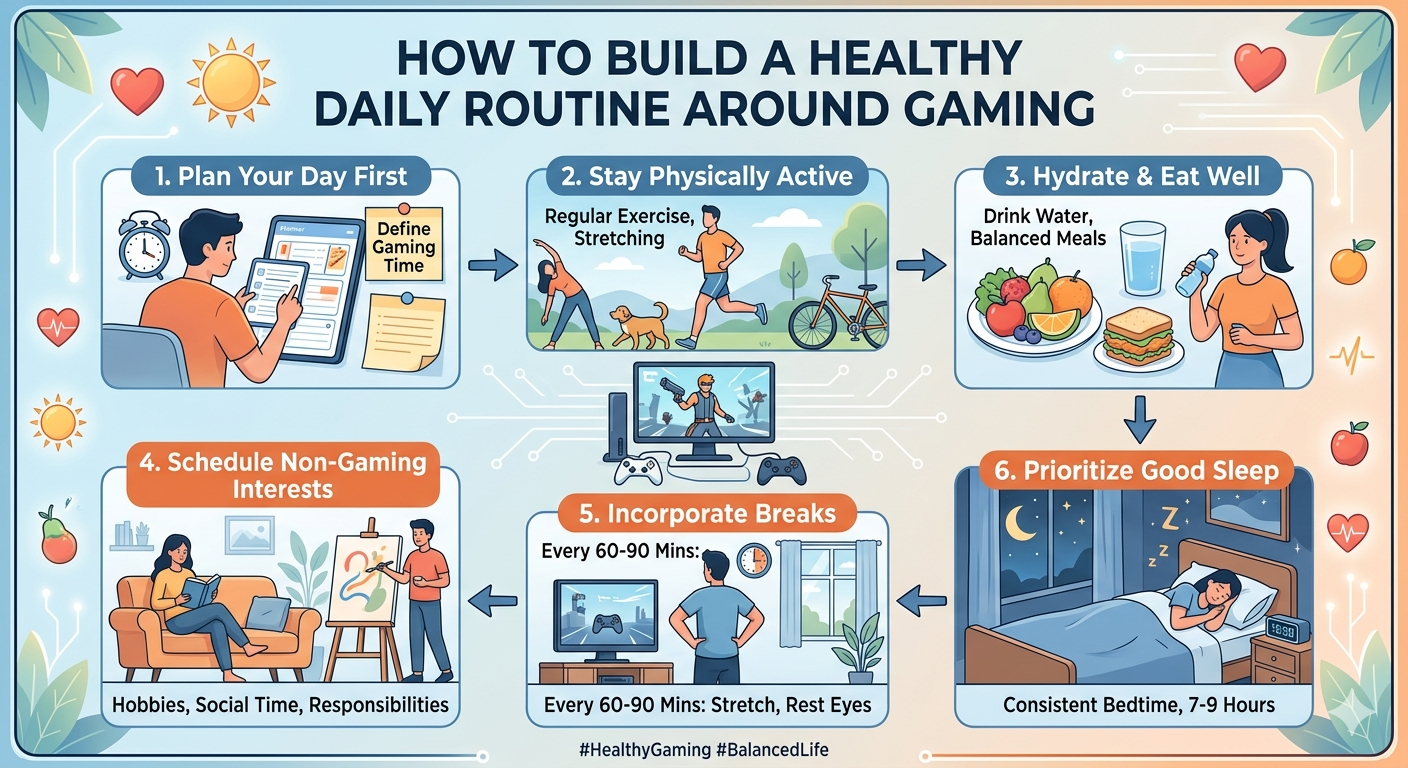
Creating Structure That Includes Gaming Without Harming School, Sleep, and Family Time
Gaming isn’t the problem. Lack of structure is.
For many children and teens, video games are one of the most enjoyable parts of the day—sometimes the most enjoyable. That’s why trying to eliminate gaming entirely usually backfires. It leads to frustration, secret playing, or constant conflict at home.
A better approach is not restriction, but structure.
A healthy routine doesn’t treat gaming as an enemy. Instead, it places gaming in the right position—alongside school, sleep, exercise, family time, and personal growth. When balanced correctly, gaming becomes a reward, a hobby, and sometimes even a social activity, rather than a disruptive force.
This guide breaks down how to build that balance in a realistic, sustainable way.
1. Start With the “Non-Negotiables” First
Before adding gaming into a daily routine, you need to lock in the essentials. These are the parts of the day that should not be negotiated:
- Sleep
- School or learning time
- Meals
- Hygiene
- Physical activity
- Family interaction
Think of these as the “foundation layer” of the day.
A common mistake is planning gaming first and fitting everything else around it. That almost always leads to late nights, skipped homework, or rushed routines.
Instead, flip the order:
Build the structure first, then place gaming inside it.
Sleep Comes First (Always)
Sleep is the most important factor in any routine involving gaming.
Gaming sessions often stretch time perception. A 30-minute match can turn into two hours without realizing it. That’s why sleep boundaries must be clear and consistent.
A strong rule for most children and teens:
- No gaming in the final 60–90 minutes before bedtime
- Devices out of the bedroom at night (if possible)
- Fixed sleep and wake times, even on weekends
Good sleep improves:
- Focus in school
- Mood stability
- Memory
- Impulse control
Ironically, kids often enjoy gaming more when they’re well-rested because frustration drops and performance improves.
2. Build the School-First Framework
Schoolwork should sit above gaming in priority order—not because gaming is “bad,” but because education requires sustained mental effort that gaming can easily disrupt if left unchecked.
A useful structure is:
- School hours (fixed)
- Homework / study time (fixed block)
- Break
- Gaming (earned time)
The key idea is simple:
Gaming happens after responsibilities, not instead of them.
This removes daily negotiation battles like “Can I play first and do homework later?”
It also builds a psychological habit: work first, reward later.
3. Use Gaming as a Scheduled Activity, Not a Constant Option
One of the biggest differences between healthy and unhealthy gaming habits is whether gaming is:
- Scheduled → controlled, predictable, balanced
- Spontaneous/free access all day → disruptive, addictive patterns
A scheduled approach might look like:
- 1–2 hours of gaming on weekdays
- 2–3 hours on weekends
- Only after homework and chores are completed
The exact timing matters less than consistency.
Children actually respond better to clear boundaries than vague ones. “You can play later” creates constant negotiation. “You can play from 5:30–6:30 PM” removes ambiguity.
4. Create a Simple Daily Routine Template
Here’s an example of a balanced structure:
Morning
- Wake up
- Breakfast
- School
Afternoon
- Return home
- Snack + rest
- Homework/study block
Evening
- Physical activity (walk, sport, outdoor play)
- Gaming session (time-limited)
- Family dinner / conversation
Night
- Relaxation (non-gaming)
- Sleep routine
The exact timing will vary depending on school schedules, but the pattern remains the same:
Responsibilities → physical activity → gaming → wind down → sleep
This order prevents gaming from taking over emotional energy or delaying rest.
5. Tie Gaming to Responsibility (But Avoid Punishment Logic)
A powerful but often misunderstood strategy is linking gaming access to responsibilities.
Examples:
- Homework completed → gaming allowed
- Chores done → gaming time unlocked
- Good behavior → weekend gaming bonus time
However, this should not become a punishment system where gaming is constantly taken away. That can make it feel like a reward that is always at risk, which increases obsession.
Instead, aim for:
Gaming as a structured privilege, not a threatened one.
This builds accountability without resentment.
6. Encourage “Quality Gaming,” Not Just More Gaming
Not all gaming experiences are equal.
Some games:
- Encourage teamwork
- Require strategy
- Promote creativity
- Support problem-solving
Others:
- Are purely repetitive
- Encourage endless scrolling or grinding
- Use manipulative reward systems
- Push constant spending or time loops
Parents don’t need to control every game—but they should understand what types of experiences children are engaging with.
A useful question is:
“Is this game engaging my child’s mind, or just consuming their time?”
7. Watch for Time Distortion (The Hidden Problem)
One of the biggest issues with gaming is not addiction itself, but time distortion.
Games are designed to:
- Remove natural stopping points
- Extend engagement through rewards
- Create “just one more match” loops
This is why kids often say:
“I didn’t realize it got so late.”
To counter this:
- Use visible timers
- Set session alarms
- Encourage breaks between matches
- Define stopping points in advance (“after two matches, stop”)
The goal is not to reduce enjoyment—it’s to restore awareness of time.
8. Protect Family Time Intentionally
If gaming is always available, it can quietly replace family interaction.
That’s why family time should be treated as a fixed part of the schedule, not an optional activity.
Examples:
- Dinner together without devices
- Evening conversation time
- Weekly family activity (walk, outing, game night)
These moments matter because they:
- Build communication skills
- Strengthen emotional bonds
- Reduce isolation
- Balance screen-based stimulation with real-world interaction
A healthy routine doesn’t just include gaming—it protects life outside gaming.
9. Balance Gaming With Physical Activity
Gaming is sedentary. That doesn’t make it harmful on its own—but it does mean it needs balance.
A strong daily routine includes:
- Outdoor play
- Sports
- Walking
- Exercise breaks
Even 30–60 minutes of movement per day makes a significant difference in:
- Mood
- Sleep quality
- Focus
- Stress levels
Without physical activity, gaming time tends to expand and energy levels become uneven—kids feel tired but restless at the same time.
10. Teach Self-Regulation, Not Just Rules
Rules work in the short term. Self-regulation works in the long term.
Instead of only saying:
“You can only play for one hour”
Also teach:
- How to stop when time is up
- How to pause without frustration
- How to recognize fatigue
- How to balance choices
Over time, the goal is for children to start managing gaming themselves—not rely entirely on external enforcement.
This is one of the most valuable life skills gaming environments can support when guided correctly.
11. Be Flexible, But Not Inconsistent
Flexibility is important. Strict routines that never adjust can break down quickly.
Examples of healthy flexibility:
- Extra gaming time on holidays
- Reduced gaming during exams
- Occasional longer sessions on weekends
But flexibility should not turn into unpredictability.
Avoid:
- “Sometimes unlimited, sometimes none”
- Changing rules based on mood
- Constant negotiation every day
Consistency creates stability. Stability reduces conflict.
12. Recognize Warning Signs Early
Even in structured routines, it’s important to notice when balance is slipping.
Possible warning signs:
- Sleep is regularly delayed
- Homework rushed or ignored
- Irritability when not gaming
- Loss of interest in offline activities
- Frequent arguments about stopping
These don’t automatically mean a serious problem—but they do signal that the routine needs adjustment.
Often, the solution is not removing gaming entirely, but:
- Reducing daily time
- Strengthening boundaries
- Improving sleep consistency
- Increasing offline activities
13. Make Gaming Social, Not Isolating
Gaming becomes healthier when it is shared.
Encourage:
- Playing with friends (in moderation)
- Cooperative games instead of constant solo grinding
- Occasional family participation in games
Social gaming can:
- Improve communication skills
- Reduce isolation
- Create shared experiences
- Make gaming less compulsive and more intentional
Isolation tends to intensify unhealthy patterns. Connection balances them.
14. Don’t Turn Gaming Into the Center of Negotiation
One of the most overlooked issues in families is that gaming becomes the main topic of conflict.
Daily arguments about time, limits, and behavior can make gaming feel more powerful than it actually is.
A better approach:
- Set rules once
- Stick to them calmly
- Avoid daily debates
- Focus on overall routine, not constant control
When gaming stops being a constant negotiation, it loses much of its emotional intensity.
15. The Real Goal: Balance, Not Elimination
A healthy gaming routine is not about cutting gaming out of life.
It’s about ensuring that gaming:
- Fits into a structured day
- Does not interfere with sleep
- Does not replace school or responsibilities
- Does not isolate children from family or physical activity
Gaming can exist comfortably in a well-designed routine. In fact, when balanced properly, it often becomes more enjoyable—not less—because it is no longer associated with stress, guilt, or conflict.
Final Thoughts
Building a healthy daily routine around gaming is not about strict control or total freedom—it’s about structure with flexibility.
Children thrive when they know:
- When they can play
- When they need to stop
- What comes first in the day
- How gaming fits into their overall life
The most successful routines are not the most restrictive ones. They are the most consistent, predictable, and balanced.
When gaming has its place—not too big, not too small—it stops being a problem and becomes what it was always meant to be:
A part of life, not the center of it.