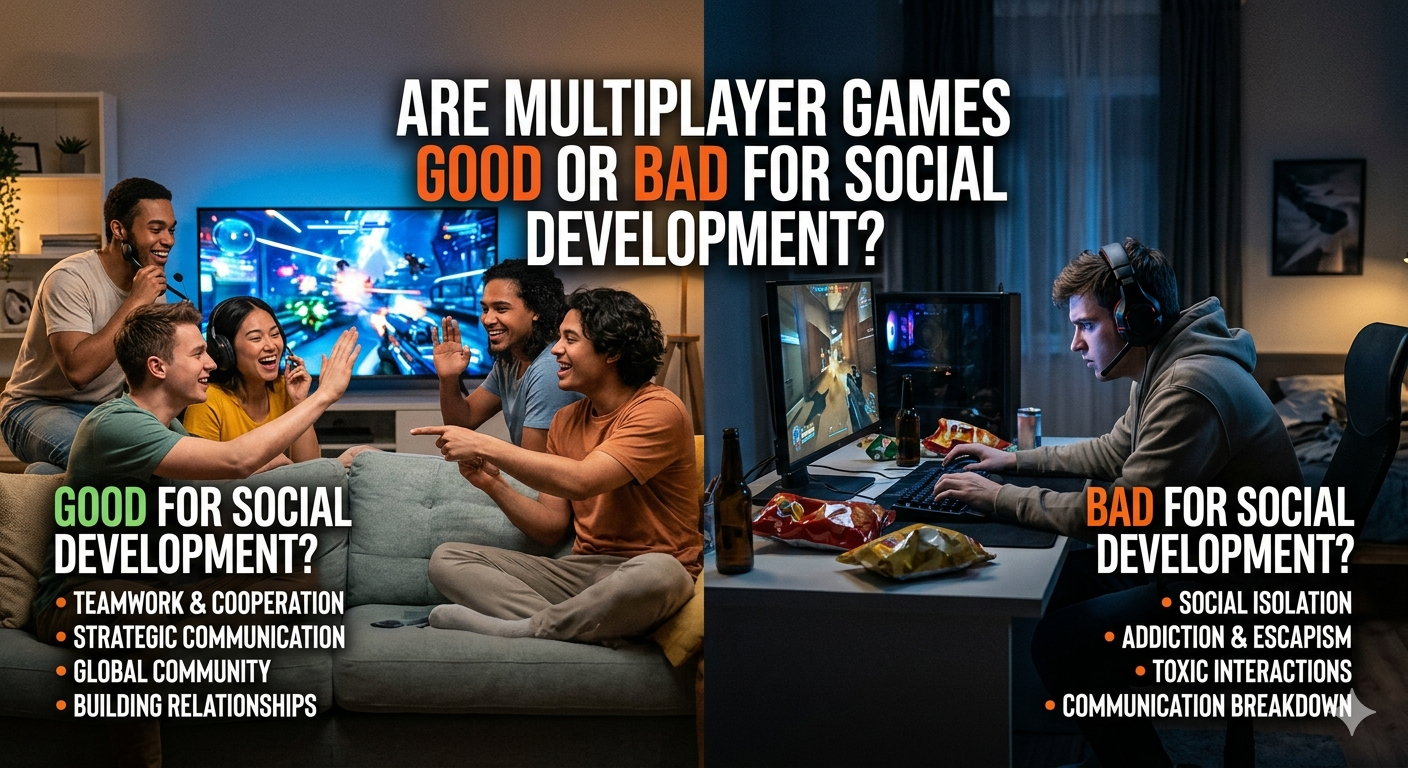
Analyzing Teamwork, Communication, and Online Risks in Multiplayer Environments
Multiplayer games sit at one of the most debated intersections in modern childhood and adolescence. For some parents and educators, they are powerful social platforms where children learn teamwork, communication, and collaboration. For others, they are unpredictable online spaces filled with toxic behavior, distraction, and exposure to unsafe interactions.
The truth is not simple—and that’s exactly why the debate keeps going.
Multiplayer games are neither inherently good nor inherently bad for social development. They are social environments, and like any social environment, their impact depends on structure, moderation, guidance, and the specific communities involved.
To understand their real influence, we need to break down what actually happens inside multiplayer spaces—and how those experiences shape social skills in both positive and negative ways.
The Core Question: What Counts as “Social Development”?
Before judging multiplayer games, it’s important to define what we mean by social development.
Social development includes skills such as:
- Communication (speaking, listening, clarity)
- Cooperation and teamwork
- Conflict resolution
- Emotional regulation in group settings
- Empathy and understanding others
- Adaptability in social situations
These skills don’t develop in isolation—they are shaped by repeated interaction with other people.
Multiplayer games are, at their core, interactive systems built around repeated social interaction. That makes them potentially powerful environments for practicing these skills.
But the quality of that practice varies dramatically.
The Positive Side: Multiplayer Games as Social Training Grounds
1. Teamwork Under Pressure
Many popular multiplayer games require coordinated teamwork to succeed. Whether it’s a strategy game, a battle arena, or a cooperative mission, players often must:
- Assign roles
- Share responsibilities
- React quickly as a group
- Adjust strategy based on team performance
This creates a real-time learning environment where children experience what it means to rely on others and be relied upon.
Unlike many offline settings, multiplayer games provide:
- Immediate feedback
- Clear consequences for poor coordination
- Constant opportunities for improvement
This repetition strengthens teamwork instincts over time.
A child who plays cooperative games regularly often becomes more comfortable with group coordination and structured collaboration.
2. Communication Skills in Real Time
In multiplayer environments, communication is not optional—it is essential.
Players must:
- Give clear instructions quickly
- Listen to teammates under pressure
- Interpret short, sometimes imperfect messages
- Adjust plans based on incoming information
This type of communication is very different from classroom or casual conversation. It is:
- Fast
- Goal-oriented
- Context-heavy
- Emotionally charged at times
These conditions help children develop practical communication skills such as clarity, brevity, and responsiveness.
Even shy or introverted players often find it easier to communicate in structured game environments because the focus is on shared goals rather than personal expression.
3. Learning Leadership and Responsibility
Multiplayer games often create informal leadership roles.
A child might:
- Organize a team strategy
- Coordinate group movement
- Assign roles based on strengths
- Make decisions during critical moments
These experiences introduce leadership in a low-risk environment.
Importantly, leadership in games is earned through performance, not age or status. This can be empowering for children who may not usually take leadership roles in school or family settings.
They learn that:
Leadership is about clarity, decision-making, and responsibility—not authority alone.
4. Exposure to Diverse Social Groups
Online multiplayer games connect players from different:
- Countries
- Cultures
- Languages
- Age groups
- Backgrounds
This exposure can broaden social awareness. Children learn that:
- People communicate differently
- Not everyone shares the same norms
- Collaboration can still work across differences
In many cases, this is one of the first times children interact with global diversity in real-time communication settings.
That exposure can improve adaptability and tolerance—if guided well.
5. Safe Practice for Social Risk-Taking
Real-world social situations often feel high-stakes for children. Fear of embarrassment or rejection can limit participation.
Multiplayer games provide a lower-pressure environment where:
- Mistakes are reversible
- New interactions are constant
- Social “reset” is easy (new match, new team)
This allows children to practice:
- Speaking up
- Asking questions
- Taking initiative
- Dealing with failure socially
In this sense, multiplayer games function as a kind of social rehearsal space.
The Other Side: Real Risks in Multiplayer Environments
While there are clear benefits, multiplayer games also introduce genuine social risks that cannot be ignored.
1. Toxic Communication and Harassment
One of the most widely documented issues in online multiplayer spaces is toxic behavior, including:
- Insults and verbal abuse
- Aggressive competition
- Exclusion or bullying
- Mocking less skilled players
Because communication is often anonymous and fast-paced, social boundaries can break down easily.
Children exposed to repeated toxicity may:
- Become desensitized to rude behavior
- Mirror aggressive communication styles
- Experience stress or frustration
- Avoid social interaction in games altogether
This is one of the strongest arguments critics raise—and it is valid in many cases.
2. Negative Peer Influence
Multiplayer environments often reward:
- Aggression
- Dominance
- Constant competition
In some communities, toxic behavior becomes normalized as “just how the game is played.”
Children may adopt:
- Harsh communication styles
- Competitive hostility
- Lack of empathy toward teammates
This doesn’t happen in every game or group—but when it does, it can strongly shape behavior.
3. Dependence on Online Validation
Multiplayer games often include ranking systems, rewards, and social recognition.
This can lead to:
- Over-reliance on in-game status
- Emotional dependence on performance outcomes
- Frustration tied to ranking or wins/losses
Children may begin to tie self-worth to in-game success, especially in highly competitive environments.
4. Communication That Doesn’t Transfer Cleanly
While multiplayer games improve certain communication skills, they do not always translate perfectly into real-world settings.
For example:
- Game communication is often task-focused, not emotional
- Conversations are short and functional
- Social nuance is reduced in fast exchanges
As a result, a child may become excellent at in-game coordination but still struggle with deeper real-life communication such as conflict resolution or emotional expression.
5. Exposure to Unsafe Interactions
Because multiplayer games connect strangers, children may encounter:
- Inappropriate language
- Manipulative behavior
- Unwanted contact
- Unsafe community spaces
This is especially concerning in open voice chat environments.
Without supervision or safety settings, these risks increase significantly.
The Key Factor: Environment Matters More Than the Game
Not all multiplayer games create the same social environment.
There are three major variables:
1. Game Design
Some games emphasize:
- Cooperation (team-based survival, strategy games)
- Competition (ranked shooters, battle arenas)
- Creativity (sandbox multiplayer environments)
The design influences how players interact socially.
2. Community Culture
Every game develops its own social culture.
Some communities are:
- Supportive and cooperative
- Highly competitive but respectful
- Toxic and aggressive
The same game can feel completely different depending on who is playing it.
3. Moderation and Safety Systems
Games with:
- Strong reporting systems
- Chat filters
- Matchmaking protections
tend to create safer environments for social interaction.
Without these systems, negative behavior spreads more easily.
Can Multiplayer Games Teach Empathy?
This is one of the most debated questions.
On one hand, multiplayer games can reduce empathy when:
- Players dehumanize opponents
- Toxic behavior becomes normalized
- Communication becomes purely competitive
On the other hand, they can increase empathy when:
- Players cooperate toward shared goals
- Teams support struggling members
- Players interact regularly with diverse individuals
Empathy development depends heavily on context.
A supportive team environment can encourage understanding and patience. A hostile environment can do the opposite.
The Role of Parents and Guidance
Parental involvement plays a major role in shaping whether multiplayer gaming is positive or negative.
Helpful approaches include:
1. Understanding the Games Being Played
Knowing:
- What the game involves
- Who the child plays with
- What communication features exist
helps identify risks early.
2. Encouraging Reflection
Simple conversations like:
- “How did your team work together today?”
- “Did anything in the game feel unfair or stressful?”
help children process social experiences rather than simply react to them.
3. Teaching Digital Boundaries
Children should learn:
- When to mute or block toxic players
- When to leave harmful environments
- How to avoid oversharing personal information
These are modern social safety skills.
4. Balancing Online and Offline Social Life
Multiplayer games should not replace real-world interaction.
Healthy development includes:
- Face-to-face friendships
- Family communication
- Physical group activities
Online and offline social skills reinforce each other when balanced properly.
So, Are Multiplayer Games Good or Bad?
The most accurate answer is:
Multiplayer games are social training environments that can strengthen or weaken social skills depending on context.
They are not inherently beneficial or harmful. Instead, they amplify the environment they create:
- Cooperative communities → teamwork and empathy improve
- Toxic communities → aggression and emotional stress increase
- Balanced use → social skills grow alongside awareness and resilience
Final Thoughts
Multiplayer games are one of the most complex social spaces children interact with today. They combine teamwork, communication, competition, and global interaction in a way few other environments do.
Used well, they can help children learn:
- Cooperation under pressure
- Clear communication
- Adaptability in diverse groups
- Leadership and responsibility
Used poorly or without guidance, they can also expose children to:
- Toxic behavior
- Emotional stress
- Poor communication habits
- Over-competition and frustration
The difference is not the game itself—it is the environment, the boundaries, and the balance.
Multiplayer gaming is neither a threat nor a miracle tool for social development. It is a digital social world.
And like any social world, it shapes children based on how they enter it, how long they stay in it, and what guidance they receive along the way.