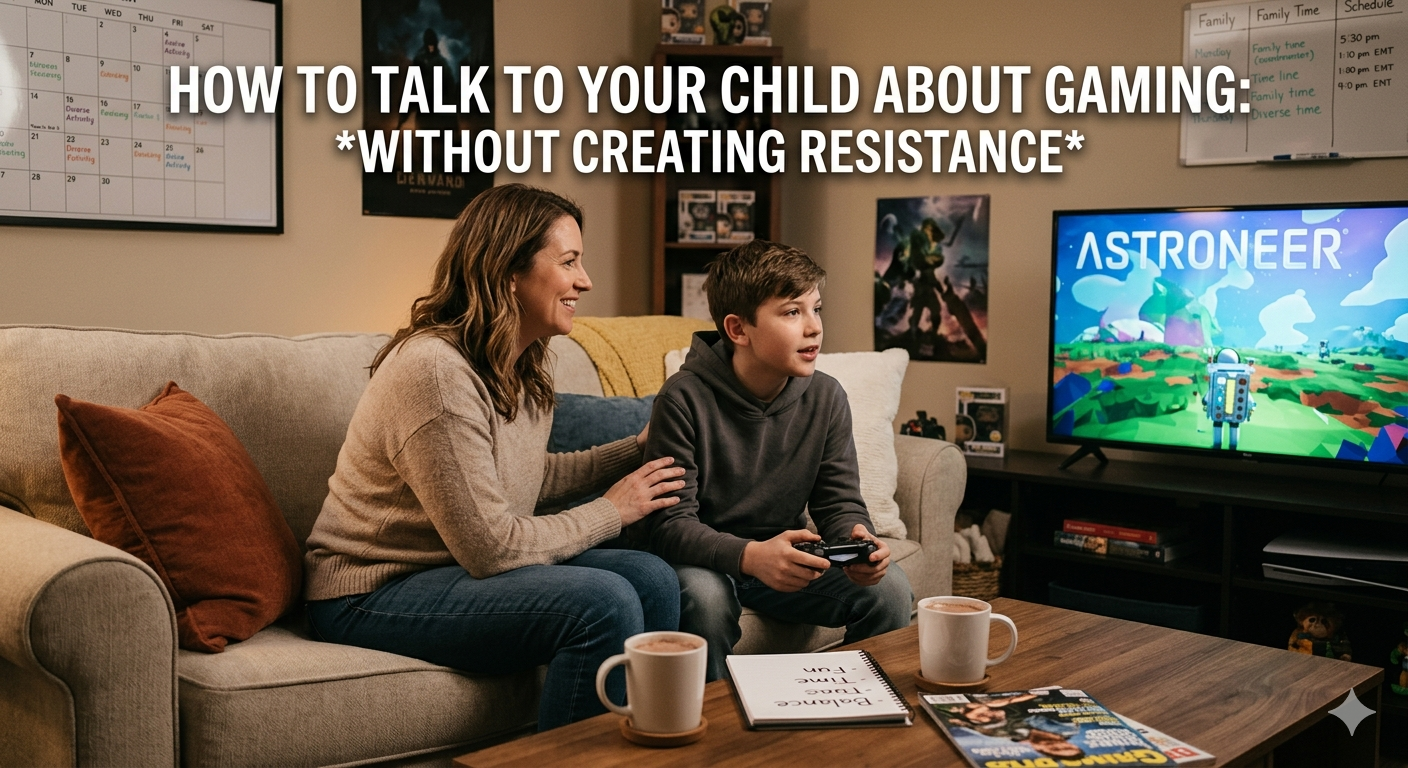
Communication strategies that build trust instead of conflict
Talking to children about gaming can feel like stepping into a minefield. One wrong comment—“You’ve been on that game too long”—and the conversation shifts from calm to conflict in seconds. On the other side, total silence doesn’t help either, because habits form without guidance or shared understanding.
The challenge isn’t gaming itself. It’s communication.
Most resistance around gaming doesn’t come from the games—it comes from how the topic is introduced, framed, and enforced at home. When children feel judged, controlled, or misunderstood, they defend their behavior. When they feel heard and involved, they are far more willing to self-regulate.
This article focuses on practical, real-world communication strategies that reduce conflict and build cooperation around gaming.
Why Conversations About Gaming Often Fail
Before improving communication, it helps to understand why these conversations go wrong so often.
1. Gaming is emotionally meaningful to children
To adults, gaming may look like entertainment. To children, it often represents:
- Social connection (friends online)
- Achievement and progress
- Stress relief
- Identity and status
- Autonomy and control
So when gaming is questioned, it can feel like a personal challenge—not just a rule discussion.
2. Parents often lead with restriction instead of understanding
Common opening lines include:
- “You play too much.”
- “Turn it off now.”
- “That game is a waste of time.”
Even if these statements are understandable, they often trigger resistance because they start with judgment, not curiosity.
3. Conversations happen during conflict moments
Most gaming discussions happen:
- When time is already up
- When homework is late
- When emotions are high
At that point, neither side is in a good state for rational discussion.
4. There is usually no shared language about gaming
If parents don’t understand:
- Game structure
- Social dynamics
- Progress systems
Then children feel misunderstood, and conversations lose credibility.
Principle #1: Start With Curiosity, Not Control
The most effective shift parents can make is simple:
Replace correction with curiosity.
Instead of:
- “Why are you still playing?”
Try:
- “What are you working on in the game right now?”
- “What makes this game fun for you?”
This does two things:
- Reduces defensiveness
- Builds understanding of the child’s perspective
When children feel genuinely heard, they are more open to listening in return.
Principle #2: Separate the Child From the Behavior
One of the biggest communication mistakes is blending identity with behavior.
Statements like:
- “You’re addicted to games”
- “You never stop playing”
- “You only care about gaming”
These create resistance because they feel like labels, not observations.
Instead, focus on specific behaviors:
- “I notice it’s been hard to stop when matches are running long.”
- “I see bedtime is getting pushed later on gaming nights.”
This keeps the conversation factual rather than emotional.
Principle #3: Choose the Right Time to Talk
Timing changes everything.
Avoid:
- Right after gaming sessions
- During arguments
- Late at night
- In rushed moments
Better times:
- After dinner
- During a walk
- During a calm activity
- Weekend downtime
A good rule:
If emotions are high, delay the conversation—not the boundary.
Principle #4: Acknowledge the Value of Gaming First
If parents only talk about limits, children hear:
“Gaming is bad.”
But if parents acknowledge benefits first, trust increases.
You might say:
- “I get why you enjoy it—it looks fun and competitive.”
- “It’s interesting how you work with your friends in that game.”
- “I can see it helps you relax after school.”
This doesn’t mean approving unlimited gaming. It means recognizing reality.
When children feel understood, they stop defending and start engaging.
Principle #5: Avoid Power Struggles Over Time
Time limits are one of the most common sources of conflict.
The problem is not the limit itself—it’s how it’s enforced.
Instead of:
- “You’re done. Now.”
Try:
- “You’ve got 15 minutes left. What would you like to finish before stopping?”
This approach:
- Gives control within boundaries
- Reduces abrupt emotional shutdown
- Builds awareness of time
It shifts the dynamic from enforcement to collaboration.
Principle #6: Make Rules Collaborative When Possible
Children resist rules they feel were imposed without input.
A more effective approach is shared planning:
- “How much gaming do you think is reasonable on school nights?”
- “What should happen first—homework or gaming?”
- “How do we make sure sleep doesn’t get affected?”
Even if final decisions rest with parents, involvement increases acceptance.
People are more likely to follow rules they helped shape.
Principle #7: Focus on Balance, Not Elimination
A major communication mistake is framing gaming as something to “reduce to zero.”
That creates:
- Defensiveness
- Secret behavior
- Emotional pushback
Instead, frame the goal as balance:
- Sleep
- School
- Friends
- Family time
- Gaming
When gaming is treated as one part of life—not the enemy—children respond more calmly.
Principle #8: Ask Better Questions
Good questions open conversation. Poor questions shut it down.
Avoid:
- “Why are you wasting time?”
- “Don’t you think you play too much?”
Try:
- “What do you like most about this game?”
- “What makes you want to keep playing after one match?”
- “How do you feel after long gaming sessions?”
These questions encourage reflection instead of defense.
Principle #9: Name the Mechanisms Without Blaming
Children often don’t realize how games are designed to keep them engaged.
Instead of saying:
- “The game is addicting you”
Try:
- “These games are designed so it’s hard to stop after one match.”
- “A lot of games give rewards that make you want to keep playing.”
This approach:
- Removes blame
- Builds awareness
- Encourages self-regulation
It turns the conversation from conflict into education.
Principle #10: Recognize Emotional States Before Discussing Rules
If a child is:
- Frustrated from losing
- Excited after winning
- Stressed from school
They are not in a good state for structured discussion.
A simple check-in helps:
- “Are you okay to talk about gaming now or later?”
This small step reduces escalation significantly.
Principle #11: Reinforce Positive Behavior Clearly
Parents often only comment when problems happen.
But reinforcement matters just as much.
Examples:
- “I noticed you stopped on time yesterday—that was responsible.”
- “You handled that loss well and took a break afterward.”
- “You balanced homework and gaming today nicely.”
This builds motivation without pressure.
Principle #12: Avoid Threat-Based Control
Threats like:
- “No gaming for a week if you don’t listen”
- “I’ll take everything away”
Often lead to:
- Secret gaming
- Resentment
- Power struggles
Instead, focus on predictable structure:
- Clear rules
- Consistent consequences
- Calm enforcement
Consistency is more effective than intensity.
Principle #13: Understand That Gaming Is Social
For many children, gaming is not solo entertainment—it is social interaction.
They may be:
- Playing with friends
- Communicating in teams
- Maintaining online relationships
So removing gaming abruptly can feel like:
Losing a social space
Recognizing this helps parents approach conversations more sensitively.
Instead of:
- “Stop playing that game”
Try:
- “How are your friends doing in the game?”
- “Who do you usually play with?”
This shifts tone from restriction to interest.
Principle #14: Teach Self-Awareness, Not Just Rules
Long-term success comes from helping children notice their own patterns.
You can guide them to reflect:
- “How do you feel after long gaming sessions?”
- “Do you notice when it becomes hard to stop?”
- “What helps you switch off easily?”
Self-awareness leads to self-regulation, which is far more effective than external control alone.
Principle #15: Accept That Conflict Will Not Disappear Completely
Even with perfect communication, some resistance is normal.
Gaming is enjoyable, immersive, and socially rewarding. Children will naturally want more of it.
The goal is not zero conflict—it is reduced intensity and faster resolution.
Healthy communication looks like:
- Short disagreements
- Calm explanations
- Predictable boundaries
- Quick emotional recovery
Not constant arguments or emotional shutdowns.
A Simple Conversation Model Parents Can Use
Here is a practical structure for difficult gaming conversations:
1. Observe (neutral)
“I’ve noticed gaming has been running later than usual.”
2. Acknowledge (empathy)
“I understand it’s fun and you enjoy playing with your friends.”
3. State concern (clear but calm)
“I’m concerned it’s affecting sleep and school focus.”
4. Invite input
“What do you think would help us balance it better?”
5. Agree on structure
“Let’s try a set stop time on school nights and see how it works.”
This keeps the tone collaborative rather than confrontational.
Final Thoughts
Talking to children about gaming is not about winning arguments or enforcing strict control. It is about building a communication environment where both sides feel heard, respected, and understood.
Resistance usually comes from:
- Feeling judged
- Feeling controlled
- Feeling misunderstood
- Lack of involvement in decisions
Trust grows when conversations shift toward:
- Curiosity instead of criticism
- Structure instead of sudden restriction
- Collaboration instead of commands
- Understanding instead of assumptions
When that shift happens, gaming stops being a battleground.
It becomes just one part of a larger conversation about balance, responsibility, and growing up in a digital world.