Video games are everywhere. From mobile puzzle apps to competitive online shooters, gaming has become one of the world’s biggest entertainment industries. For many people, games offer relaxation, creativity, social interaction, and even education. But not all games are equally valuable.
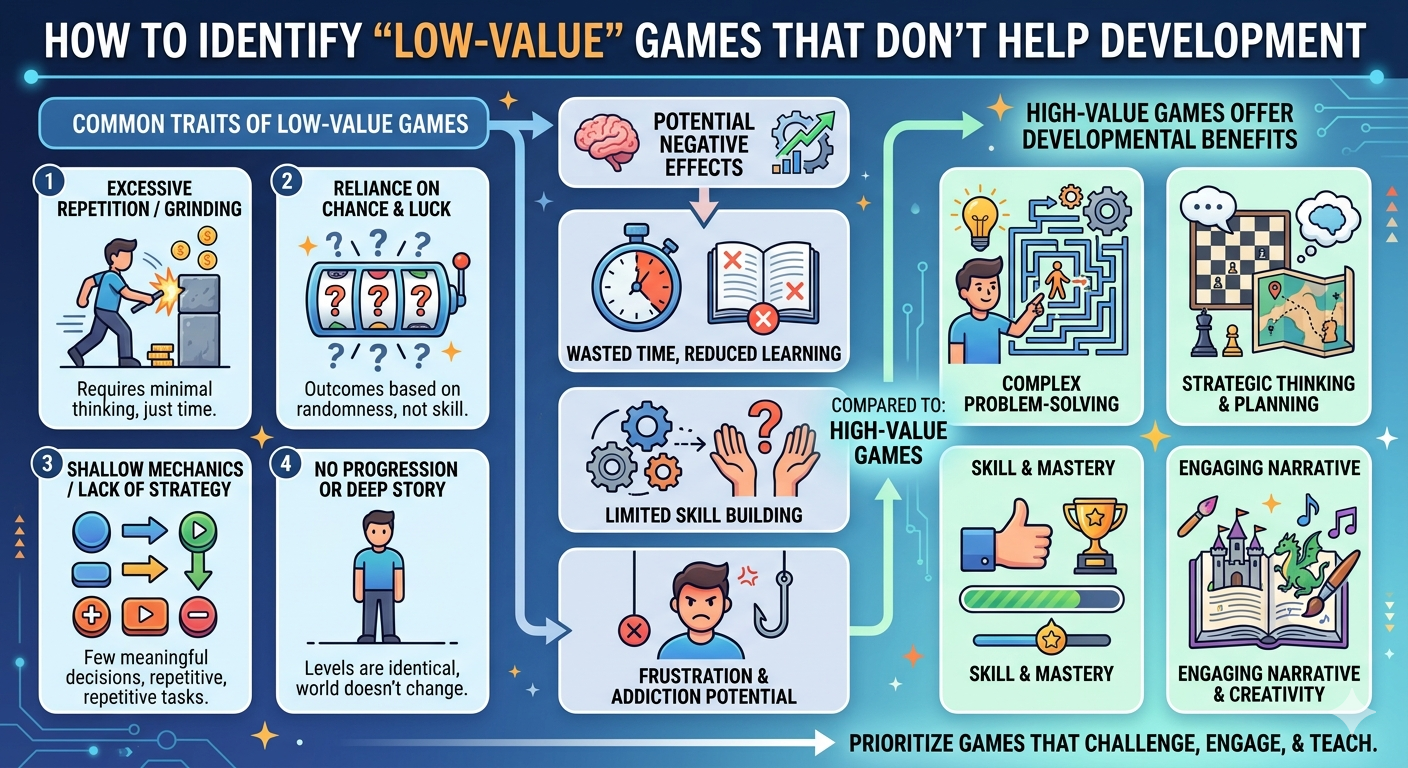
Some games sharpen strategic thinking, improve coordination, teach teamwork, or inspire creativity. Others simply consume hours without contributing much to personal growth, useful skills, or meaningful enjoyment. These are what many people call “low-value” games.
That doesn’t mean every game must be educational or productive. Entertainment has value too. The problem begins when certain games dominate your time while offering little in return — especially when they leave you feeling drained, distracted, frustrated, or stuck in repetitive habits.
Learning to identify low-value games can help you make better decisions about how you spend your time, attention, and energy.
What Makes a Game “Low-Value”?
A low-value game is not necessarily a bad game. It simply means the game provides minimal long-term benefit relative to the time invested.
These games often:
- Encourage endless repetition
- Rely heavily on addictive reward loops
- Offer little skill transfer to real life
- Minimize creativity and decision-making
- Prioritize monetization over meaningful gameplay
- Leave players mentally exhausted rather than refreshed
The key issue is imbalance. If a game absorbs large amounts of time without helping you grow, relax meaningfully, connect socially, or build useful abilities, it may fall into the low-value category for you.
The Difference Between Healthy Gaming and Time Consumption
A useful question to ask is:
“What am I gaining from this experience besides temporary stimulation?”
Healthy gaming often provides one or more of the following:
- Strategic thinking
- Social connection
- Creativity
- Problem-solving
- Stress relief
- Coordination skills
- Storytelling appreciation
- Competitive discipline
- Patience and persistence
Low-value gaming usually revolves around:
- Habitual grinding
- Mindless repetition
- Fear of missing rewards
- Endless scrolling mechanics
- Artificial progression systems
- Short dopamine spikes without satisfaction
After healthy gaming, players often feel fulfilled or refreshed.
After low-value gaming, players frequently feel:
- Guilty
- Empty
- Tired
- Irritable
- Unproductive
- Mentally scattered
That emotional aftermath matters.
Warning Sign #1: The Game Relies on Endless Grinding
Grinding refers to repetitive actions performed mainly to unlock rewards, levels, currency, or upgrades.
Examples include:
- Repeating identical missions
- Farming digital currency
- Completing repetitive daily tasks
- Clicking through repetitive gameplay loops
Grinding becomes low-value when:
- The activity itself is not enjoyable
- Progress is artificially slowed
- Rewards are stretched to keep players engaged longer
- You continue only because you already invested time
Some repetition exists in many good games. The problem is when repetition replaces meaningful gameplay entirely.
Ask yourself:
- Would I still play if there were no rewards attached?
- Am I enjoying the process or only chasing progression?
If progression is the only motivation, the game may be exploiting your psychology more than entertaining you.
Warning Sign #2: You Feel Compelled to Log In Daily
Many modern games use “daily reward” systems.
These systems create pressure through:
- Login bonuses
- Limited-time events
- Daily streaks
- Exclusive timed rewards
The goal is simple: build habit dependency.
A game becomes low-value when it starts feeling like an obligation instead of entertainment.
If missing one day creates anxiety or fear of “falling behind,” the game may be manipulating behavioral patterns rather than providing genuine enjoyment.
Healthy games invite you back because they are enjoyable.
Low-value games pressure you back because they weaponize scarcity and habit loops.
Warning Sign #3: The Gameplay Requires Minimal Thinking
Some games offer meaningful challenges that encourage:
- Adaptation
- Planning
- Creativity
- Tactical decision-making
Others rely almost entirely on automatic routines.
If most gameplay involves:
- Repetitive tapping
- Idle waiting
- Following obvious instructions
- Automatic combat
- Predictable outcomes
…then the game may not be stimulating your brain in any meaningful way.
Passive engagement can become mentally numbing over time.
A useful game typically demands at least one of these:
- Learning
- Adaptation
- Experimentation
- Reflection
- Strategic adjustment
Without those elements, the experience can become pure consumption.
Warning Sign #4: The Game Prioritizes Monetization Over Design
Many low-value games are designed around extracting money rather than creating memorable experiences.
Common signs include:
- Constant pop-up offers
- Artificial waiting timers
- Pay-to-win systems
- Aggressive microtransactions
- Premium currencies
- Excessive advertisements
These systems intentionally create frustration to encourage spending.
The gameplay itself becomes secondary.
A strong game design asks:
“How can we make this fun?”
A manipulative design asks:
“How can we maximize engagement and spending?”
When monetization dominates the experience, player development usually becomes irrelevant.
Warning Sign #5: You Rarely Remember the Experience
Think about your gaming sessions from the past week.
Can you clearly remember:
- Exciting moments?
- Clever strategies?
- Emotional stories?
- Meaningful interactions?
Or does everything blur together?
Low-value games often create forgettable experiences because the gameplay loop lacks depth or novelty.
Hours disappear without memorable moments.
High-quality games often create:
- Stories worth discussing
- Skills worth mastering
- Challenges worth remembering
Low-value games create mostly time consumption.
Warning Sign #6: The Game Creates More Frustration Than Satisfaction
Challenge itself is not bad. Difficult games can build patience, resilience, and strategic thinking.
But some games intentionally create frustration to increase engagement.
This includes:
- Artificial difficulty spikes
- Unfair matchmaking
- Randomized rewards
- Progress blockers
- Manipulative ranking systems
Players keep chasing the next win or reward while experiencing constant stress.
If you regularly finish gaming sessions angry, emotionally drained, or mentally exhausted, it may be worth reconsidering the value of that experience.
Entertainment should not consistently damage your mood.
Warning Sign #7: The Game Replaces Better Activities
One of the clearest indicators of low-value gaming is opportunity cost.
Ask yourself:
“What activities is this replacing?”
Gaming becomes problematic when it consistently replaces:
- Exercise
- Learning
- Sleep
- Social relationships
- Career development
- Creative hobbies
- Reading
- Real-world experiences
Even enjoyable games can become low-value if they dominate your schedule to the point that personal growth suffers.
Time is limited. Every hour spent gaming is an hour not spent elsewhere.
That doesn’t mean gaming is bad. It means balance matters.
The Psychology Behind Low-Value Games
Many low-value games are carefully engineered around behavioral psychology.
Common techniques include:
Variable Rewards
Players receive unpredictable rewards, similar to slot machines. This unpredictability increases compulsive engagement.
Artificial Scarcity
Limited-time items create urgency and fear of missing out.
Progression Addiction
Bars, ranks, levels, and achievements create constant pressure to continue.
Social Pressure
Guild systems, competitive rankings, and online expectations make players feel obligated to stay active.
Endless Objectives
The game always introduces another goal before satisfaction fully arrives.
These systems are effective because they target dopamine-driven behavior loops.
The result is often high engagement but low fulfillment.
Not All “Fun” Games Are Developmental
A common mistake is assuming that because a game is enjoyable, it must be valuable.
Enjoyment alone is not the issue.
The better question is:
“Does this game improve my life in some way — even temporarily?”
A game can provide value through:
- Relaxation
- Creativity
- Social bonding
- Emotional storytelling
- Stress reduction
But some games deliver only stimulation without meaningful recovery or enrichment.
After several hours, you may feel neither rested nor accomplished.
That’s a sign the game may be low-value for your current goals.
High-Value vs Low-Value Gaming
Here’s a practical comparison.
| High-Value Gaming | Low-Value Gaming |
|---|---|
| Encourages thinking | Encourages repetition |
| Builds strategy | Builds dependency |
| Feels meaningful | Feels compulsive |
| Supports creativity | Minimizes creativity |
| Creates memorable experiences | Feels forgettable |
| Respects player time | Consumes endless time |
| Motivates learning | Motivates grinding |
| Ends with satisfaction | Ends with exhaustion |
Again, this distinction is personal. A game that is valuable for one person may be low-value for another depending on goals and habits.
Questions to Evaluate Any Game
Before investing heavily in a game, ask yourself:
1. What skills does this develop?
Possible answers:
- Strategic thinking
- Reflexes
- Teamwork
- Creativity
- Problem-solving
If the answer is “none,” reconsider the time investment.
2. Would I still play without rewards?
If not, the reward system may be the primary attraction.
3. How do I feel afterward?
- Refreshed?
- Inspired?
- Relaxed?
- Drained?
- Irritated?
- Empty?
Your emotional state reveals a lot.
4. Am I choosing this intentionally?
Or are you opening the game automatically out of habit?
5. Is this helping or hurting my broader goals?
Gaming should fit into your life — not consume it.
Why Young People Are Especially Vulnerable
Children and teenagers are particularly susceptible to low-value games because:
- Their impulse control is still developing
- Reward systems affect them more strongly
- Social pressure is highly influential
- They may struggle with time management
Many games intentionally target younger audiences with:
- Bright reward systems
- Fast progression
- Social competition
- Cosmetic unlocks
- Constant notifications
Parents and educators should focus not only on screen time, but also on screen quality.
Two hours spent building creative projects differs greatly from two hours spent endlessly grinding repetitive rewards.
The Role of Mobile Gaming
Mobile gaming deserves special attention because many mobile games are designed around:
- Short attention spans
- Habit loops
- Frequent monetization
- Constant engagement triggers
Not all mobile games are harmful, but the platform heavily encourages low-value design patterns.
Because phones are always nearby, these games can quietly consume fragmented moments throughout the day:
- Waiting in line
- During meals
- Before sleep
- During study breaks
This constant interruption weakens focus and attention over time.
How to Shift Toward Higher-Value Gaming
You do not necessarily need to quit gaming entirely.
Instead, focus on intentional gaming.
Choose Games With Depth
Look for games that encourage:
- Strategy
- Creativity
- Exploration
- Problem-solving
Set Time Boundaries
Avoid endless sessions driven by automatic habit.
Prioritize Social and Creative Experiences
Games with meaningful teamwork or creative expression often provide more lasting value.
Avoid Manipulative Systems
Be cautious around:
- Excessive microtransactions
- Daily streak pressure
- Endless grinding mechanics
Pay Attention to Emotional Outcomes
Your mood after gaming matters more than your mood during gaming.
Entertainment Should Add Value to Life
Not every hobby must produce measurable productivity. Rest matters. Fun matters. Leisure matters.
But there is a major difference between:
- Intentional entertainment
and - Endless consumption
Low-value games often blur that line by keeping players occupied without providing meaningful enjoyment, growth, or recovery.
The goal is not to eliminate gaming.
The goal is to become conscious of how certain games influence:
- Your focus
- Your habits
- Your mood
- Your goals
- Your time
When you recognize the patterns behind low-value gaming, you gain the ability to make more intentional choices.
Final Thoughts
Games are powerful tools. At their best, they inspire creativity, teach persistence, strengthen friendships, and provide unforgettable experiences. At their worst, they become carefully engineered attention traps that absorb time while offering little in return.
Identifying low-value games requires honesty.
Ask yourself:
- Am I truly enjoying this?
- Is this helping me grow, connect, or recover?
- Or am I simply chasing rewards out of habit?
The answer may change how you spend hundreds of hours each year.
The most valuable games are not necessarily the most popular, competitive, or addictive. They are the ones that respect your time, enrich your experience, and leave you better than before you started playing.