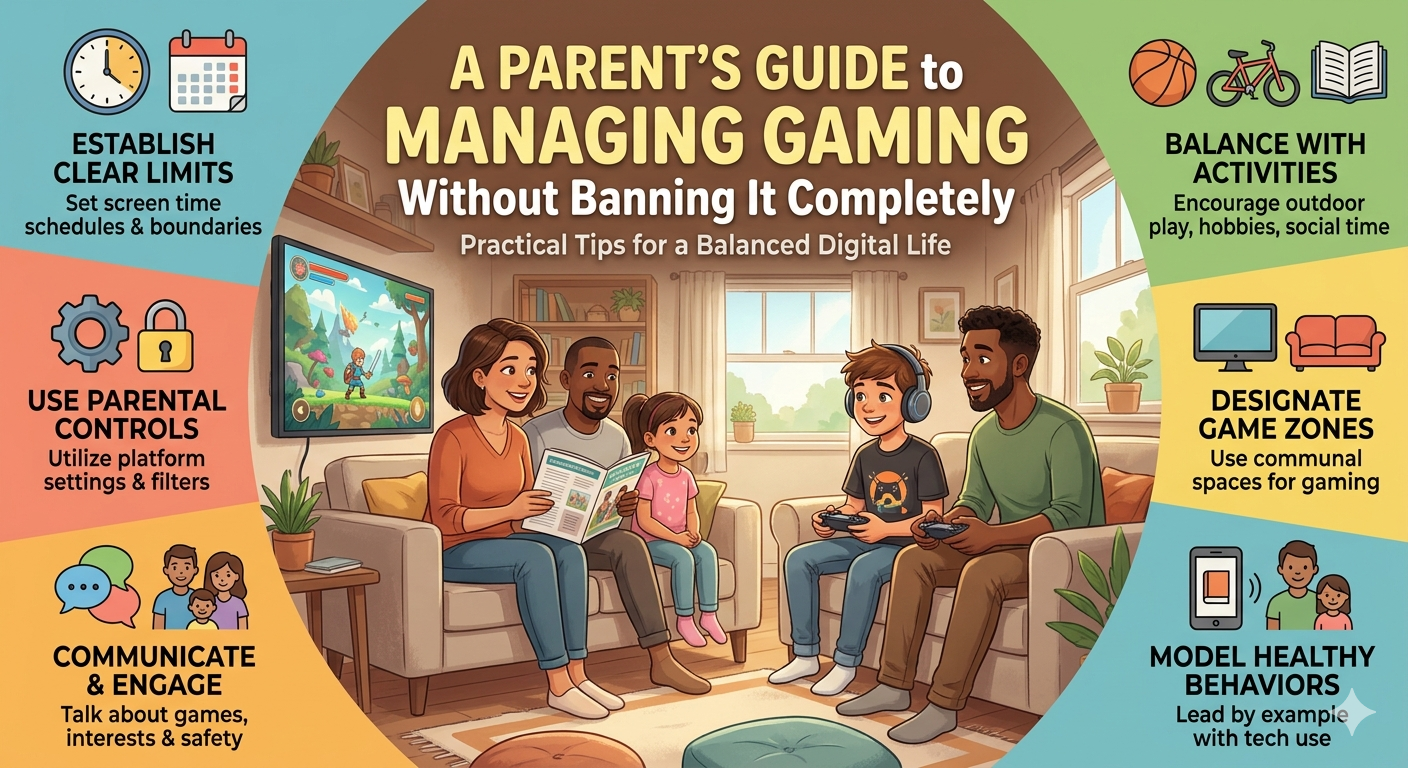
For many parents, video games feel like a constant battle. One moment gaming seems harmless and entertaining, and the next it appears to consume a child’s entire attention span. Homework gets delayed, sleep schedules shift, family conversations shrink, and frustration grows on both sides.
As a result, many parents consider extreme solutions:
- Total gaming bans
- Confiscating devices permanently
- Strict punishments
- Zero-screen policies
While these approaches may work temporarily, they often create resistance, secrecy, resentment, and unhealthy relationships with technology.
The modern reality is simple: gaming is now a major part of childhood, social interaction, entertainment, and digital culture. Most children will play games in some form. The goal is not to eliminate gaming entirely, but to teach balance, discipline, and healthy habits.
The healthiest long-term approach is not complete restriction. It is guided management.
Parents who focus on balance rather than extremes are more likely to raise children who can regulate themselves responsibly — even when no one is watching.
This guide explains how parents can manage gaming in a practical, sustainable way without turning the home into a constant conflict zone.
Why Banning Games Completely Usually Backfires
Many parents ban games because they are scared:
- Scared of addiction
- Scared of academic decline
- Scared of isolation
- Scared of inappropriate content
- Scared of wasted time
Those concerns are understandable. Gaming can become unhealthy when left unmanaged.
But total bans often create unintended consequences.
1. Gaming Becomes More Desirable
The more forbidden something becomes, the more emotionally powerful it often feels.
Children may:
- Obsess over games even more
- Sneak gaming secretly
- Watch gaming content online instead
- Play excessively outside the home
Instead of learning moderation, they learn concealment.
2. Children Miss Opportunities to Learn Self-Control
A child who never learns to regulate gaming may struggle later when full freedom eventually arrives.
Self-discipline develops through practice.
Children need opportunities to:
- Make choices
- Manage limits
- Experience consequences
- Learn balance gradually
A controlled environment teaches healthier long-term habits than complete prohibition.
3. Gaming Is Social Now
For many children and teenagers, gaming is not just entertainment.
It is:
- Friendship
- Social bonding
- Teamwork
- Shared culture
- Communication
Completely removing gaming can unintentionally isolate children from peer groups and conversations.
The goal should be healthy participation, not social exclusion.
The Real Problem Is Usually Not Gaming Alone
In many homes, gaming becomes the visible symptom of deeper issues:
- Lack of structure
- Emotional stress
- Poor routines
- Boredom
- Social struggles
- Academic frustration
- Limited offline activities
Sometimes children use games as:
- Escape
- Stress relief
- Social connection
- Achievement replacement
Punishing gaming without understanding why the child is overusing it often fails.
Parents should ask:
“What role is gaming playing in my child’s life?”
That question matters more than raw screen-time numbers alone.
Start With Understanding, Not Immediate Control
Many children feel that adults criticize gaming without trying to understand it.
That creates defensiveness immediately.
Before setting rules, parents should learn:
- What games their child plays
- Why those games are enjoyable
- Who they play with
- What motivates them
- How the games work
You do not need to become a gamer yourself.
But basic curiosity changes the conversation dramatically.
Instead of:
“Games are ruining your brain.”
Try:
“What do you enjoy most about this game?”
That shift builds trust.
Children are more willing to cooperate when they feel respected rather than attacked.
Separate Healthy Gaming From Problematic Gaming
Not all gaming is equal.
Some games encourage:
- Creativity
- Teamwork
- Problem-solving
- Strategy
- Communication
Others rely heavily on:
- Endless grinding
- Addictive reward systems
- Aggressive monetization
- Constant engagement loops
Parents should evaluate:
- How the child behaves after gaming
- Whether responsibilities are maintained
- Whether sleep is affected
- Whether mood changes significantly
- Whether gaming dominates life completely
Gaming becomes unhealthy when it consistently harms:
- Education
- Physical health
- Relationships
- Emotional stability
- Sleep
- Daily functioning
The issue is not simply the existence of games.
It is imbalance.
Focus on Routines Instead of Constant Policing
One of the biggest mistakes parents make is turning gaming into a daily argument.
Constant monitoring creates exhaustion for everyone.
Instead, create predictable routines.
For example:
- Homework before gaming
- Gaming only after responsibilities are completed
- No gaming during meals
- Device-free bedtime
- Time limits on school nights
Consistency matters more than harshness.
Children adapt better to stable expectations than emotional enforcement.
A calm system works better than constant conflict.
Use Gaming as Part of Balance, Not the Center of Life
Gaming becomes unhealthy when it crowds out everything else.
Children need multiple sources of fulfillment, including:
- Sports
- Reading
- Outdoor play
- Creative hobbies
- Family interaction
- Social activities
- Exercise
- Skill-building
If gaming becomes the only enjoyable activity, dependency increases.
Parents should actively help children discover:
- Interests
- talents
- hobbies
- goals outside gaming
Balance is easier when life itself is balanced.
Set Clear Time Boundaries
Children generally struggle with self-regulation because their brains are still developing.
That is normal.
Healthy limits are important.
The key is setting realistic boundaries instead of impossible restrictions.
Examples:
- 1–2 hours on school nights
- Longer sessions on weekends
- Scheduled gaming windows
- Breaks every hour
- No gaming before school responsibilities
Avoid vague rules like:
“Don’t play too much.”
Children need clarity.
Specific expectations reduce conflict.
Avoid Using Games as Constant Punishment or Reward
Many families accidentally make gaming emotionally unhealthy by tying it to everything.
Examples:
- “If you behave, you earn gaming.”
- “If you fail once, gaming disappears.”
- “Gaming is the only reward available.”
This can increase emotional attachment to games even further.
Gaming becomes psychologically elevated instead of normalized.
Instead, treat gaming as:
- One activity among many
- A privilege connected to responsibility
- A normal part of leisure time
Not a magical prize or emotional weapon.
Watch for Emotional Warning Signs
Healthy gamers can stop playing and return to normal life relatively smoothly.
Problematic patterns often include:
- Extreme anger when interrupted
- Emotional withdrawal
- Loss of interest in everything else
- Sleep disruption
- Declining grades
- Social isolation
- Constant irritability
- Secretive behavior
The emotional reaction surrounding gaming often reveals more than total hours played.
Parents should focus on behavioral patterns, not panic over every gaming session.
Create Tech-Free Zones in the Home
Boundaries become easier when they are built into the environment.
Helpful examples include:
- No devices at dinner
- No gaming devices in bedrooms overnight
- Family activity times
- Device-free mornings
- Shared gaming spaces instead of isolated rooms
These limits reduce unhealthy immersion naturally without requiring constant confrontation.
Environment shapes behavior more than lectures do.
Sleep Should Be Non-Negotiable
One of gaming’s biggest dangers for children is sleep disruption.
Late-night gaming affects:
- Focus
- Emotional regulation
- Memory
- School performance
- Physical health
Many children lose track of time while gaming because games are intentionally immersive.
Parents should prioritize:
- Consistent bedtime schedules
- Device shutdown times
- Charging devices outside bedrooms
- Reduced stimulation before sleep
A tired child struggles with self-control in every area of life.
Sleep is foundational.
Teach Self-Awareness Instead of Only Enforcing Rules
The ultimate goal is not parental control forever.
The goal is internal discipline.
Children should gradually learn to ask themselves:
- How do I feel after gaming?
- Am I neglecting responsibilities?
- Is this helping me relax or stressing me out?
- Am I gaming intentionally or automatically?
These conversations help children develop self-awareness instead of blind obedience.
Long-term success comes from internal regulation.
Be Careful With Your Own Technology Habits
Children notice adult behavior more than adult lectures.
If parents constantly:
- Scroll phones
- Watch television endlessly
- Use devices during conversations
- Ignore family interaction
…then anti-gaming lectures lose credibility.
Healthy technology culture starts with the entire household.
Children respond better when expectations feel shared rather than one-sided.
Encourage Social Gaming Over Isolated Gaming
Not all gaming experiences are equally harmful.
Games played with:
- Friends
- Siblings
- Parents
- Teammates
…can create social interaction and bonding.
Completely isolated gaming for endless hours tends to become more concerning.
Parents can improve gaming quality by:
- Playing occasionally with children
- Asking about online friendships
- Encouraging cooperative games
- Monitoring online safety respectfully
Engagement works better than total detachment.
Understand the Difference Between Passion and Addiction
Some children become deeply passionate about games.
That alone does not mean addiction.
A child may simply:
- Love competition
- Enjoy strategy
- Appreciate storytelling
- Enjoy social interaction
- Be highly enthusiastic
Gaming becomes problematic when the child loses balance and functionality.
Ask:
- Are responsibilities still being handled?
- Is physical health stable?
- Are relationships healthy?
- Can the child stop when necessary?
Intensity alone is not always danger.
Teach Digital Literacy Early
Children should understand how modern games are designed.
Parents can explain:
- Microtransactions
- Reward loops
- Advertising tactics
- Daily streak systems
- Fear-of-missing-out mechanics
This helps children recognize manipulation instead of passively absorbing it.
Digital literacy is now as important as traditional literacy.
Children who understand game psychology are often better equipped to manage it responsibly.
Replace Conflict With Collaboration
Instead of imposing every rule unilaterally, involve children in discussions.
Ask:
- What gaming schedule feels fair?
- What responsibilities should come first?
- What happens if balance slips?
Children are more likely to respect rules they helped create.
Collaboration also teaches accountability.
The goal is not domination.
It is guidance.
Avoid Turning Every Conversation Into Criticism
If every interaction about gaming becomes negative, communication breaks down.
Children stop listening.
Parents should also acknowledge:
- Positive behavior
- Good balance
- Responsible decisions
- Honest communication
Recognition matters.
Children who feel trusted often behave more responsibly than children who feel constantly controlled.
When Professional Help May Be Needed
Sometimes gaming problems become severe enough to require outside support.
Warning signs include:
- Severe emotional distress
- Major academic decline
- Extreme isolation
- Aggression
- Inability to stop gaming despite serious consequences
- Significant sleep deprivation
- Neglect of hygiene or health
In these situations, underlying issues such as anxiety, depression, ADHD, or social difficulties may also be involved.
Professional guidance can help families rebuild healthier patterns without shame or panic.
The Goal Is Balance, Not Perfection
No family manages technology perfectly.
Children will sometimes overplay.
Parents will sometimes overreact.
Rules will occasionally fail.
That is normal.
The objective is not to create a completely screen-free childhood.
The objective is to help children develop:
- Balance
- Self-control
- Awareness
- Responsibility
- Healthy routines
Gaming itself is not the enemy.
Lack of balance is.
Building a Sustainable Family Gaming Culture
The healthiest homes usually avoid both extremes:
- Unlimited unrestricted gaming
and - Total prohibition
Instead, they create:
- Structure
- Communication
- Consistency
- Shared expectations
- Flexibility
- Trust
When children learn moderation early, they are better prepared for adulthood in a digital world filled with distractions.
That lesson extends far beyond gaming.
It teaches:
- Time management
- Emotional regulation
- Decision-making
- Self-discipline
Those skills matter for life.
Final Thoughts
Gaming is now part of modern childhood. Trying to erase it completely is rarely realistic or sustainable. The better path is teaching children how to engage with games responsibly while maintaining healthy priorities.
Parents do not need to choose between total freedom and total control.
There is a middle ground:
- Clear boundaries
- Open communication
- Balanced routines
- Respectful guidance
- Shared responsibility
Children who learn moderation are far more likely to develop healthy long-term relationships with technology than children raised under constant extremes.
The ultimate goal is not simply reducing screen time.
It is helping children build lives where gaming has a healthy place — but never becomes the entire foundation of their identity, happiness, or daily routine.