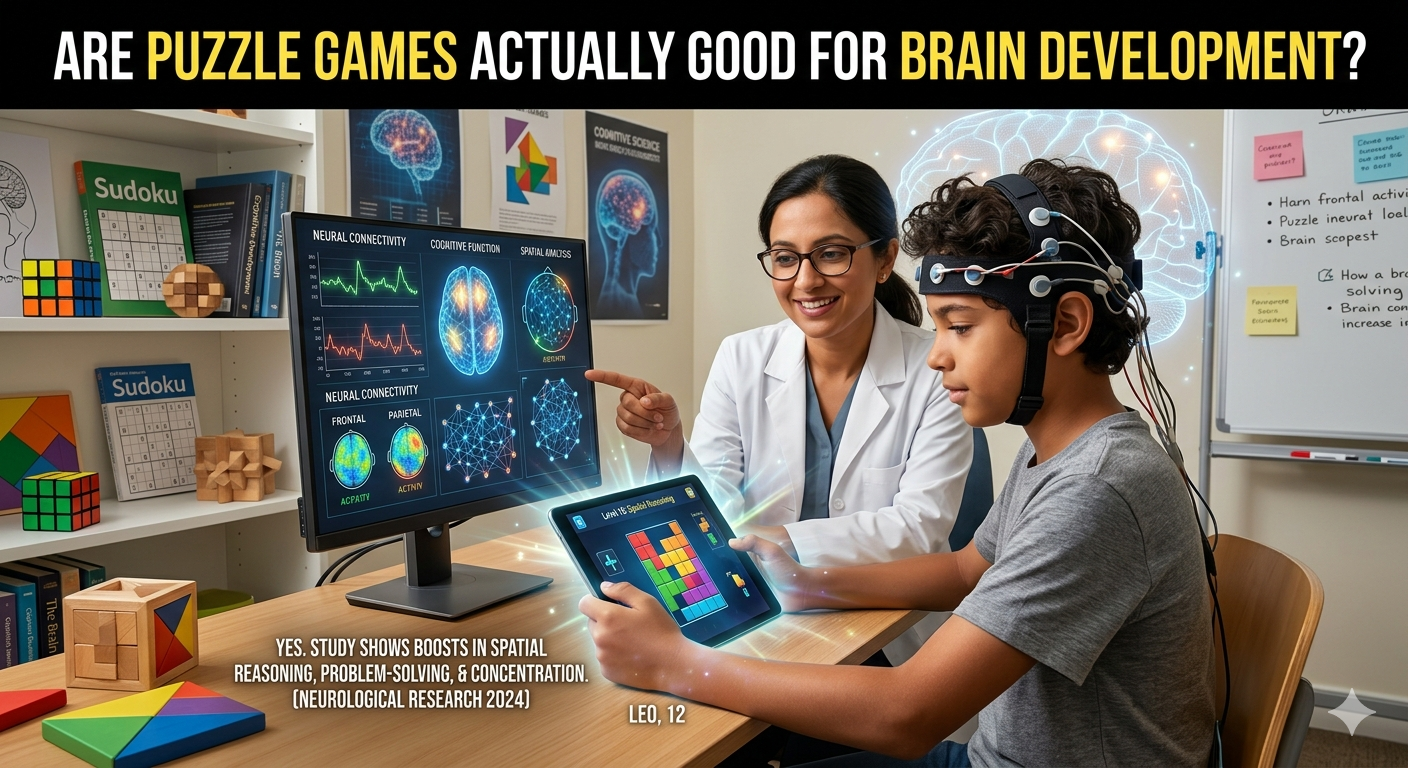
For decades, puzzle games have carried a reputation as “brain boosters.” Parents encourage children to solve Sudoku puzzles, adults play Minesweeper during breaks, and millions download logic apps promising sharper memory and faster thinking. But are these games genuinely improving brain development, or are they simply entertaining ways to pass time?
The answer is more nuanced than most marketing slogans suggest.
Research shows that puzzle games can strengthen certain cognitive skills, especially attention, working memory, logical reasoning, and problem-solving. However, they are not magic tools that instantly raise intelligence or prevent cognitive decline on their own. Their benefits tend to be specific, gradual, and closely tied to how consistently and thoughtfully they are used. (Frontiers)
Games like Sudoku, Minesweeper, crosswords, chess apps, and mobile logic challenges engage the brain in ways that resemble mental exercise. Just like physical workouts strengthen muscles through repeated challenge, puzzle games stimulate neural pathways through repeated problem-solving.
Still, science also warns against exaggerating their effects. Becoming better at Sudoku does not automatically make someone smarter in every area of life. Instead, puzzle games appear to improve the specific mental abilities they repeatedly train. (Real Simple)
So what exactly do puzzle games improve? Which games are most effective? And where do the myths end and the real cognitive benefits begin?
Let’s examine what the evidence actually says.
Why Puzzle Games Affect the Brain
The human brain is built around adaptation. Neuroscientists call this neuroplasticity — the brain’s ability to reorganize itself by forming new neural connections throughout life.
When someone solves a puzzle repeatedly, the brain strengthens networks involved in:
- Attention
- Pattern recognition
- Logical reasoning
- Memory recall
- Decision-making
- Spatial awareness
This is similar to practicing a musical instrument. The more a specific mental process is used, the more efficient the related neural pathways become.
Research on puzzle-based cognitive activities shows consistent activation in areas of the brain responsible for executive function and working memory. (Frontiers)
For example, Sudoku-solving studies found increased activity in frontoparietal brain networks associated with cognitive control, reasoning, and memory processing. (Frontiers)
That does not mean puzzle games transform the brain overnight. But it does mean they provide structured mental stimulation — something the brain benefits from across all ages.
The Real Cognitive Skills Puzzle Games Can Improve
1. Working Memory
Working memory is the brain’s ability to temporarily hold and manipulate information.
When solving Sudoku, players constantly track possible number placements while remembering previous moves. In Minesweeper, players hold multiple logical possibilities in mind simultaneously.
This repeated mental juggling strengthens short-term information management.
Research consistently links puzzle-solving with better working memory performance, especially in adults and older populations. (Frontiers)
2. Attention and Concentration
Puzzle games reward sustained focus.
Unlike fast-action games filled with sensory overload, logic games often require careful concentration over long periods. Missing one detail can ruin the entire solution.
Games like Minesweeper particularly train selective attention because players must monitor multiple clues at once while avoiding distractions.
Over time, this can improve mental endurance and task persistence.
3. Pattern Recognition
Many puzzle games revolve around identifying hidden relationships.
Sudoku teaches players to recognize numerical patterns and elimination strategies. Logic-grid puzzles encourage relational thinking. Sequence games develop predictive reasoning.
Pattern recognition is deeply connected to learning efficiency because the brain naturally seeks structure in information.
People who frequently engage with puzzles often become faster at detecting rules, inconsistencies, and trends.
4. Problem-Solving Skills
Every puzzle is essentially a miniature problem-solving exercise.
Players:
- Analyze information
- Test hypotheses
- Eliminate impossible outcomes
- Revise strategies
- Learn from mistakes
These are core executive-function skills used in academics, work, and everyday decision-making.
Puzzle games create low-risk environments where the brain practices analytical thinking repeatedly.
5. Mental Flexibility
Many advanced puzzles force players to abandon ineffective strategies and try new approaches.
This develops cognitive flexibility — the ability to shift perspectives and adapt thinking styles.
Cognitive flexibility is strongly associated with learning, creativity, and emotional regulation.
Sudoku: More Than a Number Game
Sudoku is one of the world’s most popular puzzle games because it combines simplicity with deep logical complexity.
At first glance, Sudoku looks mathematical. In reality, it relies far more on reasoning than arithmetic.
Players must:
- Track multiple constraints
- Eliminate possibilities
- Hold information mentally
- Apply sequential logic
Brain-imaging research found Sudoku activates brain regions associated with executive control, visuospatial memory, and performance monitoring. (Frontiers)
The game especially exercises:
- Working memory
- Deductive reasoning
- Sustained attention
- Error detection
One important detail from research is that puzzle difficulty matters.
Easy puzzles may become automatic too quickly, limiting cognitive stimulation. Moderately challenging puzzles produce the strongest engagement because they force the brain into active problem-solving without overwhelming it. (Frontiers)
This aligns with broader neuroscience findings: the brain grows most when challenged slightly beyond its comfort zone.
Minesweeper: The Hidden Logic Trainer
Minesweeper may look simple, but cognitively it is surprisingly demanding.
The game requires players to:
- Interpret spatial clues
- Infer hidden information
- Calculate probabilities
- Maintain concentration
- Balance logic with uncertainty
Computer scientists even classify Minesweeper as a highly complex logical problem. (arXiv)
What makes Minesweeper especially valuable for cognitive development is the way it trains:
- Logical inference
- Spatial reasoning
- Risk assessment
- Sequential deduction
Unlike some puzzle games that become repetitive, Minesweeper continuously forces players to evaluate changing information.
This dynamic reasoning process resembles real-world decision-making more closely than static memory drills.
Logic Apps and “Brain Training” Platforms
Mobile apps such as Lumosity, Peak, Elevate, and other brain-training platforms market themselves as cognitive enhancers.
Some research supports moderate benefits from these programs, especially in task-specific performance improvements. (PLOS)
However, scientists remain cautious about exaggerated claims.
The biggest issue is something called transfer effects.
Improving at a memory game does not always improve memory in everyday life. Often, users simply become better at the game itself.
For example:
- Practicing a speed-matching puzzle may improve speed on similar tasks
- But it may not dramatically improve school performance or workplace productivity
Studies generally show:
- Strong improvement in trained tasks
- Smaller improvement in related cognitive tasks
- Limited evidence for broad intelligence increases (Health)
That does not make these apps useless.
They still:
- Encourage mental engagement
- Build cognitive habits
- Promote attention and persistence
- Provide structured stimulation
The key is realistic expectations.
Brain-training apps are best viewed as mental exercise tools — not miracle intelligence boosters.
Do Puzzle Games Increase IQ?
This is where many misconceptions begin.
Current evidence does not strongly support the idea that puzzle games dramatically raise general intelligence or IQ.
Instead, puzzle games appear to improve:
- Specific cognitive skills
- Task efficiency
- Familiar reasoning patterns
For instance:
- Sudoku improves Sudoku-related reasoning
- Minesweeper improves logical deduction
- Spatial puzzles improve spatial awareness
These gains can certainly be useful in life, education, and work.
But they are usually narrower than marketing claims suggest.
Researchers often describe puzzle benefits as domain-specific improvements rather than universal intelligence enhancement. (Health)
Can Puzzle Games Help Children’s Brain Development?
Yes — especially when used in moderation and balanced with other activities.
For children, puzzle games can support:
- Attention control
- Patience
- Sequential thinking
- Problem-solving confidence
- Persistence after failure
Children’s brains are highly adaptable, making them particularly responsive to cognitively stimulating activities.
Puzzle games also teach an important psychological skill: tolerating frustration.
Many puzzles require repeated attempts before success. This helps children develop resilience and delayed gratification.
However, variety matters.
A child who only plays one repetitive puzzle game may stop receiving meaningful cognitive challenge once mastery occurs.
The best developmental benefits happen when children engage with:
- Different puzzle styles
- Increasing difficulty levels
- Social discussion about strategies
- Offline problem-solving activities too
Older Adults and Cognitive Aging
Puzzle games are especially popular among older adults because they provide mentally engaging activity without physical strain.
Research suggests regular cognitive stimulation may help maintain mental sharpness and cognitive reserve as people age. (The Guardian)
Some studies associate puzzle participation with:
- Better memory maintenance
- Slower cognitive decline
- Improved attention
However, experts emphasize that puzzle games alone are not enough.
Brain health is strongly connected to:
- Physical exercise
- Sleep quality
- Nutrition
- Social interaction
- Stress management
Puzzle games work best as part of an overall healthy lifestyle. (Health)
The Biggest Limitation of Puzzle Games
The brain adapts quickly.
Once a puzzle becomes too familiar, the cognitive challenge decreases.
This is why endlessly repeating easy Sudoku puzzles may eventually provide little additional mental benefit.
The strongest cognitive growth occurs when:
- The task remains challenging
- New strategies are required
- Difficulty gradually increases
- Players actively think rather than operate automatically
Novelty matters.
Learning an entirely new type of puzzle often stimulates the brain more than replaying familiar patterns.
Are Fast-Paced Puzzle Apps Better Than Traditional Puzzles?
Not necessarily.
Many modern apps prioritize:
- Reward loops
- Streak systems
- Notifications
- Addictive engagement
These mechanics increase usage but do not automatically improve cognitive benefits.
Traditional puzzles like:
- Sudoku
- Chess
- Crosswords
- Nonograms
- Logic grids
often involve deeper sustained reasoning than rapid-fire mobile mini-games.
The quality of cognitive engagement matters more than flashy presentation.
The Emotional Benefits Are Important Too
One overlooked advantage of puzzle games is emotional regulation.
Solving puzzles can:
- Reduce stress
- Create feelings of accomplishment
- Improve confidence
- Encourage mindfulness-like focus
This emotional impact indirectly supports cognitive health because chronic stress harms attention and memory systems.
Puzzle games also provide a healthy alternative to passive screen consumption.
What Science Ultimately Says
The scientific consensus is surprisingly balanced.
Puzzle games are neither useless gimmicks nor miracle brain enhancers.
They are best understood as targeted cognitive workouts.
Research supports benefits in:
- Attention
- Working memory
- Logical reasoning
- Executive function
- Problem-solving skills (Frontiers)
But evidence for dramatic improvements in overall intelligence remains limited. (Health)
The strongest benefits appear when puzzle games are:
- Moderately challenging
- Played consistently
- Combined with healthy habits
- Varied over time
- Used actively rather than mindlessly
Final Thoughts
Puzzle games absolutely can contribute to brain development — but not in the exaggerated way many advertisements imply.
Games like Sudoku and Minesweeper sharpen specific mental skills through repeated cognitive challenge. They strengthen logical reasoning, attention control, memory processes, and problem-solving habits.
The key is understanding their role realistically.
Puzzle games are mental exercise, not magic.
Just as lifting weights strengthens muscles without automatically turning someone into an elite athlete, solving puzzles strengthens certain cognitive abilities without instantly increasing overall intelligence.
Still, consistent mental stimulation matters. And when puzzle games are combined with sleep, physical activity, learning, creativity, and social interaction, they can become a valuable part of long-term cognitive health.
In the end, the best puzzle game for brain development is not necessarily the hardest or most popular one.
It is the one that keeps the brain engaged, challenged, curious, and thinking.