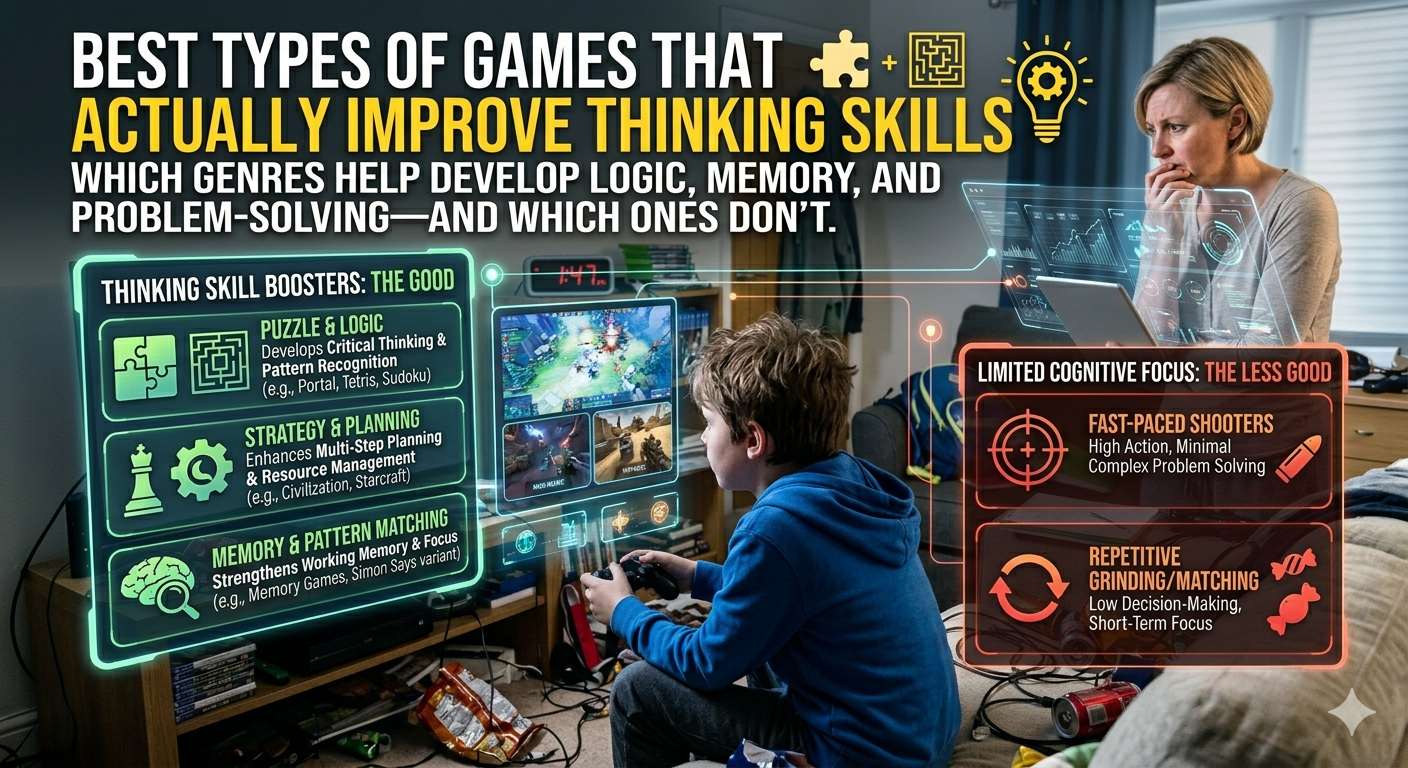
Which genres build logic, memory, and problem-solving—and which ones don’t
Not all games are equal when it comes to brain development. Some genuinely strengthen thinking skills like logic, planning, memory, and decision-making, while others mostly train reflexes or simply entertain without much cognitive challenge.
Research on video games shows that different genres stimulate different parts of the brain. Strategy, puzzle, and simulation games tend to produce the strongest cognitive benefits because they require planning, attention control, and adaptive thinking. (ScienceDirect)
But that doesn’t mean every “smart-looking” game is useful. Some genres offer minimal cognitive transfer beyond entertainment.
Let’s break it down clearly.
1. Puzzle Games – The strongest all-round brain trainers
Puzzle games are the most consistently beneficial category for thinking skills. They force players to recognize patterns, solve structured problems, and think ahead.
Common examples include Sudoku, match-3 puzzles, jigsaw puzzles, and logic grid games.
Studies show these types of games can improve memory, attention, and processing speed, especially when difficulty increases gradually. (Healthline)
Why puzzle games work so well
They train:
- Working memory (holding information temporarily)
- Pattern recognition
- Step-by-step reasoning
- Focus under constraints
Real cognitive effect
Your brain learns to:
- Track multiple possibilities at once
- Eliminate wrong options logically
- Plan several moves ahead
Strong puzzle subgenres
- Number logic (Sudoku-style)
- Spatial puzzles (Tetris-style thinking)
- Tile-matching (pattern recognition)
- Escape-room puzzles (multi-step reasoning)
2. Strategy Games – Best for decision-making and planning
Strategy games are among the most powerful genres for developing executive function—the brain’s control system for planning and decision-making.
They include:
- Turn-based strategy (like Civilization-style games)
- Real-time strategy (like StarCraft-style games)
- Tactical battle games
Research shows strategy game training improves:
- Cognitive flexibility (switching between tasks)
- Working memory
- Complex decision-making under pressure (ScienceDirect)
Why strategy games are powerful
Unlike puzzles with fixed solutions, strategy games:
- Force constant adaptation
- Require resource management
- Demand long-term planning
- Include unpredictable outcomes
Brain skills trained
- Prioritizing tasks under pressure
- Managing multiple goals at once
- Thinking several steps ahead
- Learning from failure quickly
These skills are highly transferable to real-life planning and problem-solving.
3. Simulation & Sandbox Games – Creativity + systems thinking
Simulation games (like city builders or life simulators) are excellent for developing systems thinking—understanding how parts of a system interact.
Examples include building, farming, or open-world sandbox games.
What they improve
- Planning and resource management
- Cause-and-effect understanding
- Creative problem-solving
- Long-term thinking
These games are powerful because they don’t give one correct solution. Instead, players experiment and learn consequences naturally.
Why they matter for thinking skills
You constantly ask:
- What happens if I change this system?
- How do I optimize limited resources?
- What strategy creates long-term success?
That’s real-world thinking practice.
4. Action Games – Fast thinking, attention, and reaction skills
Action games are often misunderstood. They don’t primarily build deep reasoning, but they strongly improve attention control and visual processing speed.
Research suggests action games can improve:
- Visual attention
- Reaction time
- Decision speed under pressure (Springer)
Cognitive strengths
- Quick decision-making
- Multitasking under pressure
- Tracking fast-moving information
But there’s a limit
They rarely improve:
- Deep logical reasoning
- Long-term planning
- Memory organization
So they train “fast thinking,” not “deep thinking.”
5. Memory Games – Direct but narrow cognitive training
Memory-based games (like card matching or sequence recall games) directly target short-term memory.
What they improve
- Recall ability
- Pattern retention
- Short-term focus
They are useful but limited:
- Gains are often task-specific
- Transfer to real-life thinking is smaller compared to strategy or puzzle games
Still, they are excellent for beginners or children building foundational memory skills.
6. Creative Games – Building imagination and flexible thinking
Creative games (like open-world building or design-focused games) help develop divergent thinking—the ability to generate multiple solutions.
Cognitive benefits
- Creativity and imagination
- Experimentation mindset
- Problem-solving through trial and error
These games are especially useful for:
- Children developing creativity
- Learners who struggle with rigid thinking
- Players who enjoy exploration over competition
7. Competitive Multiplayer Games – Mixed cognitive impact
This category includes fast-paced competitive games.
They can improve:
- Reflexes
- Short-term attention
- Rapid decision-making
However, they are not strong for:
- Deep reasoning
- Memory building
- Long-term planning
Important downside
Competitive environments can sometimes:
- Encourage impulsive decisions
- Increase stress responses
- Focus on speed over thinking quality
So they train performance under pressure—not necessarily smarter thinking.
8. Games that improve thinking the least
Some genres offer entertainment but very limited cognitive development.
Examples:
- Idle/clicker games
- Repetitive grind-based games
- Highly scripted “one-path” games
- Passive watching/auto-play experiences
Why they don’t help much
- No meaningful decision-making
- No memory challenge
- No planning or adaptation required
They are fine for relaxation, but not brain training.
Key comparison: Which genres actually build thinking skills?
| Genre | Logic | Memory | Problem-solving | Long-term planning |
|---|---|---|---|---|
| Puzzle games | ⭐⭐⭐⭐ | ⭐⭐⭐⭐ | ⭐⭐⭐⭐ | ⭐⭐⭐ |
| Strategy games | ⭐⭐⭐⭐ | ⭐⭐⭐ | ⭐⭐⭐⭐ | ⭐⭐⭐⭐ |
| Simulation games | ⭐⭐⭐ | ⭐⭐⭐ | ⭐⭐⭐⭐ | ⭐⭐⭐⭐ |
| Action games | ⭐ | ⭐⭐ | ⭐⭐ | ⭐ |
| Memory games | ⭐⭐ | ⭐⭐⭐⭐ | ⭐ | ⭐ |
| Idle games | ⭐ | ⭐ | ⭐ | ⭐ |
What actually matters more than genre
Even within the same genre, the design quality matters more than the label.
Games improve thinking skills when they include:
- Increasing difficulty levels
- Real decision-making (not scripted outcomes)
- Need for planning ahead
- Feedback and adaptation
- Multiple possible solutions
If a game becomes automatic or repetitive, the cognitive benefit drops sharply.
Final takeaway
If the goal is to genuinely improve thinking skills, the best choices are:
- Puzzle games → logic + memory
- Strategy games → planning + decision-making
- Simulation games → systems thinking + creativity
Meanwhile:
- Action games mainly improve speed and attention
- Memory games help short-term recall but don’t generalize much
- Passive or repetitive games offer minimal cognitive growth
The biggest difference isn’t “games vs no games”—it’s whether the game forces your brain to think, adapt, and solve problems or just react and repeat.