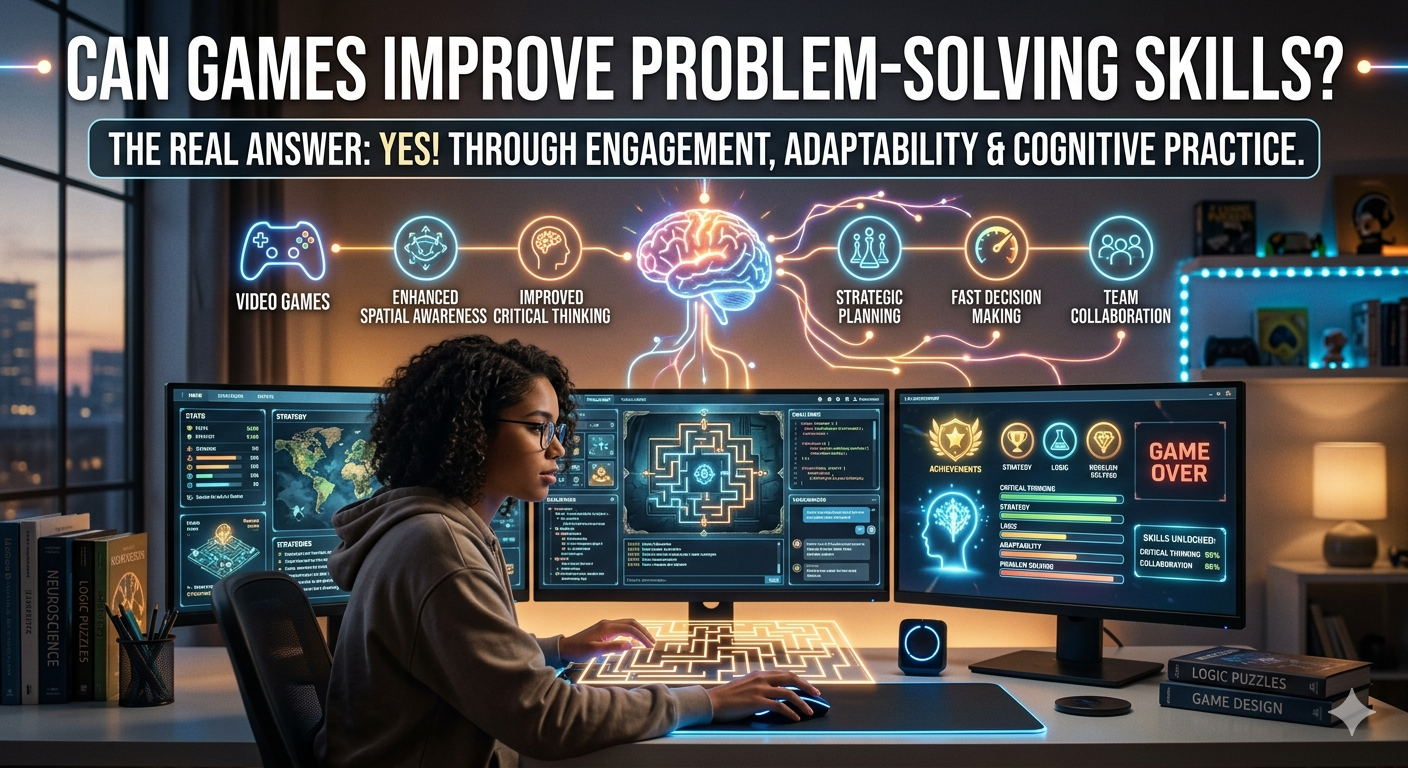
When games help—and when they just create repetitive behavior without learning
Video games sit in a strange cultural space. For some people, they’re a waste of time. For others, they’re powerful learning tools that quietly train the brain. The truth is more nuanced: games can improve problem-solving skills—but only under specific conditions. And just as often, they don’t. Sometimes they simply reinforce repetition, habit loops, or “optimized gameplay” that doesn’t transfer to real-life thinking.
To understand what’s really going on, we need to separate structured cognitive challenge from mindless repetition disguised as progress.
What “problem-solving skills” actually mean in games
Problem-solving in psychology isn’t just “figuring things out.” It includes:
- Identifying a goal
- Breaking down constraints
- Testing strategies
- Adapting when things fail
- Transferring learned rules to new situations
Research on game-based learning defines it as a cognitive process where players must “conceptualize and manipulate knowledge” to overcome obstacles and reach goals (PMC).
In good games, this happens constantly. You don’t just follow instructions—you experiment, fail, adjust, and retry.
That loop is where learning can happen.
When games do improve problem-solving
1. Strategy and systems-heavy games
Games like real-time strategy titles or complex simulations force players to juggle multiple systems at once—resources, timing, positioning, risk management.
Studies show that certain genres can improve cognitive skills such as attention control, decision-making, and flexible thinking (ScienceDirect).
In controlled experiments, players of complex strategy games improved abilities like task-switching and working memory compared to non-players in some conditions (Reddit).
Why this works:
- You must constantly reassess changing conditions
- There is no single “correct” solution
- Mistakes are feedback, not failure
This mimics real-world problem-solving more closely than most people expect.
2. Puzzle and logic-based games
Puzzle games train a more direct form of reasoning:
- pattern recognition
- spatial reasoning
- constraint solving
These games are especially effective when they gradually increase difficulty and force adaptation instead of memorization.
Adaptive puzzle systems in research settings have even been designed specifically to maintain an “optimal challenge zone” for learning (arXiv).
That “just hard enough to struggle, not so hard you quit” zone is where cognitive growth tends to happen.
3. Well-designed role-playing games (RPGs)
RPGs like World of Warcraft or similar systems-heavy games require:
- planning builds or strategies
- resource optimization
- group coordination
- long-term decision consequences
In experiments comparing RPG play with control conditions, researchers found no dramatic universal gains—but still observed structured improvements in rule application skills under certain conditions (PMC).
Even when transfer to real-world tasks is limited, RPGs can strengthen how players think inside structured systems.
4. The key ingredient: novelty + challenge
One of the strongest predictors of cognitive benefit is whether a game forces you to learn continuously, not repeat mastered patterns.
Recent research highlights that benefits are more likely when:
- players are exposed to new mechanics
- difficulty adapts over time
- gameplay remains mentally demanding rather than automatic (Windows Central)
This is crucial. The brain improves when it is required to update its strategies, not when it repeats efficient routines.
When games do NOT improve problem-solving
This is where the popular narrative breaks down.
1. Repetitive gameplay with mastered mechanics
Once a game becomes familiar, the brain often shifts into “autopilot mode.”
At that point:
- decision-making becomes reflexive
- strategies stop evolving
- problem-solving turns into pattern execution
This is where games stop training thinking and start training efficiency loops.
You’re no longer solving new problems—you’re executing known answers faster.
2. Optimization without understanding
Many games reward optimization over exploration:
- grinding the same strategy
- following meta builds
- repeating high-reward actions
This can create the illusion of skill development, but it often trains:
- memorization
- reaction timing
- routine execution
Not deeper reasoning.
This is why some researchers warn that improvements in games often stay task-specific, meaning they don’t always transfer to real-world problem-solving (Springer Nature Link).
3. Games that remove meaningful consequences
If failure has no cost—or is instantly reset—players may not fully engage in reflective thinking.
Real problem-solving requires:
- weighing trade-offs
- living with consequences
- planning beyond immediate rewards
Some games flatten these pressures, which reduces cognitive depth.
4. “Brain training” style repetition games
Simple brain-training apps often improve performance only on the exact tasks they train, without broader cognitive transfer.
They can make you better at the game itself—but not necessarily better at general problem-solving in life.
The biggest misconception: “All gaming is cognitive training”
This is where debates usually go wrong.
Games are not inherently educational or non-educational. They are systems of interaction.
Two people can play the same game:
- One explores strategies, experiments, and reflects
- The other repeats optimized patterns for rewards
Only one is actively strengthening transferable problem-solving skills.
Why transfer to real life is inconsistent
Even when games improve cognitive abilities, transferring those skills outside gaming is not guaranteed.
Studies show mixed results:
- some improvements in attention, flexibility, and decision-making
- but limited or inconsistent transfer to unrelated real-world tasks (ScienceDirect)
Why?
Because real-world problems are:
- less structured
- emotionally loaded
- socially complex
- less predictable
Games simplify reality into rule systems. Life doesn’t.
So the brain may learn to solve game problems, not general problems.
The real dividing line: learning vs looping
Here’s the simplest way to understand it:
Games help problem-solving when they:
- force adaptation
- introduce new systems
- reward experimentation
- punish static thinking
- require planning and reflection
Games do NOT help when they:
- rely on repetition
- reward memorized patterns
- minimize consequences
- encourage autopilot efficiency
- stop introducing novelty
The difference is not genre alone—it’s how you engage with the system over time.
A subtle but important truth
Even when games don’t improve broad intelligence, they can still:
- train patience under pressure
- improve short-term decision speed
- strengthen focus in complex environments
- build comfort with trial-and-error thinking
But these are tools, not upgrades.
They only become transferable skills when they are repeatedly challenged and consciously reflected on.
Final answer
Yes—games can improve problem-solving skills, but only when they continuously demand adaptation, strategy, and learning under changing conditions.
But many games, especially once mastered, stop doing that. They shift into repetition machines where players optimize known patterns instead of discovering new solutions.
So the real difference isn’t “games vs no games.”
It’s this:
Are you still solving problems—or just replaying solutions you already found?