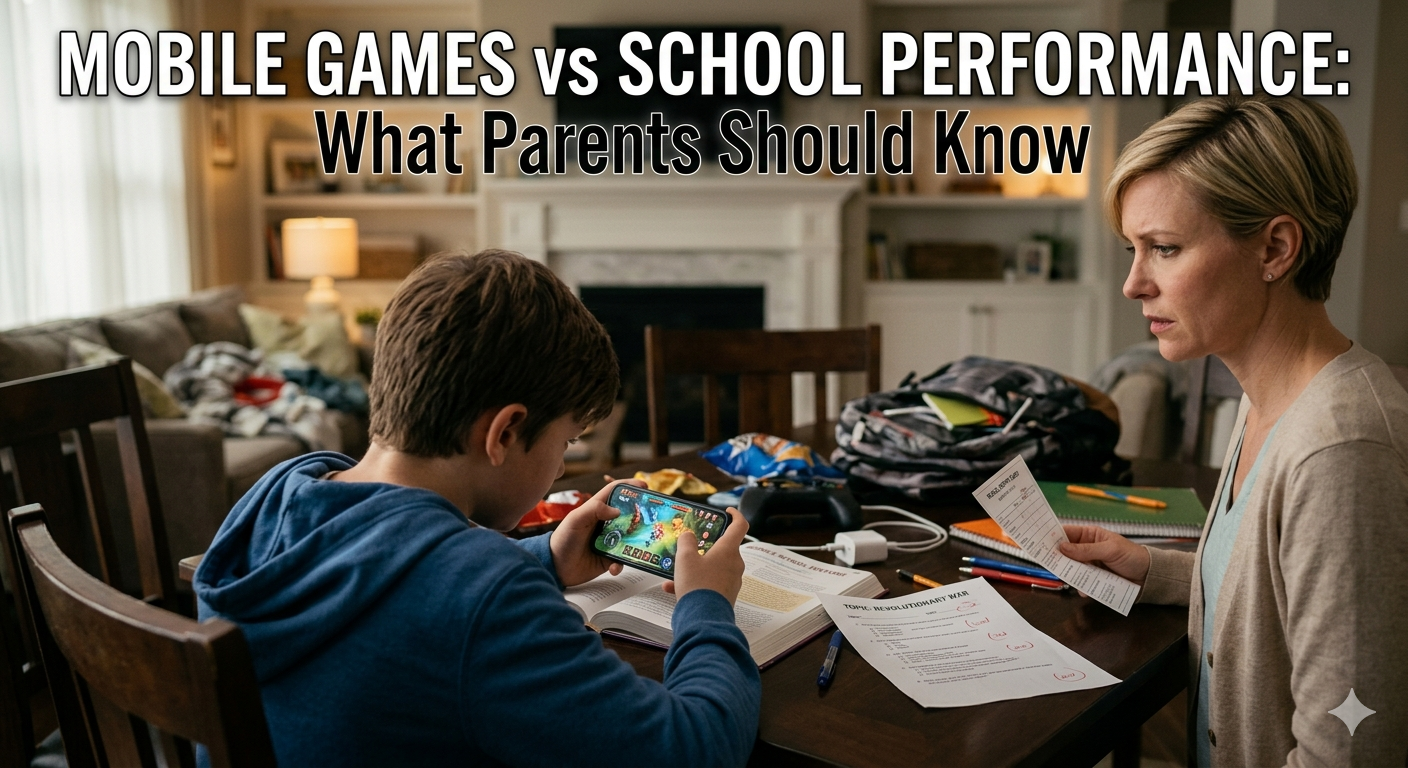
How excessive gaming affects concentration, homework habits, and academic results
Mobile games have become a normal part of childhood and teenage life. Whether it is action games, puzzle apps, multiplayer competitions, or casual entertainment, children today carry gaming devices in their pockets at all times. Smartphones and tablets have made gaming more accessible than ever before, allowing children to play anytime and anywhere.
For many families, mobile games are harmless fun in moderation. Games can improve problem-solving skills, creativity, and even social interaction. However, when gaming becomes excessive, many parents begin to notice changes in school performance, focus, motivation, and daily habits.
A child who once completed homework on time may begin procrastinating. Grades may slowly decline. Teachers may report lack of concentration in class. Parents may struggle with arguments about screen time and study routines.
This raises an important question:
Are mobile games affecting children’s academic performance?
The answer is not always simple. Mobile gaming itself is not automatically harmful. The real concern is excessive, unbalanced, or emotionally dependent gaming that interferes with healthy routines, concentration, sleep, and learning.
This article explores how excessive mobile gaming can affect school performance and what parents can do to create a healthier balance without constant conflict.
Why Mobile Games Are So Addictive for Children
To understand the impact on school performance, parents first need to understand why mobile games are so difficult for children to stop playing.
Mobile games are intentionally designed to capture attention through:
- instant rewards,
- bright visuals,
- competitive systems,
- achievements,
- daily challenges,
- social interaction,
- and constant stimulation.
Unlike traditional entertainment, mobile games provide continuous feedback and excitement. Children feel a sense of progress, achievement, and emotional reward every few seconds.
Many games also use psychological techniques such as:
- reward streaks,
- surprise prizes,
- timed events,
- rankings,
- and social pressure to keep players returning.
For children whose self-control systems are still developing, resisting these rewards can be extremely difficult.
The issue becomes serious when gaming starts replacing activities essential for academic success:
- studying,
- reading,
- sleeping,
- physical activity,
- and focused attention.
The Link Between Excessive Gaming and Poor Concentration
One of the most common effects parents notice is reduced concentration.
Children who spend long hours switching rapidly between games, notifications, videos, and online interactions may struggle with sustained attention during schoolwork.
School requires:
- patience,
- mental effort,
- delayed rewards,
- and long periods of focus.
Mobile games are very different. They train the brain to expect:
- fast stimulation,
- immediate excitement,
- and constant interaction.
As a result, some children begin finding schoolwork “boring” compared to gaming.
Homework may feel frustrating because it lacks the instant rewards games provide.
Children may:
- lose focus quickly,
- become restless while studying,
- switch between tasks constantly,
- or seek entertainment every few minutes.
Over time, this can weaken study habits and academic consistency.
How Gaming Affects Homework Habits
Homework problems are often one of the earliest warning signs.
Many parents notice patterns such as:
- rushing through assignments,
- incomplete work,
- procrastination,
- careless mistakes,
- or refusal to study.
In some households, homework becomes a daily battle because children are mentally focused on returning to their games.
Children may:
- hide devices during study time,
- secretly play games,
- delay homework intentionally,
- or multitask between studying and gaming.
Unfortunately, multitasking usually reduces learning quality.
A child cannot fully absorb information while constantly checking notifications, switching apps, or thinking about a game.
Even short interruptions reduce concentration and make studying less effective.
Some children spend hours “doing homework” while very little actual learning happens because gaming distractions break their attention repeatedly.
Sleep Problems and Academic Performance
One of the most overlooked effects of excessive mobile gaming is sleep disruption.
Many children and teenagers use phones late at night, often without parents realizing how much time is being spent gaming after bedtime.
Late-night gaming can affect:
- sleep quality,
- memory,
- mood,
- concentration,
- and classroom performance.
Children who sleep poorly often struggle with:
- attention,
- emotional regulation,
- problem-solving,
- and information retention.
A tired brain learns less efficiently.
Even highly intelligent students may see falling grades if chronic sleep deprivation becomes part of their routine.
Blue light from screens can also interfere with natural sleep cycles, making it harder for children to fall asleep quickly.
When gaming becomes a nighttime habit, school performance often suffers the next day.
Emotional Dependence on Mobile Games
For some children, gaming becomes more than entertainment. It becomes emotional escape.
Children may turn to mobile games when they feel:
- stressed,
- lonely,
- anxious,
- bored,
- pressured,
- or emotionally disconnected.
Games provide predictable rewards and temporary relief from uncomfortable emotions.
This emotional dependence can create a cycle:
- School stress increases.
- The child escapes into gaming.
- Homework and grades worsen.
- Stress increases further.
- Gaming becomes even more appealing.
Parents sometimes assume the child is lazy or irresponsible when the real issue is emotional coping.
Understanding the emotional role gaming plays is important for creating healthy solutions.
Social Media and Gaming Combination
Modern mobile gaming is often connected with social interaction.
Children may:
- chat with friends,
- compete online,
- join gaming groups,
- or follow gaming content creators.
This makes it harder to separate gaming from social life.
Some children fear missing out if they stop playing.
Others feel pressure to stay active in online gaming communities.
This social aspect can increase screen time significantly and make children emotionally resistant to limits.
Parents may hear:
- “Everyone else is online.”
- “My friends are waiting.”
- “I’ll lose progress.”
- “I need to finish this event.”
These concerns feel real to children, even if adults see them differently.
Warning Signs That Gaming Is Affecting School Performance
Not every child who enjoys games has a problem.
The concern begins when gaming consistently interferes with academic responsibilities and healthy routines.
Parents should watch for signs such as:
- declining grades,
- incomplete homework,
- loss of interest in school,
- poor concentration,
- irritability when gaming stops,
- reduced sleep,
- hiding screen use,
- lying about gaming time,
- skipping responsibilities,
- or emotional outbursts related to devices.
One sign alone may not indicate a serious issue.
However, repeated patterns over time deserve attention.
Why Punishment Alone Often Fails
Many parents respond to falling grades with strict punishments:
- confiscating devices,
- banning games completely,
- yelling,
- or threatening consequences.
While limits are necessary, punishment alone often creates more conflict without addressing the deeper issue.
Children may:
- become secretive,
- resentful,
- emotionally reactive,
- or more obsessed with gaming.
Sudden total bans can sometimes increase emotional attachment to games because children feel controlled rather than guided.
The goal should not simply be removing games.
The goal is teaching balance, self-regulation, and healthy priorities.
Creating Healthy Screen Time Boundaries
Healthy boundaries work better when they are:
- predictable,
- calm,
- consistent,
- and realistic.
Parents should create clear routines around:
- homework,
- bedtime,
- meals,
- physical activity,
- and gaming time.
For example:
- Homework before games
- No gaming during meals
- Devices outside bedrooms at night
- Screen-free study periods
- Limited gaming on school nights
Consistency is more important than harshness.
Children adapt better when expectations stay stable instead of changing daily.
The Importance of Device-Free Study Time
One of the most effective academic strategies is creating distraction-free study periods.
Even when children claim they can study while gaming or checking phones, research consistently shows that multitasking reduces learning quality.
Parents can help by:
- keeping phones away during homework,
- using quiet study spaces,
- limiting notifications,
- and encouraging focused work sessions.
Short focused study periods are often more productive than long distracted ones.
Some families use methods such as:
- 25 minutes of focused work,
- followed by a short break.
This can feel more manageable for children who struggle with attention.
Encouraging Offline Activities
Children are less dependent on gaming when they have meaningful offline experiences.
Parents should encourage activities such as:
- sports,
- reading,
- art,
- music,
- outdoor play,
- clubs,
- social activities,
- and family interaction.
Many children use games simply because they lack other engaging options.
A balanced lifestyle naturally reduces excessive screen dependence.
This does not mean forcing children into activities they hate. Instead, parents can help children discover interests that provide enjoyment and confidence outside screens.
How Parents Can Improve Cooperation
Constant arguments about gaming can damage family relationships.
Children are more cooperative when parents:
- stay calm,
- listen respectfully,
- avoid insults,
- and explain expectations clearly.
Instead of:
“You’re addicted to your phone.”
Try:
“I’m concerned because gaming is affecting homework and sleep.”
Children respond better when conversations focus on behavior rather than personal criticism.
Parents should also involve children in problem-solving discussions.
Ask:
- “What schedule would help you balance school and gaming?”
- “What makes it hard to stop playing?”
- “How can we improve homework time?”
Collaboration increases responsibility.
The Role of Parents’ Own Screen Habits
Children observe adult behavior closely.
If parents constantly use phones during meals, conversations, or family time, children may resist limits they see adults ignoring.
Healthy digital habits should become part of family culture.
Simple habits help:
- device-free dinners,
- family walks,
- shared activities,
- and intentional offline time.
Children learn balance partly through observation.
Are All Games Harmful?
No.
Not all gaming is harmful, and moderate gaming does not automatically damage academic performance.
Some games may improve:
- problem-solving,
- creativity,
- coordination,
- teamwork,
- and strategic thinking.
The issue is not gaming itself but imbalance.
Problems usually arise when gaming:
- replaces sleep,
- interferes with studying,
- damages routines,
- or becomes emotionally compulsive.
A child who plays games moderately while maintaining strong school habits and healthy routines may not have a serious problem at all.
Balance matters more than complete elimination.
When Academic Pressure Makes Gaming Worse
Interestingly, excessive academic pressure can sometimes increase gaming behavior.
Children overwhelmed by:
- constant criticism,
- unrealistic expectations,
- or fear of failure
may escape into games for relief.
Parents should consider whether the home environment feels supportive or constantly stressful.
Children need:
- encouragement,
- emotional safety,
- and realistic expectations.
Fear-based parenting may improve obedience temporarily but often increases emotional escape behaviors over time.
Helping Children Build Self-Control
Self-regulation develops gradually.
Children do not magically learn balance without guidance and practice.
Parents can support self-control by teaching:
- time management,
- emotional awareness,
- delayed gratification,
- and healthy routines.
Celebrate progress, even if improvement is slow.
For example:
- stopping gaming without arguments,
- finishing homework independently,
- following screen rules,
- or improving bedtime habits.
Positive reinforcement often works better than constant criticism.
When Professional Help May Be Necessary
Sometimes gaming problems become severe enough to require professional support.
Parents should consider outside help if a child:
- cannot function without gaming,
- becomes extremely aggressive when devices are removed,
- shows signs of anxiety or depression,
- completely loses interest in school,
- isolates socially,
- or experiences major sleep problems.
Mental health professionals can help determine whether deeper emotional, behavioral, or developmental challenges are involved.
Seeking support early can prevent long-term academic and emotional difficulties.
Practical Strategies for Parents
Here are practical steps parents can begin using immediately:
1. Set clear gaming schedules
Predictability reduces arguments.
2. Keep devices out of bedrooms at night
This improves sleep and reduces secret gaming.
3. Create distraction-free homework time
Focused studying improves learning quality.
4. Use calm communication
Avoid shouting and personal criticism.
5. Encourage balanced activities
Children need enjoyable offline experiences.
6. Watch for emotional struggles
Gaming may be masking stress or anxiety.
7. Model healthy technology habits
Children copy adult behavior.
8. Focus on long-term balance
The goal is healthy habits, not total control.
Final Thoughts
Mobile games are now part of modern childhood, and they are not automatically harmful. However, excessive gaming can affect concentration, homework habits, sleep, emotional health, and academic performance when balance disappears.
Parents should avoid seeing gaming as the enemy. The real goal is helping children develop healthy routines, emotional regulation, and responsible technology use.
Children need:
- structure,
- connection,
- consistency,
- and guidance.
When parents stay calm, set clear boundaries, and support balanced lifestyles, children are far more likely to succeed academically while still enjoying technology in healthy ways.
The most effective parenting approach is not based on fear or punishment. It is based on teaching children how to manage screens responsibly while protecting their learning, well-being, and future success.