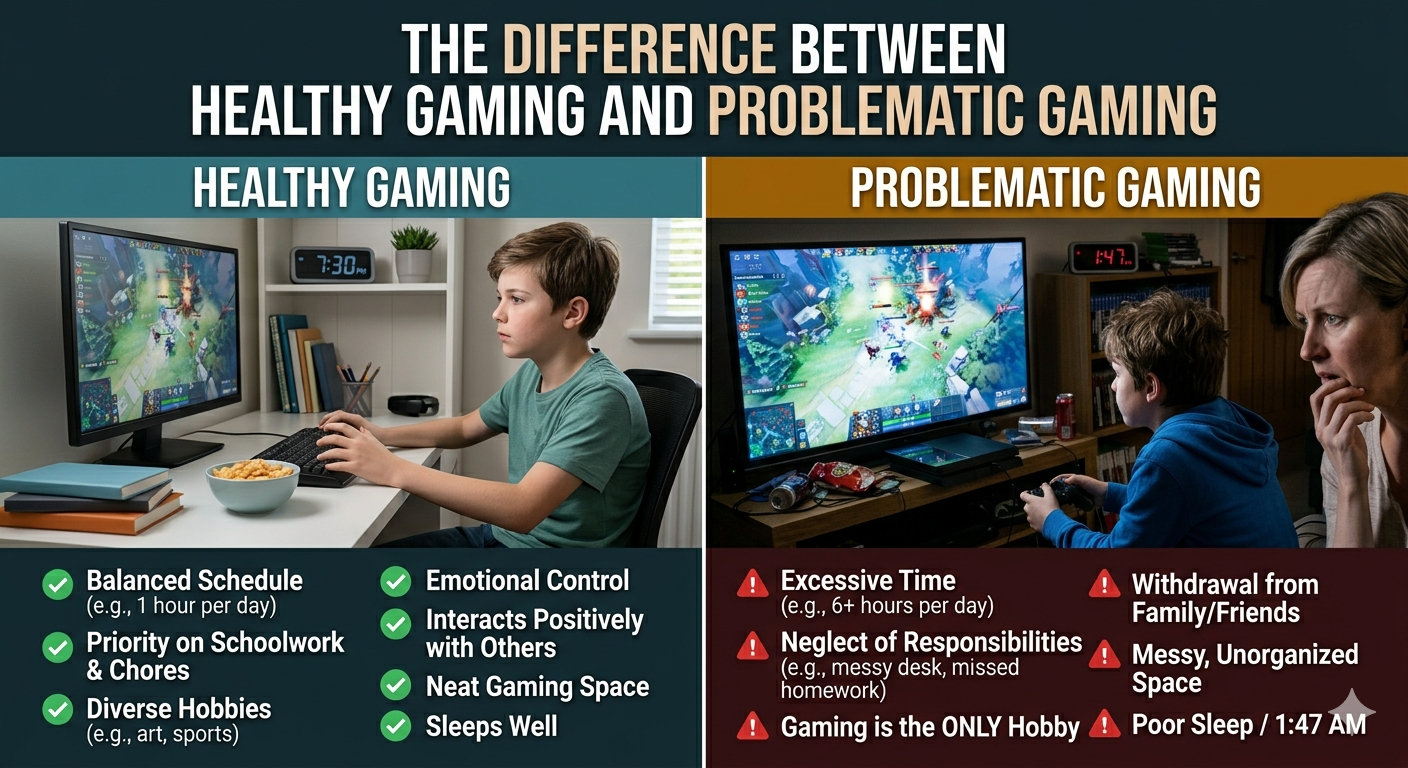
Clear Boundaries Every Parent Should Understand to Avoid Long-Term Negative Effects
Gaming is no longer a niche hobby—it is part of modern childhood. From mobile games to consoles and online multiplayer worlds, children are growing up in environments where games are constantly available, highly engaging, and socially connected.
For parents, this creates a difficult question:
When is gaming harmless entertainment, and when does it become a problem?
The answer is not simply about how many hours a child plays. Two children can both play three hours a day, and one may be perfectly balanced while the other develops emotional, behavioral, or academic difficulties.
The difference lies in how gaming is used, how it affects the child, and whether it supports or disrupts development.
Understanding this distinction is one of the most important skills for modern parenting.
1. Gaming Itself Is Not the Problem
The first and most important clarification is this:
Gaming is not inherently harmful.
In fact, many games can support:
- Problem-solving skills
- Hand-eye coordination
- Creativity
- Strategic thinking
- Teamwork in multiplayer settings
- Stress relief and relaxation
Just like movies, books, or sports, gaming is a medium. The impact depends on:
- The content of the games
- The structure of play
- The child’s personality and age
- The balance with other activities
The goal is not elimination. The goal is balance and awareness.
2. Healthy Gaming: What It Looks Like
Healthy gaming supports a child’s life rather than replacing it. It exists as one activity among many, not the center of daily routine.
Here are the key characteristics of healthy gaming:
A Balanced Time Relationship
In healthy gaming, the child:
- Plays for a limited, consistent amount of time
- Can stop without emotional distress
- Does not constantly think about gaming when offline
- Does not sacrifice sleep, homework, or meals
The exact number of hours varies by age, but what matters more is flexibility and control.
A healthy gamer can say:
“I’m done for now,” and actually stop.
Emotional Stability After Gaming
A strong indicator of healthy gaming is emotional balance afterward.
After playing, the child:
- Feels relaxed or satisfied
- Is not unusually irritable or aggressive
- Transitions smoothly to other activities
- Does not experience mood crashes
Games should not leave children emotionally dysregulated.
Gaming Does Not Replace Real Life
In healthy patterns:
- School performance remains stable
- Sleep routines are consistent
- Social interaction continues offline
- Hobbies and physical activity are present
Gaming is a complement, not a replacement.
The Child Can Self-Regulate
One of the strongest signs of healthy gaming is self-control.
Even without strict enforcement, the child:
- Takes breaks naturally
- Stops after goals are achieved
- Does not constantly negotiate for “just five more minutes”
- Can tolerate being away from games
Self-regulation is the long-term goal of parenting in the digital age.
Games Are Age-Appropriate and Purposeful
Healthy gaming often includes:
- Age-appropriate content
- Clear goals and structure
- Games that require thinking or creativity
- Limited exposure to aggressive monetization or manipulation
The child engages with games as play or learning, not compulsion.
3. Problematic Gaming: What It Looks Like
Problematic gaming is not defined by a single behavior. It is a pattern of disruption across emotional, behavioral, and functional areas of life.
Loss of Control Over Play Time
One of the strongest warning signs is inability to stop.
The child:
- Plays far longer than intended
- Becomes upset when asked to stop
- Negotiates or argues constantly for more time
- Sneaks gaming sessions
- Loses awareness of time while playing
This shift from choice to compulsion is a key indicator.
Emotional Dependency on Games
In problematic gaming, emotional states become tied to gaming.
The child may:
- Become irritable when not playing
- Show mood swings depending on game performance
- Use gaming as the only coping mechanism for stress
- Experience anxiety when unable to play
Instead of being entertainment, gaming becomes emotional regulation.
Decline in Academic or Daily Responsibilities
A major red flag is functional decline:
- Homework is ignored or rushed
- Grades begin to drop
- Daily hygiene or routines are neglected
- Family responsibilities are avoided
When gaming begins interfering with basic responsibilities, it becomes problematic.
Social Withdrawal
Children may start:
- Avoiding friends or family interactions
- Preferring games over real-life activities
- Losing interest in offline hobbies
- Communicating less with parents
Over time, the digital world becomes more rewarding than real relationships.
Sleep Disruption
Gaming often affects sleep patterns in problematic cases:
- Staying up late to play
- Difficulty waking up in the morning
- Fatigue during the day
- Irregular sleep cycles
Sleep is one of the earliest systems affected by excessive gaming.
Escalating Tolerance (Needing More Time)
Another sign is “tolerance,” where:
- The same amount of gaming no longer feels satisfying
- The child demands more time to feel enjoyment
- Simple games become boring quickly
- Only high-intensity games feel engaging
This mirrors reward-system adaptation in the brain.
4. The Key Difference: Control vs Compulsion
The simplest way to distinguish healthy from problematic gaming is this:
Healthy Gaming = Choice
Problematic Gaming = Compulsion
Ask these questions:
- Can the child stop easily?
- Does the child choose to play, or feel forced to?
- Does gaming enhance life or dominate it?
If gaming is flexible and balanced, it is healthy.
If it feels necessary or uncontrollable, it is becoming problematic.
5. The Role of Game Design in Behavior
Not all games influence behavior equally.
Some games are designed for:
- Short, meaningful sessions
- Skill development
- Clear endings or goals
Others are designed for:
- Endless play loops
- Constant rewards
- Fear of missing out (daily events)
- Competitive pressure
- Microtransactions and progression systems
Problematic gaming is often linked not just to the child’s behavior, but also to game design that encourages continuous engagement.
Understanding this helps parents separate:
- “My child enjoys gaming”
from - “My child is being pulled into a system designed for endless play”
6. Age Matters: When Risk Increases
Different ages show different vulnerability patterns.
Younger Children (6–10)
- Struggle with self-control
- Respond strongly to rewards
- May not recognize time limits
- More likely to become emotionally reactive
At this stage, structure from parents is essential.
Preteens (10–13)
- Begin exploring independence
- More influenced by peers and online trends
- Start forming gaming habits
- May resist restrictions more strongly
This is a critical stage for setting boundaries.
Teenagers (13+)
- Capable of self-regulation, but not always consistent
- Social gaming becomes important
- Identity and peer acceptance influence play
- Stress may lead to escapism through gaming
Teen gaming requires guidance, not control alone.
7. Warning Signs Parents Should Not Ignore
Parents should pay attention if several of the following appear together:
- Gaming replaces sleep or meals
- Frequent anger when gaming is interrupted
- Declining school performance
- Loss of interest in offline hobbies
- Secretive gaming behavior
- Emotional instability tied to gaming
- Isolation from family or friends
One sign alone may not indicate a serious problem.
A pattern over time is what matters.
8. How to Maintain Healthy Gaming Habits
Preventing problematic gaming is easier than correcting it later.
A. Set Clear but Flexible Boundaries
Instead of vague restrictions like “don’t play too much,” use:
- Fixed daily or weekly limits
- Consistent schedules
- Clear expectations about school and sleep priorities
Consistency builds predictability.
B. Encourage Breaks and Variety
Children should have:
- Outdoor play
- Physical activity
- Creative hobbies
- Family time
- Non-screen relaxation
Gaming should never be the only source of enjoyment.
C. Talk About Gaming, Don’t Just Restrict It
Open conversations help children:
- Understand why limits exist
- Reflect on their own habits
- Feel trusted rather than controlled
Questions like:
- “How did that game make you feel?”
- “Did you enjoy it or feel stressed?”
can be surprisingly powerful.
D. Watch Emotional Patterns, Not Just Time
A child playing two hours calmly may be healthier than one playing one hour in a compulsive, emotional state.
Focus on:
- Behavior before and after gaming
- Emotional regulation
- Ability to transition to other tasks
E. Be a Model for Balance
Children learn more from observation than instruction.
If adults:
- Overuse screens
- Struggle with digital balance
- Use devices as constant distraction
Children are more likely to mirror those behaviors.
9. The Long-Term Goal: Self-Regulated Gaming
The goal is not to create a child who “never plays too much” under supervision.
The goal is a child who eventually:
- Recognizes healthy limits
- Manages their own time
- Chooses balanced behavior
- Understands when gaming is affecting their life
Self-regulation is the strongest protection against long-term negative effects.
Final Thoughts
The difference between healthy gaming and problematic gaming is not simply measured in hours, ratings, or game titles.
It is reflected in:
- Emotional control
- Daily functioning
- Balance with real life
- Ability to stop
- Impact on sleep, school, and relationships
Gaming becomes harmful not when it exists, but when it begins to dominate attention, emotions, and responsibilities.
When parents focus on patterns rather than panic, they gain a clearer, calmer understanding of their child’s digital life.
And in that clarity lies the ability to guide children toward a relationship with gaming that is not only safe—but genuinely positive and developmentally healthy.