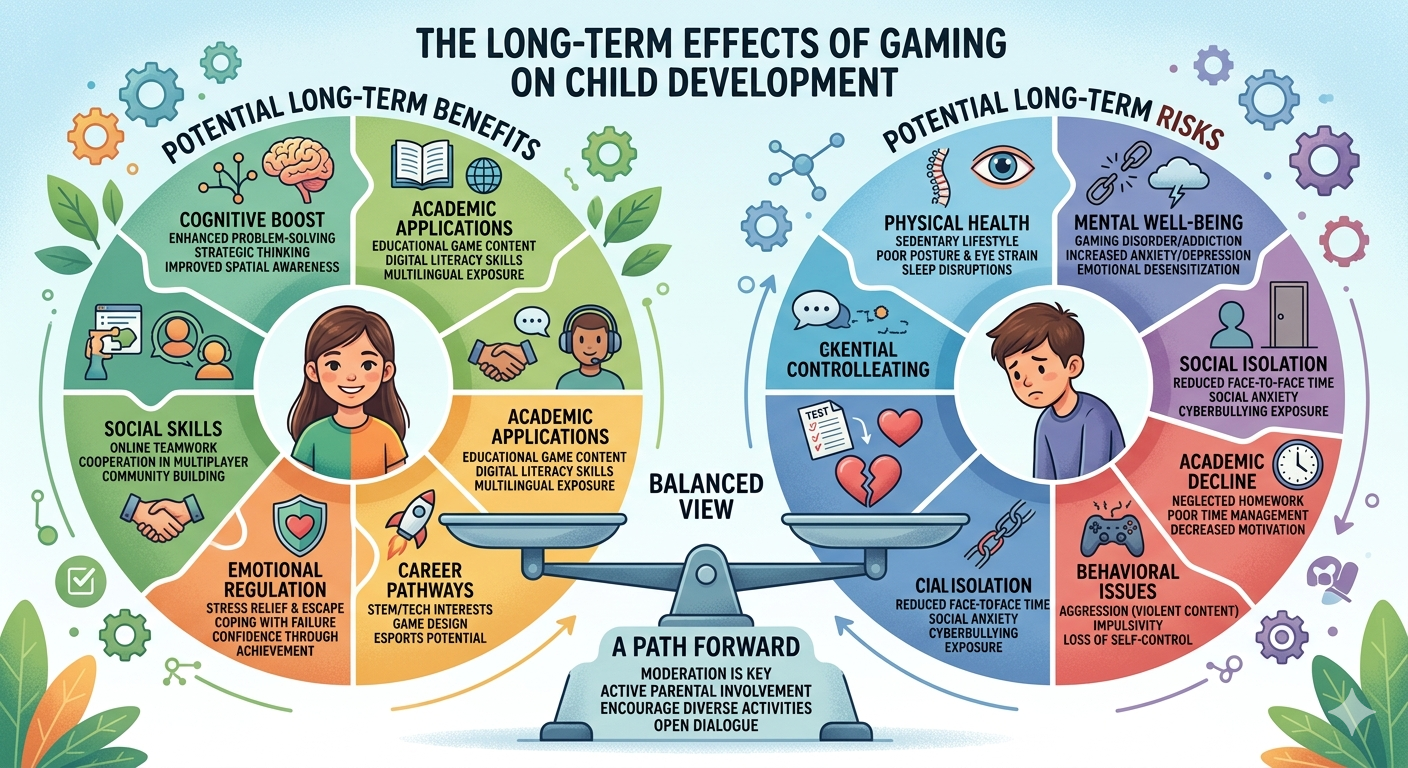
Video gaming has become one of the most common leisure activities for children and adolescents worldwide. With smartphones, consoles, and computers easily accessible, many children now grow up with gaming as a regular part of their daily routines. This has sparked ongoing debate among parents, educators, and researchers: does gaming help or harm child development over time?
The answer is not simple. Long-term effects of gaming are neither entirely positive nor entirely negative. Instead, they depend on factors such as game type, duration, social context, and the child’s personality and environment. Research increasingly shows a mixed picture—gaming can support certain cognitive and social skills while also posing risks if overused or poorly managed.
Cognitive Development: Potential Mental Benefits
One of the most widely studied areas is how gaming affects brain development and cognitive abilities. Many games require players to solve problems quickly, manage resources, and adapt to changing environments. Over time, this can strengthen certain mental skills.
Studies suggest that regular gaming may improve attention, spatial awareness, and decision-making speed. Action and strategy games, in particular, often require players to track multiple objects, anticipate outcomes, and respond rapidly. These repeated mental demands can train the brain in ways that traditional classroom learning does not always replicate.
Some longitudinal research has even found that children who engage in moderate gaming may show improvements in certain measures of intelligence over time, while screen-based passive activities like watching videos do not provide the same benefits. (Reddit)
Additionally, systematic reviews indicate that non-problematic gaming can be associated with enhanced cognitive skills such as inhibition control and problem-solving abilities. (Springer Link)
However, these benefits are not universal. They depend heavily on the type of game and the amount of time spent playing. Educational or strategy-based games tend to be more beneficial than repetitive or overly simplistic games.
Academic Performance: A Double-Edged Effect
The relationship between gaming and academic performance is complex. Moderate gaming may support cognitive skills that indirectly help learning, such as memory and attention control. However, excessive gaming can interfere with homework, reading, and study time.
Children who spend too many hours gaming may experience reduced academic engagement simply due to time displacement—there are only so many hours in a day. Late-night gaming sessions can also reduce sleep quality, which directly affects concentration and memory retention in school.
In short, gaming itself is not inherently harmful to academic success, but poor time management and excessive use can lead to negative outcomes.
Social Development: Connection or Isolation?
Gaming has evolved from a solitary activity into a highly social experience. Many modern games involve teamwork, communication, and collaboration with other players around the world.
Positive social outcomes include:
- Improved teamwork and cooperation skills
- Opportunities to build friendships online
- Enhanced communication in collaborative games
- A sense of belonging in gaming communities
Some studies even suggest that cooperative gaming can encourage prosocial behavior, especially when children play together with friends or family.
However, social risks also exist. Excessive gaming can sometimes:
- Reduce face-to-face interaction
- Lead to social withdrawal in extreme cases
- Encourage exposure to toxic online behavior
- Contribute to dependence on virtual rather than real-world relationships
Research shows that heavy competitive gaming may reduce prosocial behavior in some children, particularly when gaming becomes frequent and intense. (PMC)
Thus, gaming can either strengthen or weaken social development depending on balance and context.
Emotional Development: Stress Relief or Emotional Risk?
Gaming can have a strong emotional impact on children. For many, it serves as a form of relaxation and stress relief. After school pressure or emotional stress, games can offer a sense of escape and achievement.
Positive emotional effects include:
- Reduced stress and anxiety through entertainment
- Increased motivation through rewards and achievements
- A sense of accomplishment and progress
However, there are potential downsides:
- Frustration or anger from competitive losses
- Emotional dependence on gaming for mood regulation
- Risk of addiction-like behavior in vulnerable children
- Increased irritability when gaming is restricted
In some cases, excessive gaming has been linked to emotional difficulties such as mood swings or increased internalizing behaviors. (PMC)
The key issue is not gaming itself, but how it is used as an emotional coping tool.
Physical Health: The Hidden Cost of Screen Time
Long-term gaming habits can also influence physical health. While gaming is not physically harmful in itself, prolonged sedentary behavior can lead to:
- Reduced physical activity
- Increased risk of obesity
- Poor posture and musculoskeletal strain
- Eye fatigue and sleep disruption
Children who spend many hours gaming are often less engaged in outdoor play or sports, which are essential for physical development. Sleep disruption is particularly important, as screen exposure late at night can affect sleep cycles and overall well-being.
Balancing gaming with physical activity is therefore essential for healthy development.
Behavioral Development: Self-Control and Habit Formation
One of the most important long-term concerns is how gaming affects self-regulation and behavior. Children are still developing impulse control, and highly engaging games can make it difficult to stop playing.
In some cases, frequent gaming can contribute to:
- Reduced patience and attention span
- Difficulty with time management
- Preference for instant rewards over delayed gratification
In more extreme cases, problematic gaming patterns can resemble behavioral addiction, although this affects a minority of players.
On the positive side, games that require planning and strategy can actually improve self-regulation skills by encouraging structured thinking and goal setting.
The Role of Game Type and Content
Not all games affect children in the same way. The impact depends heavily on content and structure:
- Educational games: Often improve learning and memory
- Strategy games: Enhance planning and problem-solving
- Action games: Improve reaction time and attention
- Violent or toxic online environments: May increase aggression or exposure to negative behavior patterns
Research consistently shows that context matters more than gaming itself. Cooperative, age-appropriate games tend to produce more positive outcomes than highly competitive or violent environments.
Family Environment and Parenting Matter Greatly
Parental involvement plays a critical role in shaping how gaming affects development. Children who game under supervision and clear boundaries tend to experience more positive outcomes.
Effective parenting strategies include:
- Setting reasonable time limits
- Encouraging breaks and physical activity
- Choosing age-appropriate games
- Playing together to understand content
- Discussing online behavior and safety
When parents are engaged, gaming becomes more structured and less likely to lead to negative habits.
Long-Term Perspective: A Balanced Conclusion
Over time, gaming does not act as simply “good” or “bad” for child development. Instead, it functions as a powerful tool that can shape cognitive, emotional, social, and physical growth in different ways.
Positive long-term effects may include:
- Improved problem-solving and cognitive flexibility
- Better hand-eye coordination and reaction speed
- Social connection through online collaboration
- Stress relief and emotional engagement
Potential negative long-term effects may include:
- Reduced physical activity and health concerns
- Academic distraction if unmanaged
- Risk of social withdrawal in extreme cases
- Emotional dependence or behavioral issues in some children
The most important factor is balance. Moderate, guided gaming can support healthy development, while excessive or unregulated gaming can create challenges.
Final Thoughts
Gaming is now a permanent part of modern childhood, not a temporary trend. Instead of focusing on banning or fully embracing it, the more realistic approach is understanding how to integrate gaming into a balanced lifestyle.
When combined with physical activity, education, social interaction, and parental guidance, gaming can be part of a healthy developmental environment. Without balance, however, it can gradually shift from a harmless activity into a source of long-term developmental concerns.
Ultimately, the long-term effects of gaming depend less on the games themselves and more on how, why, and how much children play them.