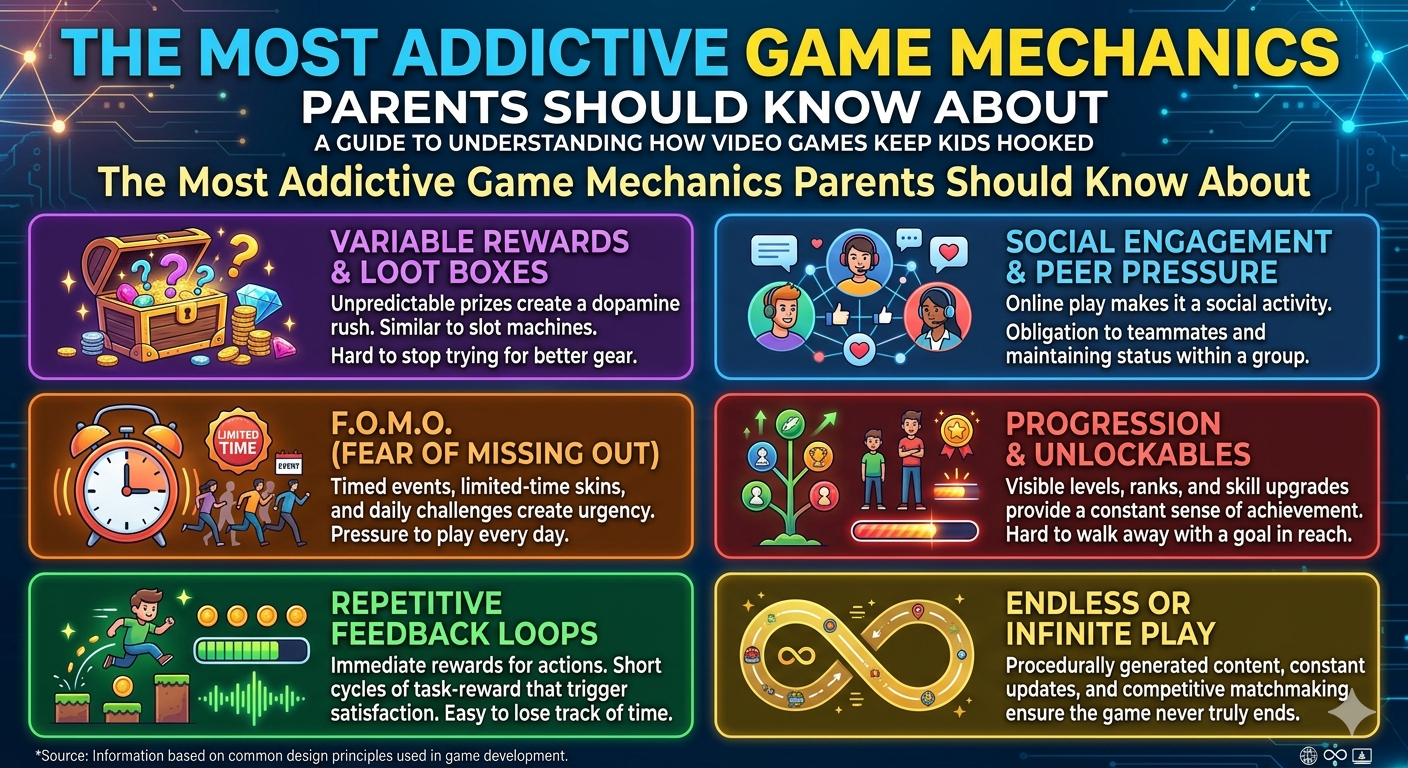
Understanding Loops, Rewards, Streaks, and Behavioral Triggers in Modern Games
Modern video games are not just entertainment products. They are carefully engineered systems built around psychology, habit formation, and behavioral feedback loops. While this doesn’t automatically make games “bad,” it does mean that many of today’s most popular games are designed to keep players engaged for long periods—sometimes far longer than intended.
For parents, the challenge is not simply deciding whether games are good or bad. It’s understanding how they work.
Once you understand the mechanics behind engagement, gaming behavior becomes much more predictable—and much easier to guide in a healthy direction.
This article breaks down the most common addictive design systems used in modern games, why they are so effective, and how parents can recognize them in everyday gameplay.
Why Game Design Matters More Than Ever
Older video games were usually simple:
- You play
- You win or lose
- You stop
Modern games are different. Many are built as:
- Live services
- Ongoing worlds
- Social ecosystems
- Reward-driven systems that evolve over time
That shift means games are no longer just about “completing levels.” They are about keeping players returning daily, weekly, and sometimes continuously.
To achieve that, developers rely on psychological principles such as:
- Variable rewards
- Habit loops
- Progression systems
- Social pressure
- Loss aversion
These systems are not accidental. They are deliberate design choices.
1. The Core Habit Loop: The Foundation of Engagement
At the center of almost every modern game is a simple psychological structure:
Cue → Action → Reward → Repeat
This is known as a habit loop, and it works like this:
- Cue: The game alerts or invites the player (notifications, daily challenges, friends online)
- Action: The player logs in and plays
- Reward: The game gives points, loot, progress, or wins
- Repeat: The player returns again to experience the cycle
This loop is powerful because it conditions the brain to expect reward after action.
Over time, the “cue” alone becomes enough to trigger desire to play.
For parents, the key insight is:
Games are not just played—they are trained into habit cycles.
2. Variable Reward Systems (The “Maybe This Time” Effect)
One of the strongest engagement mechanisms in gaming comes from unpredictable rewards.
Instead of always giving a reward, games often use:
- Random loot drops
- Mystery boxes
- Rare item chances
- Unpredictable bonuses
This is known as a variable reward schedule.
The psychology behind it is simple but powerful:
- If rewards are predictable, motivation stabilizes
- If rewards are unpredictable, motivation increases
This is the same principle found in slot machines, but adapted into gaming systems.
For example:
- You defeat an enemy → sometimes you get a rare item
- You open a chest → sometimes it contains something valuable
- You complete a match → rewards vary each time
This uncertainty creates a loop of anticipation:
“Maybe the next one will be the good reward.”
That “maybe” is what keeps players going longer than planned.
3. Daily Streak Systems: The Fear of Breaking Momentum
Many mobile and online games use streak mechanics, where players are rewarded for logging in or playing daily.
Examples include:
- Daily login bonuses
- Consecutive win streaks
- Daily missions or quests
- Reward multipliers for consistency
The key psychological trigger here is loss aversion.
Once a streak starts, the player feels:
“I can’t miss today or I’ll lose everything I’ve built.”
Even when a child doesn’t strongly want to play, they may still log in just to avoid breaking the streak.
This creates a subtle pressure system where:
- Consistency feels mandatory
- Missing a day feels like loss
- Returning becomes automatic
Over time, this can turn gaming into a daily obligation rather than a choice.
4. Progress Bars and Level Systems: The Illusion of Constant Growth
Humans are naturally motivated by visible progress. Games take full advantage of this through:
- Experience points (XP)
- Leveling systems
- Progress bars
- Skill trees
- Rank systems
These systems create a powerful feedback loop:
“I am always getting closer to something.”
Even when progress is small, the visual representation makes it feel meaningful.
For example:
- 90% to next level → feels urgent and motivating
- 1% progress → still feels like advancement
The brain responds strongly to “almost complete” signals, even if the actual reward is minor.
This is why children often say:
“I just want to finish this level.”
But “this level” is often designed to lead directly into another.
5. Matchmaking and “Just One More Game” Loops
Multiplayer games often use fast matchmaking systems that reduce downtime between matches.
The structure looks like:
- Finish match
- Instant results
- Immediate option to re-queue
- New match starts quickly
This creates a powerful loop because there is:
- No natural stopping point
- No transition break
- No pause for reflection
Combined with short match durations, this produces the classic:
“Just one more game.”
This phrase is not accidental—it emerges from system design that minimizes friction between sessions.
The easier it is to start a new game, the harder it becomes to stop.
6. Social Pressure and Team Dependency
Many modern games are multiplayer-based, which introduces a social layer of engagement.
Players may feel:
- Responsibility to teammates
- Pressure not to quit mid-game
- Fear of letting others down
- Desire to maintain group status
This creates a powerful psychological force: social obligation
Unlike solo games, multiplayer games make stopping more complicated because:
“Other people are relying on me.”
Even if a child wants to stop playing, they may feel compelled to continue for the sake of the team or friends.
This is especially strong in ranked or competitive systems where performance affects group outcomes.
7. Fear of Missing Out (FOMO) Systems
Many modern games operate as live services with:
- Limited-time events
- Seasonal rewards
- Exclusive items
- Time-sensitive challenges
These systems rely on FOMO (Fear of Missing Out).
The message is subtle but powerful:
“If you don’t play now, you might miss something permanent.”
Examples:
- Seasonal battle passes
- Event-only cosmetics
- Limited-time missions
- Rotating shop items
This encourages frequent checking and regular play, even when interest is low.
For children, this can create anxiety around “falling behind” in the game.
8. Reward Cascades: Multiple Wins in One Session
Some games are designed so that one action leads to multiple rewards:
- Completing a mission unlocks XP
- XP unlocks a new level
- Level unlocks new items
- Items unlock new abilities
This is called a reward cascade.
Instead of a single reward, players receive layered rewards that amplify satisfaction.
The effect is:
One small action feels like a major achievement chain.
This keeps motivation high and encourages longer sessions.
9. Cosmetic Rewards and Identity Building
Many games allow players to customize:
- Characters
- Skins
- Avatars
- Gear
- Profiles
These cosmetic systems create emotional attachment to digital identity.
Players begin to think:
- “This is my character”
- “This is my progress”
- “This represents me”
As a result, rewards are not just functional—they are personal.
This increases engagement because players are not just playing a game; they are building a digital identity they care about maintaining.
10. Time-Limited Energy Systems (Mobile Game Design)
Many mobile games include energy systems that limit how long a player can play in one session.
Examples:
- Energy bars that refill over time
- Lives that regenerate slowly
- Action limits per hour
While these seem restrictive, they actually create:
- Return incentives
- Scheduled play patterns
- Anticipation cycles
Players often come back multiple times a day to “use up energy,” which increases repeated engagement.
What Parents Should Watch For (Practical Signals)
Understanding mechanics is useful, but recognizing them in real life matters more.
Here are common behavioral signs linked to these systems:
1. “Streak Anxiety”
- Child feels stressed about missing daily login rewards
2. “Just One More Game” Cycles
- Difficulty stopping after matches or levels
3. Time Blindness
- Losing track of time during gameplay sessions
4. Emotional Dependence on Rewards
- Mood changes based on wins/losses or loot drops
5. Frequent Checking Behavior
- Constantly opening games for rewards or events
These are not automatically signs of addiction—but they do indicate strong engagement loops are active.
Are These Mechanics Always Harmful?
Not necessarily.
These systems can also:
- Encourage persistence
- Build routine
- Improve motivation
- Support goal-setting
- Create social connection
The issue is not their existence—it is balance and awareness.
A well-balanced gaming routine can include these mechanics without causing harm.
Problems arise when:
- Gaming replaces sleep or schoolwork
- Rewards become emotionally controlling
- Time boundaries disappear
- Play becomes compulsive rather than intentional
How Parents Can Respond Without Conflict
Trying to eliminate games entirely is usually ineffective. A better approach is structured guidance:
1. Talk About “Design Tricks,” Not Just Rules
Children are more receptive when they understand how games work rather than just being told to stop.
2. Set Time Boundaries, Not Emotional Battles
Clear limits reduce negotiation and emotional escalation.
3. Encourage Break Awareness
Teach kids to recognize when they are in long sessions.
4. Balance With Offline Activities
Sports, hobbies, and social time reduce over-reliance on gaming systems.
5. Co-Play When Possible
Understanding the game helps parents identify what mechanics are influencing behavior.
Final Thoughts
Modern video games are highly sophisticated systems built around psychology, feedback loops, and behavioral reinforcement. Features like streaks, loot systems, progression bars, and social pressure are not accidental—they are carefully designed to increase engagement.
For parents, this doesn’t mean games are “bad.” It means they are powerful environments that require awareness and structure.
When understood properly, these mechanics become less intimidating and more manageable. Instead of reacting to behavior after it becomes a problem, parents can recognize the systems shaping that behavior in real time.
The goal is not to eliminate gaming—it is to ensure that:
- Games remain a part of life, not the center of it
- Rewards don’t override responsibilities
- Engagement doesn’t replace balance
- Fun doesn’t turn into compulsion
When that balance is achieved, gaming can remain what it was always meant to be:
a source of enjoyment, connection, and creativity—not control.