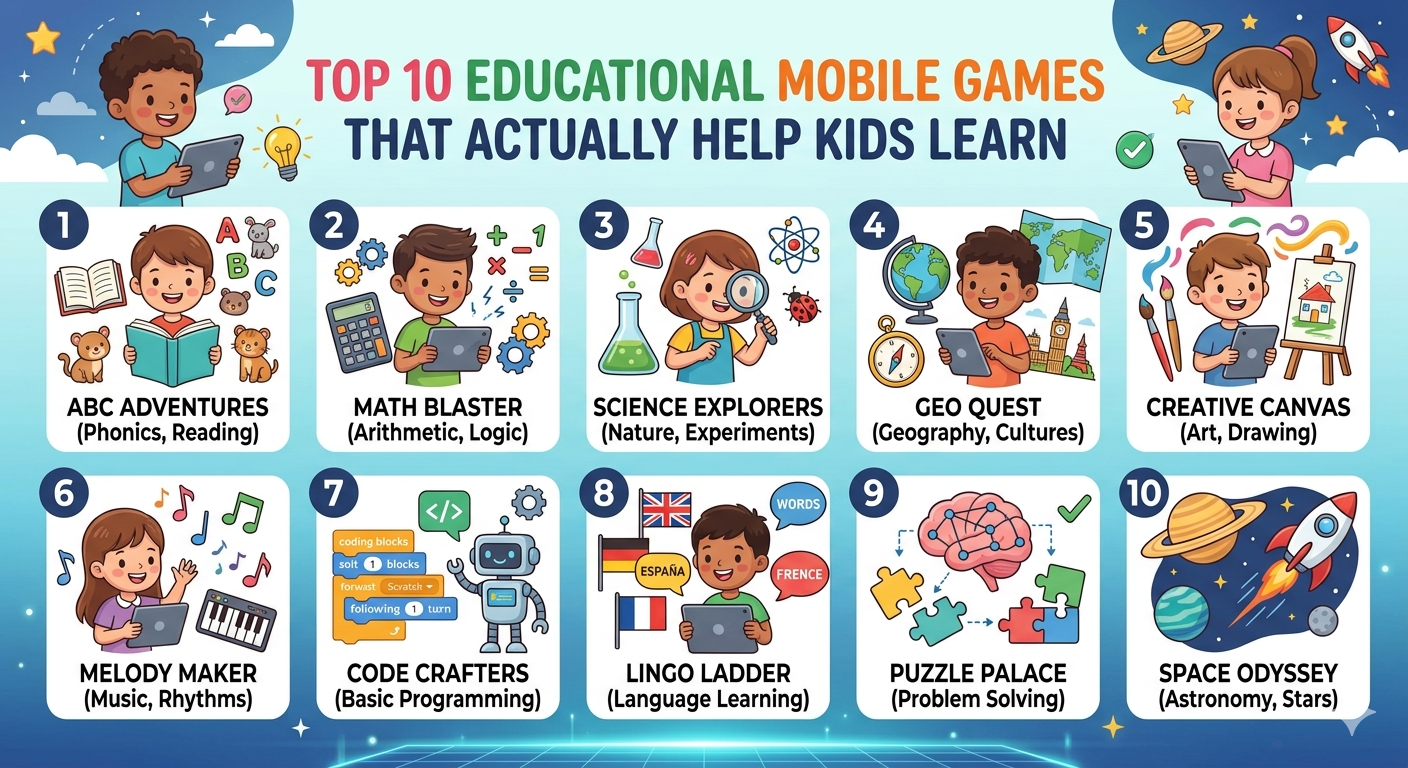
A Curated List of Games That Support Math, Logic, and Cognitive Development
Mobile games often get a bad reputation in parenting discussions, but not all games are created equal. While some are designed mainly for entertainment and endless engagement, others are thoughtfully built to support learning, problem-solving, and cognitive growth.
The challenge for parents is not whether mobile games should be allowed, but which ones are actually beneficial for learning.
The best educational games do more than just “teach facts.” They develop:
- Logical reasoning
- Mathematical thinking
- Memory and attention control
- Pattern recognition
- Problem-solving skills
- Creativity and persistence
In this guide, we’ll explore ten mobile games that genuinely support learning rather than simply pretending to be educational. These are games that combine engagement with meaningful cognitive development.
1. Prodigy Math Game
Prodigy Math Game
Best for: Ages 6–12
Focus: Mathematics (arithmetic, fractions, problem-solving)
Prodigy Math Game turns math practice into a fantasy-style adventure where children solve math problems to progress through battles and quests.
What makes it effective is its adaptive difficulty system. The game adjusts questions based on the child’s performance, ensuring they are neither bored nor overwhelmed.
Key Learning Benefits:
- Arithmetic fluency
- Logical thinking
- Confidence in math
- Problem-solving under mild pressure
Unlike traditional worksheets, it creates a sense of purpose and progression, which helps children stay motivated.
2. DragonBox Algebra 12+
DragonBox Algebra 12+
Best for: Ages 8–14
Focus: Algebra concepts
DragonBox Algebra 12+ is widely praised by educators because it teaches algebra without explicitly labeling it as math.
Children solve puzzles by manipulating symbols, gradually learning the rules of algebraic equations without fear or pressure.
Key Learning Benefits:
- Early algebra understanding
- Abstract thinking
- Logical transformation of equations
- Pattern recognition
It is especially powerful because it removes math anxiety by turning abstract concepts into intuitive gameplay.
3. Lightbot: Code Hour
Lightbot
Best for: Ages 6–12
Focus: Programming logic and sequencing
Lightbot introduces children to coding concepts like loops, commands, and sequencing without requiring actual typing or syntax.
Players guide a robot through puzzles using logical commands.
Key Learning Benefits:
- Algorithmic thinking
- Step-by-step reasoning
- Logical sequencing
- Problem decomposition
It builds the foundation for computer science thinking in a very visual and intuitive way.
4. Thinkrolls
Thinkrolls
Best for: Ages 5–10
Focus: Logic, physics, problem-solving
Thinkrolls is a puzzle game where children guide characters through mazes using real-world physics principles like gravity, buoyancy, and motion.
Key Learning Benefits:
- Logical reasoning
- Physics intuition
- Trial-and-error learning
- Spatial awareness
The game encourages experimentation, which is a key part of cognitive development in early childhood.
5. Kahoot! Kids
Kahoot! Kids
Best for: Ages 6–12
Focus: General knowledge, memory, classroom learning
Kahoot! Kids transforms quizzes into interactive challenges that feel like games rather than tests.
It is often used in classrooms but is equally effective at home.
Key Learning Benefits:
- Memory reinforcement
- Quick recall skills
- Concept review across subjects
- Competitive learning in a safe environment
Because it is structured like a game show, children often engage more willingly than with traditional study methods.
6. Monument Valley
Monument Valley
Best for: Ages 8+
Focus: Spatial reasoning and visual logic
Monument Valley is a visually stunning puzzle game where players manipulate impossible architecture to guide a character through levels.
While it is not explicitly educational, it strongly develops spatial intelligence.
Key Learning Benefits:
- Spatial reasoning
- Visual perception
- Creative problem-solving
- Abstract thinking
It teaches children to think in non-linear ways, which is valuable for math, engineering, and design thinking.
7. BrainPOP Featured Movie Games
BrainPOP
Best for: Ages 7–14
Focus: Science, math, social studies, critical thinking
BrainPOP combines short animated lessons with interactive quizzes and games.
Key Learning Benefits:
- Concept understanding across subjects
- Critical thinking development
- Reinforcement through interactive quizzes
- Improved retention of school topics
It is especially useful for reinforcing classroom learning in an engaging format.
8. Toca Boca Series
Toca Boca
Best for: Ages 4–10
Focus: Creativity, imagination, open-ended play
Toca Boca games are sandbox-style experiences where children explore roles, environments, and storytelling without rules or failure conditions.
Key Learning Benefits:
- Creative expression
- Imaginative storytelling
- Emotional exploration
- Social role understanding
While not academic, creativity is a core cognitive skill linked to problem-solving and innovation.
9. Math Tango
Math Tango
Best for: Ages 6–11
Focus: Arithmetic, mental math, logic
Math Tango uses interactive storytelling and mini-games to teach math concepts in a fun and progressive way.
Key Learning Benefits:
- Mental arithmetic speed
- Number sense development
- Logical reasoning
- Confidence in math tasks
It is especially helpful for children who struggle with traditional math instruction.
10. Sudoku.com (Mobile Version)
Sudoku.com
Best for: Ages 10+
Focus: Logic, pattern recognition, concentration
Sudoku.com brings the classic Sudoku puzzle into a structured mobile format with varying difficulty levels.
Key Learning Benefits:
- Logical deduction
- Working memory
- Pattern recognition
- Patience and focus
Sudoku is especially valuable because it trains sustained attention without relying on flashy rewards or fast stimulation.
What Makes These Games Truly Educational?
Not every “educational” game deserves the label. The difference lies in how learning happens inside the game.
The most effective learning games:
1. Teach Through Interaction
Instead of passive watching, children actively solve problems.
2. Encourage Problem-Solving
They require thinking, not guessing or tapping randomly.
3. Adapt Difficulty
Good games adjust to the child’s skill level.
4. Reward Understanding, Not Just Speed
They reinforce reasoning rather than mindless repetition.
5. Build Transferable Skills
Skills learned in the game apply to real-world learning.
The Hidden Benefit: Learning Without Pressure
One of the biggest advantages of educational games is psychological.
Many children experience:
- Math anxiety
- Fear of failure
- Pressure in classroom environments
Games reduce this stress by:
- Allowing experimentation
- Removing punishment for mistakes
- Encouraging retrying
- Making learning feel like exploration
This emotional safety improves learning outcomes significantly.
How Parents Should Use Educational Games
Even the best educational game is most effective when used correctly.
Here are some practical guidelines:
1. Set Time Boundaries
30–60 minutes of structured play is often enough.
2. Combine With Real Learning
Games should reinforce—not replace—school learning.
3. Talk About What They Learned
Ask children:
- “What did you solve today?”
- “What was difficult?”
4. Avoid Overdependence
Rotate between different learning activities.
5. Observe Engagement, Not Just Time Spent
Focus on quality of attention, not just duration.
Final Thoughts
Educational mobile games can be powerful tools for cognitive development when chosen carefully.
The best games do not simply entertain children—they help them think differently, solve problems, and build confidence in learning.
Games like Prodigy Math Game, Lightbot, and DragonBox Algebra 12+ show that learning does not have to feel like traditional studying. It can be interactive, engaging, and even enjoyable.
However, the real value comes not from the games alone, but from how they are integrated into a balanced childhood—one that includes physical activity, social interaction, creativity, and rest.
When used thoughtfully, educational games are not just screen time.
They become a bridge between play and real learning.