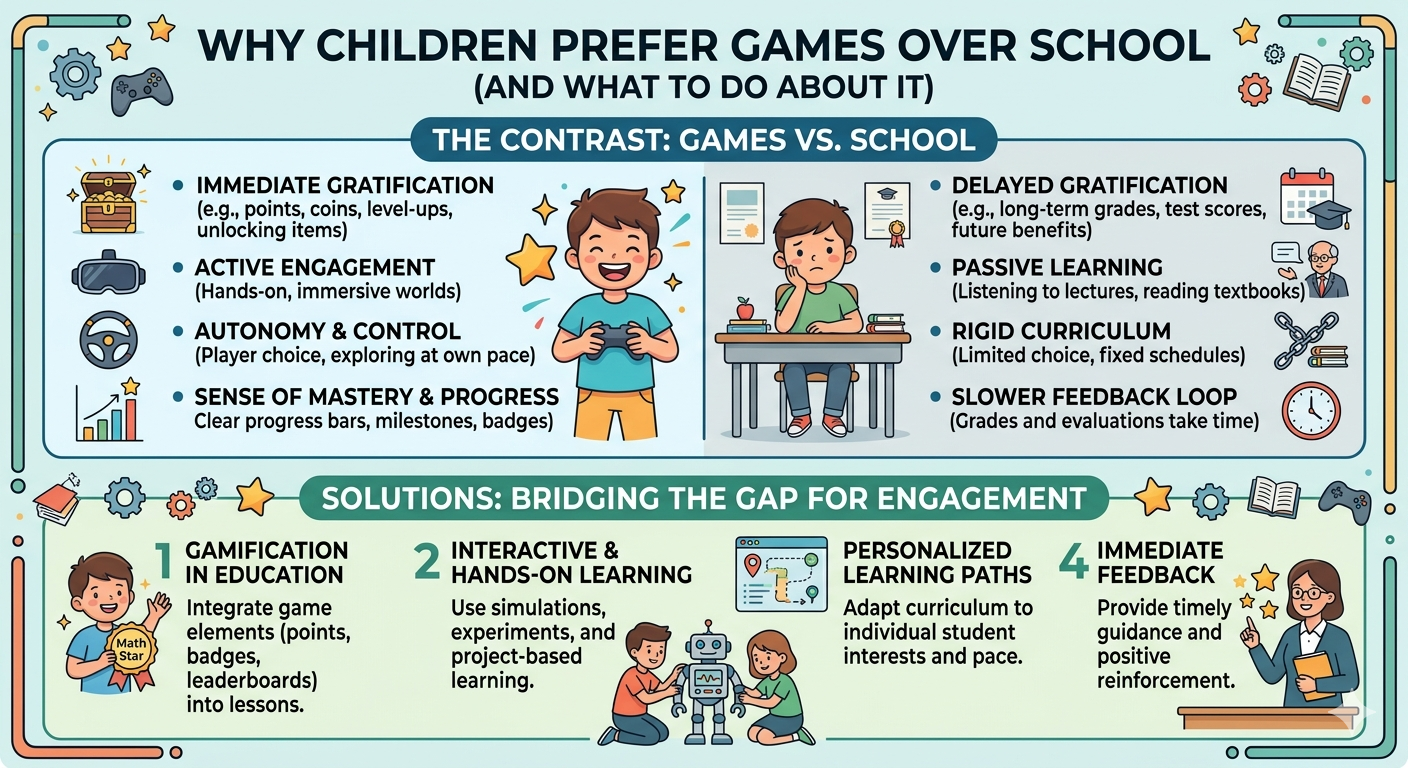
Understanding motivation, instant rewards, and how to rebalance priorities
It’s a familiar scene in many households: a child can spend hours focused, energized, and emotionally engaged while playing games—but struggles to show the same attention toward schoolwork. Homework feels slow, repetitive, and frustrating, while games feel fast, exciting, and meaningful.
This difference is not about laziness or a lack of intelligence. It’s about how motivation works, how modern games are designed, and how school environments often fail to compete with digital stimulation. Understanding this gap is the first step toward closing it.
The real reason games feel more appealing
At the core of the issue is a simple psychological truth: children are drawn to what rewards them quickly and clearly.
Games are designed around that principle.
1. Instant feedback loops
In games, every action produces immediate feedback:
- You solve a puzzle → you advance
- You defeat an enemy → you gain rewards
- You complete a task → you level up
This creates a tight loop between effort and reward. The brain learns: “If I try, I immediately see results.”
School, by contrast, often delays rewards:
- Study today → test in a week
- Homework today → grades later
- Long-term effort → abstract future benefit
For a developing brain, that delay feels emotionally disconnected.
2. Clear goals vs abstract expectations
Games rarely leave players guessing:
- “Defeat the boss”
- “Collect 10 items”
- “Reach level 5”
These are concrete, measurable objectives.
School tasks are often less explicit in meaning:
- “Learn this chapter”
- “Understand this concept”
- “Write an essay”
For a child, these can feel vague or disconnected from real outcomes.
Without clarity, motivation weakens.
3. Control and autonomy
One of the strongest drivers of motivation is the feeling of control.
Games offer:
- choice of strategy
- freedom to explore
- ability to fail and retry instantly
- customization of experience
School often offers:
- fixed curriculum
- limited autonomy
- standardized evaluation
- fear of mistakes affecting grades
Even when school content is valuable, lack of autonomy reduces emotional engagement.
4. Progress that is visible
Games constantly show growth:
- experience bars
- rankings
- achievements
- new abilities
This creates a sense of progress even during small steps.
School progress is often hidden or delayed. A child may improve significantly but only see it reflected in occasional tests or report cards.
Without visible progress, effort feels unrewarded.
The psychology behind preference: why the brain chooses games
To understand this properly, we need to look at motivation systems.
1. The reward system and dopamine
The brain reinforces behaviors that feel rewarding. Games are structured around frequent reward signals—small wins that keep engagement high.
School rewards are:
- less frequent
- less predictable
- often emotionally neutral or delayed
So the brain naturally prefers the environment where reward is more consistent.
2. Self-Determination Theory (why motivation matters)
Psychologists often describe motivation through three core needs:
- Autonomy (feeling in control)
- Competence (feeling capable)
- Relatedness (feeling socially connected)
Games often satisfy all three:
- autonomy through choice
- competence through skill progression
- relatedness through multiplayer interaction
School sometimes struggles to meet all three simultaneously, especially in rigid or exam-focused systems.
3. Flow state: where games excel
Flow is the mental state where a person is fully immersed in an activity. It happens when:
- challenge matches skill
- goals are clear
- feedback is immediate
Games are deliberately designed to maintain flow.
Schoolwork often breaks flow due to:
- interruptions
- mismatched difficulty levels
- unclear objectives
- emotional pressure from grading
It’s not just games—it’s competition for attention
Children today are not choosing between “games” and “nothing.” They are choosing between:
- highly stimulating digital environments
- structured but slower academic tasks
Games are part of a broader ecosystem of instant entertainment, including videos, social media, and interactive content.
This means school is not just competing with games—it is competing with an entire attention economy.
When games become a problem (and when they don’t)
It’s important to avoid oversimplification. Games are not inherently harmful. The issue arises when they replace, rather than complement, other parts of life.
Healthy engagement looks like:
- gaming after responsibilities are complete
- balanced time use
- interest in other activities
- flexibility in stopping
Unhealthy patterns look like:
- avoidance of schoolwork
- emotional dependence on gaming
- loss of interest in offline activities
- conflict around limits
The difference is not hours alone—it’s control and balance.
Why “just limit screen time” often fails
Many parents respond by restricting games. While boundaries are important, restriction alone often backfires.
Why?
Because it doesn’t address why games are preferred in the first place.
If school remains:
- less engaging
- less rewarding
- less interactive
Then removing games only creates frustration, not motivation.
The gap still exists—it’s just unfilled.
How to rebalance priorities effectively
Instead of focusing only on restriction, the goal should be making school feel more engaging and meaningful while also shaping healthier gaming habits.
1. Make learning feel more like progress, not punishment
Children respond strongly to visible progress.
Ways to support this:
- break large tasks into small milestones
- celebrate completed steps
- use visual trackers for progress
- show improvement over time
The brain needs evidence that effort leads to growth.
2. Connect school to real-world meaning
One reason school feels boring is that it feels abstract.
Bridging this gap helps:
- relate math to money or games
- connect science to real-life experiments
- link writing to communication or storytelling
When learning feels relevant, motivation increases naturally.
3. Introduce controlled choice
Autonomy can transform motivation.
Instead of:
- “Do this exact assignment”
Try:
- choosing topics for essays
- selecting project formats
- offering multiple ways to complete tasks
Even small choices increase engagement significantly.
4. Use games as a bridge, not an escape
Games can actually support learning when used intentionally.
For example:
- strategy games can support planning skills
- puzzle games can support logical thinking
- simulation games can teach systems thinking
The key is reflection:
- What did I learn from this?
- What strategy worked?
- Why did I fail or succeed?
Without reflection, games remain entertainment. With reflection, they can become learning tools.
5. Reduce friction in starting schoolwork
One major difference between games and school is activation energy.
Games:
- start instantly
- require no preparation
- provide immediate immersion
Schoolwork often requires:
- setup
- organization
- delayed engagement
Reducing friction helps:
- prepared workspace
- clear task lists
- starting with easiest tasks
- short initial time blocks
Starting is often the hardest part.
6. Align rewards more closely with effort
Instead of only long-term outcomes, introduce short-term reinforcement:
- praise effort, not just results
- track consistency
- reward persistence
- recognize improvement, not perfection
This helps replicate the feedback loop that games naturally provide.
The deeper issue: mismatch of design
The real reason children prefer games over school is not just motivation—it’s design.
Games are:
- interactive
- adaptive
- responsive
- emotionally engaging
Traditional schooling is often:
- linear
- standardized
- delayed in feedback
- uniform for all learners
So children are not rejecting learning—they are responding to environment quality.
What needs to change long-term
While individual strategies help, there is a broader educational challenge:
Modern learners are growing up in a world where:
- attention is fragmented
- feedback is instant
- interaction is expected
Education systems that don’t evolve risk losing engagement not because content is unimportant, but because delivery doesn’t match cognitive expectations.
Future learning environments may need to incorporate:
- adaptive learning systems
- gamified progression structures
- more interactive problem-solving
- personalized pacing
Final thoughts
Children prefer games over school not because games are “better” in an absolute sense, but because they are better at capturing attention, rewarding effort quickly, and providing clear feedback loops.
School, on the other hand, often emphasizes delayed rewards, abstract goals, and standardized structure.
The solution is not to remove games or force discipline through restriction alone. It is to understand motivation deeply and rebalance the system so that learning feels more engaging, meaningful, and responsive.
When effort feels rewarding, attention follows naturally.