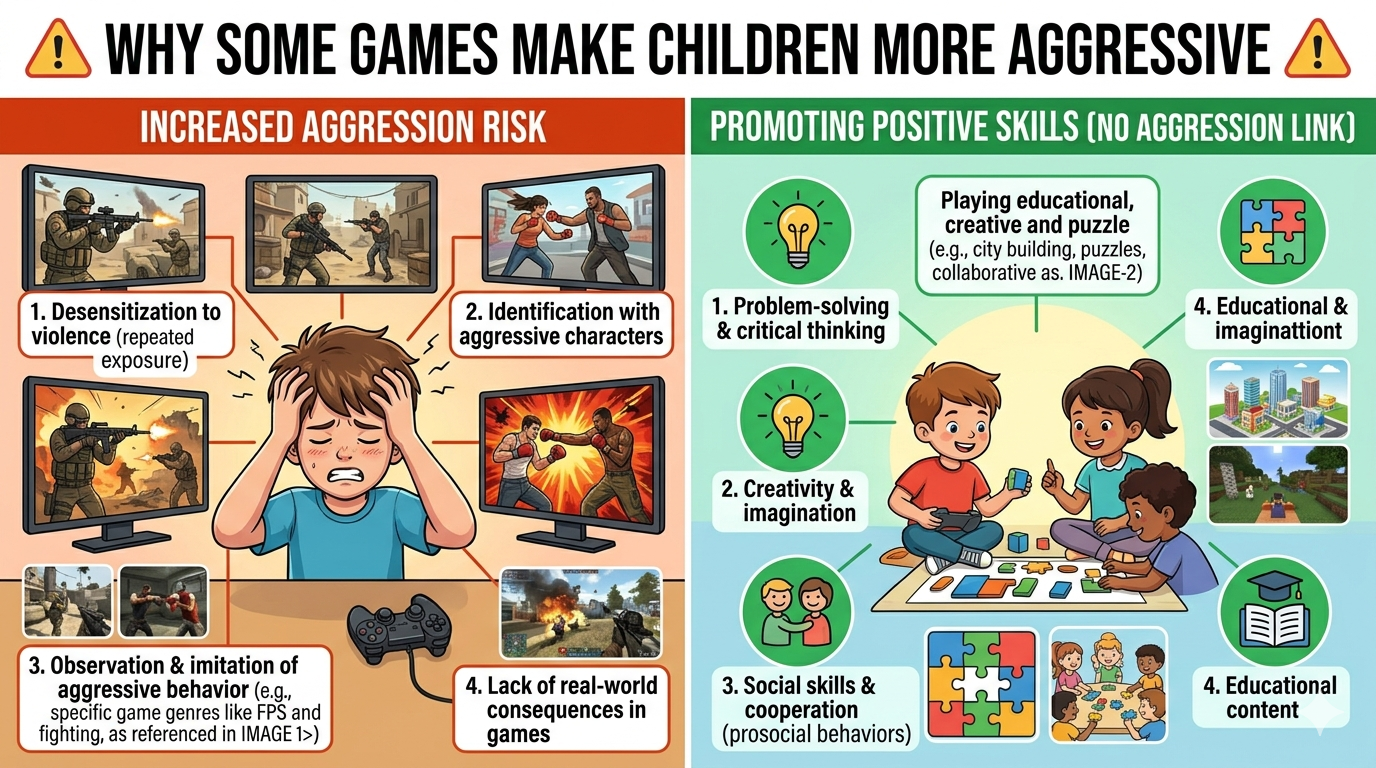
Understanding the connection between fast-paced competitive games and emotional reactions
Video games are one of the most popular forms of entertainment for children today. Most of the time, they are harmless and even beneficial—helping with coordination, problem-solving, and social interaction. However, not all games affect children in the same way. Some fast-paced, highly competitive, or violent games can temporarily increase aggressive thoughts or emotional reactions in certain players.
This doesn’t mean games “turn children violent.” Instead, research suggests that certain game features can influence short-term emotions, arousal levels, and behavior patterns, especially in younger children whose emotional control systems are still developing.
To understand this properly, we need to look at how the brain reacts to competition, speed, reward systems, and virtual violence.
1. What “aggression” really means in psychology
Before blaming games, it’s important to understand what psychologists mean by aggression.
Aggression doesn’t only mean physical violence. It can include:
- Feeling irritated or angry
- Raising your voice
- Having hostile thoughts (“I want to beat them”)
- Frustration after losing
- Competitive hostility toward others
Many studies measure aggression using these short-term emotional and cognitive reactions, not real-world violence.
Research shows that exposure to certain types of video games can temporarily increase aggressive cognition (thoughts) and aggressive emotions (anger/frustration), even if it does not lead to real-world violent behavior (Sage Journals).
2. The brain’s reward system and why games feel “intense”
Fast-paced games are designed around powerful psychological systems:
- Rewards (points, leveling up, wins)
- Instant feedback (kill, lose, respawn immediately)
- High stimulation (sound, visuals, speed)
- Competition against real players
These elements strongly activate the brain’s dopamine system, which is responsible for motivation and reward learning.
When children experience constant rewards and losses in quick cycles, the brain becomes highly stimulated. This can lead to:
- Emotional excitement
- Frustration after failure
- Strong reactions to winning or losing
This emotional “high-speed loop” is one reason competitive games feel addictive and emotionally intense.
3. Fast-paced competition increases emotional arousal
Competitive games—especially multiplayer ones—require quick reactions and constant decision-making under pressure.
According to psychological models like the General Aggression Model, aggressive responses can increase when a person experiences:
- High arousal (fast heartbeat, excitement, tension)
- Frustration (losing or being blocked)
- Competitive pressure
Research shows that competitive gaming can increase aggressive thoughts and hostile emotions, even in non-violent games, because competition itself raises emotional intensity (PMC).
In simple terms:
👉 The faster and more competitive the game, the more emotionally “charged” the player becomes.
4. Why losing feels more intense than winning feels good
One of the strongest emotional triggers in gaming is loss frustration.
In fast games:
- A mistake leads to immediate failure
- Players are quickly punished (losing rank, points, or progress)
- Recovery is fast, so the cycle repeats
This creates a psychological loop:
try → fail → frustration → try again
Children, especially younger ones, are still developing emotional regulation skills. So repeated failure in high-pressure environments can lead to:
- Anger outbursts
- Blaming teammates
- Shouting or impulsive reactions
This is not unique to gaming—it also appears in sports—but games intensify it because the cycles are much faster.
5. Violence in games and “learning by imitation”
Some games include violent actions such as shooting, fighting, or destruction.
Research suggests that brief exposure to violent games can temporarily increase aggressive thoughts and behavior in children (Sage Journals).
One explanation is called cognitive priming:
- The brain activates related concepts after exposure
- If a child sees violence in a game, aggression-related thoughts become more accessible
However, this is usually short-term and situational, not permanent personality change.
It’s important to note that many studies also show no direct link between violent games and real-world violence, but they do show small short-term emotional effects.
6. The role of competition (even without violence)
Interestingly, aggression doesn’t only come from violent games.
Even non-violent competitive games can increase hostility because:
- Players want to win at all costs
- Opponents are treated as obstacles
- Mistakes feel personal
Studies have found that competitive gameplay can reduce prosocial behavior (like cooperation) in some cases, especially with heavy or frequent play (PMC).
So the real trigger is often not violence itself, but competitive pressure + emotional intensity.
7. Online multiplayer games add social pressure
Online games introduce another factor: real human opponents.
This creates:
- Real-time communication (chat, voice)
- Teammate expectations
- Social comparison
- Toxic behavior from other players
In competitive online environments, negative behaviors can spread between players, increasing hostility in the group (arXiv).
Children may:
- Copy aggressive language
- React emotionally to insults
- Become frustrated by teamwork pressure
This social layer makes emotional reactions even stronger than single-player games.
8. Why children are more affected than adults
Children are more emotionally sensitive to gaming effects because:
1. Brain development is still ongoing
The prefrontal cortex (decision-making and self-control) is not fully developed.
2. Lower emotional regulation
They have less ability to calm themselves after frustration.
3. Stronger reward sensitivity
Children respond more intensely to rewards and competition.
4. Less perspective-taking
They may take game situations more personally.
This combination makes fast-paced games more emotionally impactful for them than for adults.
9. Important clarification: games do NOT “create violent children”
It is critical to understand what research does NOT show:
- Games do not directly cause criminal violence
- Most children who play aggressive games are not aggressive in real life
- Effects, when present, are usually small and short-term
Even major reviews highlight that while aggression-related thoughts may increase temporarily, real-world violent behavior is not clearly linked (Time).
So the issue is not “video games make children violent,” but rather:
Certain game environments can temporarily increase emotional intensity, frustration, and competitive aggression.
10. Other factors matter more than games
Aggression in children is influenced by many stronger factors, including:
- Parenting style
- School environment
- Stress or trauma
- Sleep quality
- Social relationships
- Exposure to real-life conflict
Games are just one piece of a much larger puzzle.
11. How parents can reduce negative effects
Instead of banning games completely, balance is more effective:
Set time limits
Avoid long, uninterrupted gaming sessions.
Encourage breaks
Short pauses help reset emotional arousal.
Choose age-appropriate games
Less toxic and less competitive environments are better for younger children.
Play together
Co-playing helps children process emotions and reduces impulsive reactions.
Talk about emotions
Ask how they feel after winning or losing.
Conclusion
Some games can make children appear more aggressive, but the reality is more complex than it seems. Fast-paced and competitive games increase emotional arousal, frustration, and excitement, which can lead to temporary aggressive reactions—especially in younger players.
However, these effects are usually short-lived and heavily influenced by context, personality, and environment.
The real key is not to eliminate gaming, but to understand how different types of games affect emotions—and to guide children toward healthy, balanced gaming habits that support emotional control, not overwhelm it.